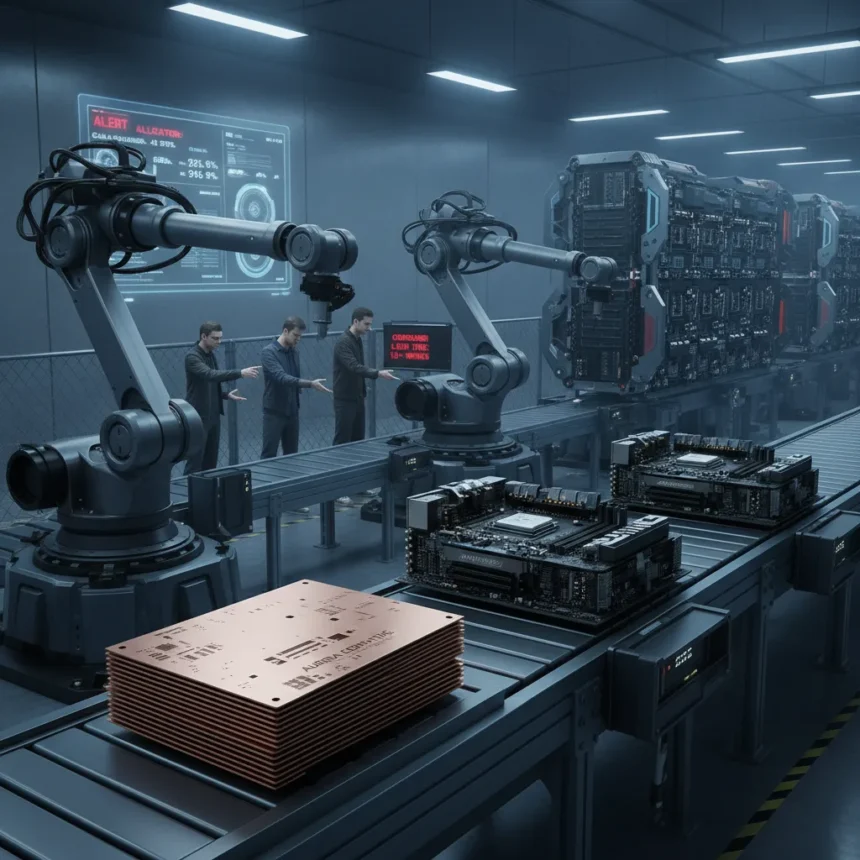
The PC motherboard manufacturer crisis is no longer a whisper in tech forums—it is now the second major component squeeze hitting DIY builders worldwide, following the RAM shortage that drove memory prices up 250-500% in recent months. According to a report from Chinese outlet Wccftech citing Digitimes, motherboard production capacity has shifted dramatically toward AI server boards, leaving consumer and gaming motherboards stranded in a queue behind hyperscalers and enterprise customers.
Key Takeaways
- AI servers now consume 60% of 2025 motherboard output, up from 30% in 2024, starving consumer PC builders.
- Lead times for consumer motherboards have extended to 8-12 weeks from previous 2-4 week cycles.
- Mid-range ATX boards (B650, Z790) prices up 20-40%, reaching $250-450 USD where available.
- TSMC’s CoWoS packaging capacity is fully booked through 2025, bottlenecking motherboard chipset production.
- Shortages expected to persist in US and EU markets until Q1 2026; Asia-Pacific markets better stocked but export-limited.
Why AI Servers Are Eating Motherboard Production
The PC motherboard manufacturer crisis stems directly from the explosive demand for AI infrastructure. Global motherboard production capacity is running at approximately 90% utilization for AI servers alone, leaving minimal slots for enthusiast and consumer boards. An anonymous industry insider cited in the Digitimes report put it bluntly: the AI server boom is consuming motherboard production lines with relentless appetite. Hyperscalers and enterprise customers now occupy the first two positions in the supply chain queue, relegating consumer PC builders to third place.
AI server motherboards require specialized designs that consumer boards do not. These boards must support 8 or more DIMM slots for high-bandwidth memory (HBM), PCIe 5.0 x16 connections for GPUs, and power delivery systems capable of handling CPUs with 400W or greater thermal design power (TDP). These constraints make AI server boards impossible to swap out for consumer alternatives—manufacturers cannot simply redirect capacity without redesigning entire product lines. As Wccftech analysts noted, consumer PC builders are now third in line behind hyperscalers and enterprise customers, a hierarchy that shows no signs of reversing.
The bottleneck extends beyond motherboard assembly. TSMC’s CoWoS packaging capacity, which is critical for integrating HBM into motherboard chipsets, is fully booked through 2025. This indirect constraint ripples through the entire supply chain, forcing chipset manufacturers to prioritize AI-focused designs over consumer-grade components. When the foundry that produces the most advanced packaging solutions is locked into AI contracts, consumer motherboards lose access to the latest technology and production slots simultaneously.


Lead Times and Prices Hit Hard for PC Builders
The real-world impact on DIY builders is immediate and painful. Lead times for consumer motherboards have stretched from a typical 2-4 weeks to 8-12 weeks, meaning a builder ordering a B650 or Z790 board today may wait three months for delivery. Prices have climbed 20-40% above pre-crisis levels, with mid-range ATX motherboards now selling for $250-450 USD where stock exists at all. High-end X870E boards command $500 USD or more at retail, with scalpers pushing prices to $700 USD on secondary markets like eBay and Newegg.
The geographic divide is stark. US and EU markets face severe shortages expected to persist until Q1 2026. Asia-Pacific regions have better stock availability, but export restrictions limit how much supply can flow to Western markets. A builder in London or Los Angeles faces a fundamentally different purchasing environment than one in Singapore or Tokyo, creating a fragmented global market where regional allocation decisions determine access.



How This Differs from the RAM Crisis
The PC motherboard manufacturer crisis echoes the RAM shortage that preceded it, but the underlying mechanics are distinct. RAM shortages were driven by price volatility and demand spikes that manufacturers could theoretically satisfy by ramping production. Motherboard shortages, by contrast, stem from a deliberate reallocation of manufacturing capacity toward a different customer segment entirely. Manufacturers like Gigabyte and ASRock are not unable to produce consumer boards—they are choosing to produce AI server boards instead because that is where the highest margins and longest contracts lie.
Console makers like Sony and Microsoft remain largely unaffected because PS5 and Xbox Series X use custom System-on-Chip (SoC) designs with integrated memory, sidestepping the motherboard and HBM bottlenecks that plague PC builders. This architectural advantage gives consoles an unexpected edge over high-end PC gaming, at least until PC motherboard supply stabilizes.
When Will Supply Return to Normal?
The PC motherboard manufacturer crisis shows no signs of resolving quickly. Digitimes projects that AI servers will consume 60% of 2025 motherboard output, up from 30% in 2024—a doubling of AI’s share in just one year. This trajectory suggests that consumer motherboards will remain constrained through 2026 at minimum. Intel‘s Arrow Lake platform launch faced slight delays due to motherboard supply constraints, and AMD’s Ryzen 9000 series motherboards using the X870 chipset encountered similar stock issues in Q3 2025.
For PC builders with immediate needs, pre-built systems from OEMs like Dell have become relatively easier to acquire because manufacturers prioritize bulk orders from enterprise customers. Refurbished or older-generation motherboards represent another workaround, though they sacrifice access to the latest features and platform support. Waiting until Q1 2026 is the most straightforward path for those willing to delay builds, as supply is expected to loosen by then—though prices may not return to pre-crisis levels for months after that.



Is the PC motherboard manufacturer crisis permanent?
No, but it will persist for at least 12-18 months. The crisis is driven by temporary but intense AI infrastructure buildout, not a fundamental shift in consumer demand. Once hyperscalers complete their initial server deployments and TSMC expands CoWoS capacity beyond 2025, motherboard manufacturers will rebalance production toward consumer boards. However, the experience will likely reshape manufacturer priorities long-term, with AI server boards receiving preferential treatment in future capacity planning.
Should I buy a motherboard now or wait?
If you need a motherboard immediately for a critical build or upgrade, buy now despite the high prices and long lead times—waiting will only extend your timeline further. If your build can wait until Q1 2026, waiting saves money and eliminates the lead-time gamble. Avoid high-end X870E boards at scalper prices unless you have a specific reason to upgrade; older-generation boards like B650 offer similar performance for less cost and shorter wait times.
The PC motherboard manufacturer crisis is a direct consequence of AI’s voracious appetite for computing infrastructure, and it reveals an uncomfortable truth: consumer PC builders are no longer the primary customers for component manufacturers. Until AI demand moderates or production capacity expands dramatically, motherboards will remain scarce and expensive. Plan your builds accordingly, and do not expect normal supply until well into 2026.
Edited by the All Things Geek team.
Source: TechRadar