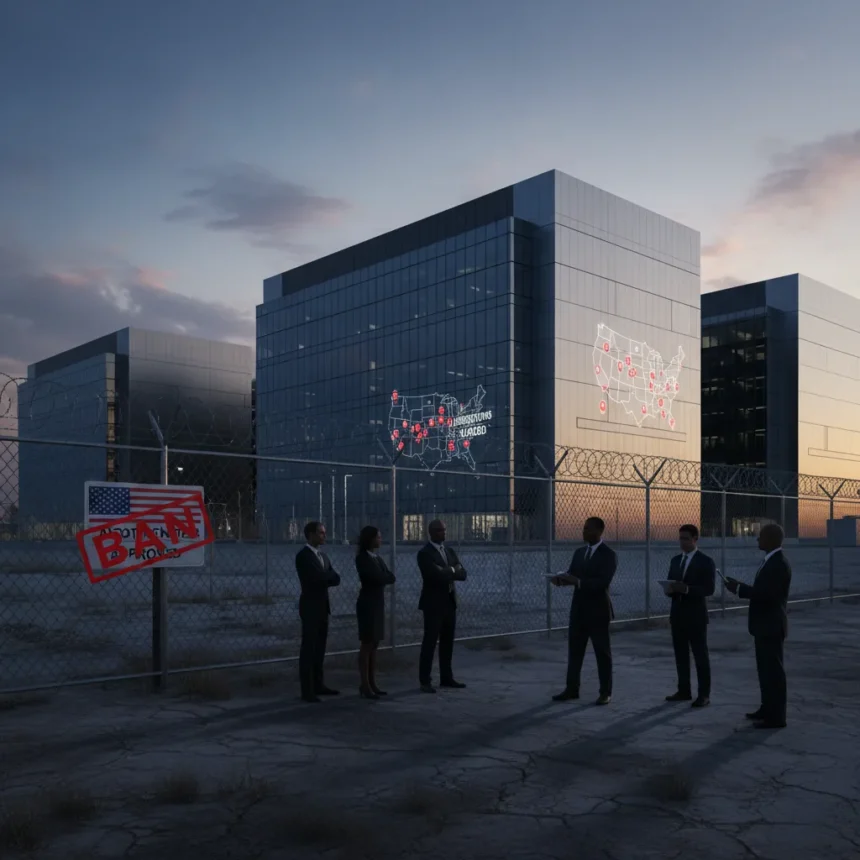
AI data center bans are spreading rapidly across America. As of April 2026, 69 U.S. jurisdictions have enacted restrictions blocking new data center construction, up from just 12 in early 2025. This explosive growth reflects a fundamental tension: the AI industry’s insatiable hunger for computing power collides head-on with communities unwilling to sacrifice their resources and quality of life.
Key Takeaways
- 69 jurisdictions across the US now have AI data center bans or moratoriums in place as of April 2026.
- Four bans are permanent: Prince William County and Fairfax County in Virginia, Montgomery County in Maryland, and Loudoun County in Virginia (indefinite moratorium).
- AI data centers consume 4-10 times more power per square foot than traditional data centers.
- U.S. data center power demand is projected to reach 35 GW by 2030, nearly double the 17 GW in 2022.
- Virginia leads with 22 restrictions, followed by California with 8 and Texas with 7.
Why AI Data Center Bans Are Exploding
The growth trajectory is staggering. In early 2025, only 12 jurisdictions had enacted restrictions. Within 15 months, that number skyrocketed to 69, with 65 of those being temporary moratoriums lasting 6-24 months. The four permanent bans signal something more ominous for the tech industry: communities are moving beyond delay tactics toward outright rejection.
The driving force is simple: AI data centers are power hogs. These facilities consume 4-10 times more electricity per square foot than traditional data centers, straining electrical grids that were never designed for this demand. U.S. data center power consumption is projected to reach 35 GW by 2030, nearly doubling from the 17 GW baseline in 2022. Beyond electricity, these facilities demand massive quantities of water for cooling—averaging 360,000 gallons per day per hyperscale data center—at a time when many regions face water scarcity. Add noise pollution, visual impacts, and competition for limited land, and local resistance becomes inevitable.
Virginia has become ground zero for the backlash, with 22 restrictions now in place. The state’s four permanent bans represent the hardest line: Prince William County (2024), Montgomery County in Maryland (2025), Fairfax County (2025), and Loudoun County (indefinite moratorium extended in 2026). These are not temporary pauses to gather data—they are rejections of the AI data center model itself.


The Geographic Shift and Industry Response
Blocked from the Northeast corridor, data center operators are pivoting to states with fewer restrictions. Georgia, Ohio, and Iowa have become magnets for new construction, with Microsoft expanding significantly in Georgia, AWS opening new campuses in Ohio, and Google investing in Iowa. These states offer a combination of regulatory permissiveness and lower land costs, though they too are beginning to face local pushback.
The industry is also exploring alternatives that bypass traditional jurisdictions entirely. Microsoft has proposed offshore floating data centers, while the company has also struck a deal with Constellation Energy to power AI facilities with nuclear energy. xAI has acquired over 1,000 acres in the Texas Panhandle, betting that rural isolation will shield it from zoning restrictions. These workarounds signal desperation—the tech industry cannot build where it wants, so it is pursuing increasingly exotic solutions.



The Clash Between Innovation and Sustainability
Tech companies argue that AI data center bans stifle innovation and hamstring U.S. competitiveness. The industry points to over $100 billion in annual U.S. data center investments and warns that regulatory obstacles could delay critical AI infrastructure by years. From this perspective, communities blocking builds are not solving problems—they are exporting them, pushing development to other nations with fewer environmental protections.
Local officials counter that their responsibility is to their constituents, not to the broader tech ecosystem. A zoning official in Prince William County captured the sentiment bluntly: data centers have become the new NIMBY battleground. Communities recognize that once a hyperscale facility is built, the resource demands are permanent. The electricity grid strain, water depletion, and noise are not temporary inconveniences—they are structural burdens that fall on local taxpayers and residents.
The permanent bans in Virginia and Maryland suggest this is not merely a regulatory pause. These jurisdictions are signaling that they will not be swayed by industry promises of economic benefit or pledges of future improvements. The calculus has shifted: the costs are too high, and the benefits too concentrated among distant shareholders.
What Happens Next
The rapid multiplication of AI data center bans creates an unprecedented constraint on infrastructure expansion. If the current trajectory continues, hundreds of jurisdictions could have restrictions in place by 2027, effectively locking out new construction across large swaths of the country. The $200 billion-plus in planned data center expansions could face severe delays or relocations.



This does not mean AI infrastructure will stop being built. It means the geography of that infrastructure will shift—toward states with fewer restrictions, toward rural areas beyond municipal reach, and toward alternative power sources like nuclear. But these solutions are more expensive, slower to implement, and geographically limited. The cumulative effect is a slowdown in AI deployment precisely when the industry argues speed is critical.
Are AI data center bans permanent or temporary?
Most bans (65 of 69) are temporary moratoriums lasting 6-24 months, typically to allow time for updated zoning regulations or infrastructure assessments. However, four jurisdictions have enacted permanent bans: Prince William County, Virginia; Montgomery County, Maryland; Fairfax County, Virginia; and Loudoun County, Virginia (which extended its moratorium indefinitely in 2026).
Which states have the most AI data center bans?
Virginia leads with 22 restrictions across multiple counties and cities. California follows with 8 bans, Texas with 7, Florida with 6, and Illinois with 5. Additional restrictions exist in Arizona, Colorado, Georgia, Maryland, North Carolina, New Jersey, New York, Ohio, Oregon, Pennsylvania, and Washington.
Why are communities banning AI data centers?
The primary concerns are power consumption (4-10 times higher than traditional data centers), massive water usage (averaging 360,000 gallons daily per facility), noise pollution, visual impacts, and strain on local electrical grids. Communities also worry about competition for land and resources, particularly in regions already facing water scarcity or aging infrastructure.
The rapid multiplication of AI data center bans reflects a hard truth the tech industry is only beginning to grasp: communities will not absorb unlimited infrastructure costs in the name of innovation. Virginia’s four permanent bans are not negotiating positions—they are rejections. As more jurisdictions follow suit, the geography of AI infrastructure will be redrawn, pushing data centers toward willing regions and forcing the industry to confront the actual cost of unlimited expansion.
Edited by the All Things Geek team.
Source: Tom's Hardware