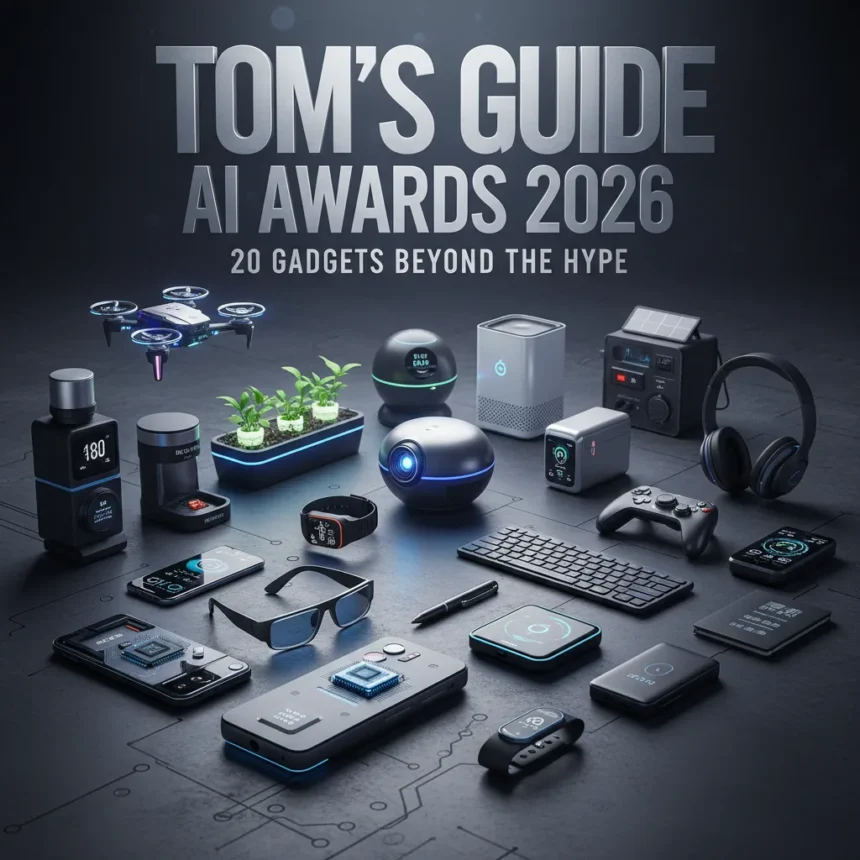
Tom’s Guide AI Awards 2026 cuts through the noise of AI hype to identify 20 products that actually matter. While 2026 has flooded the market with AI-branded gadgets—many of them trivial—this awards program separates genuine innovation from marketing theater. The selection spans everything from large language models and coding assistants to AI-powered smartphones, laptops, wearables, and smart home devices.
Key Takeaways
- Tom’s Guide AI Awards 2026 honors 20 products selected for moving beyond hype to deliver real-world impact.
- Categories span Core AI & Productivity, Personal Tech, Smart Home, and AI for Good.
- Entry fee was $250 USD per product per category, with deadlines in late March and April 2026.
- Winners include standout tools in chatbots, image generation, video tools, and AI-enhanced hardware.
- Awards favor practical on-device AI over cloud-only solutions and accessibility breakthroughs.
What the Tom’s Guide AI Awards 2026 Actually Measure
The Tom’s Guide AI Awards 2026 judges products on innovation, real-world impact, and performance testing—not hype or marketing budget. This matters because 2026 has seen an explosion of AI-labeled products that do little more than slap a chatbot interface onto existing hardware. Tom’s Guide’s editorial team focused on tools and gadgets that genuinely change how people work, create, or live. The awards organized submissions across multiple categories, allowing companies to enter products in as many categories as they wanted, with each entry carrying a $250 submission fee.
The structure reflects a shift happening across the industry: AI adoption is moving from experimental proof-of-concept to practical integration. Products winning in the Core AI & Productivity category—like advanced language models, search tools, and coding assistants—represent the foundation layer. But the real test comes in Personal Tech and Smart Home categories, where AI features must justify themselves in daily use or they become clutter.
Core AI & Productivity: Where the Foundation Matters
The Tom’s Guide AI Awards 2026 productivity category winners demonstrate how AI tooling has matured beyond conversational novelty. Best-in-class chatbots now compete on context length, reasoning depth, and integration with workflows rather than mere fluency. Image and video generation tools have moved past the uncanny-valley phase; winners in these categories produce outputs that professionals actually use in production work. Coding assistants have become indispensable for developers working at scale, and AI search tools are finally offering genuine alternatives to traditional search engines by prioritizing synthesis over link-listing.



What separates winners from the crowded field? Specificity. A writing assistant that handles emails is different from one that specializes in long-form narrative. A video generator that excels at product demos is not the same as one built for cinematic storytelling. Tom’s Guide’s awards recognized this granularity, rewarding tools that own their niche rather than claiming universal mastery.
Personal Tech: AI Hardware Is Finally Getting Practical
The Tom’s Guide AI Awards 2026 personal tech categories reveal where hardware makers have cracked the code on useful AI integration. Smartphones with on-device AI processing, laptops with dedicated AI accelerators, and tablets leveraging computational photography represent a maturation beyond gimmickry. Wearables—smartwatches, fitness trackers, smart glasses—are where AI’s promise becomes tangible: real-time health insights, contextual information without pulling out a phone, accessibility features that genuinely expand capability.



Smart glasses deserve particular attention here. Prototypes and early releases in 2026 finally delivered on the decades-old promise of ambient computing. Unlike phones, which demand your attention, smart glasses integrate information into your visual field. AI-powered glasses that understand context—recognizing faces, translating text in real time, identifying objects—shift the device from novelty to tool.
Smart Home and AI for Good: The Underrated Winners
Robot vacuums with AI mapping and obstacle avoidance have matured into genuinely useful home automation. But the Tom’s Guide AI Awards 2026 also spotlighted a category many overlook: AI for accessibility. Tools that help visually impaired users navigate, hear-impaired users communicate, and mobility-limited users control their environment represent AI’s most meaningful application. These products solve real problems for real people, not just optimize convenience for the already-comfortable.
This category matters because it exposes the difference between AI hype and AI purpose. A gadget that saves you five minutes per week is a luxury. A tool that gives someone independence is infrastructure. Tom’s Guide’s inclusion of this category signals a publishing stance: innovation worth celebrating is innovation that expands human capability, not just corporate profit margins.
Why These Awards Matter More Than CES or MWC
Tom’s Guide runs separate awards programs—CES 2026 Awards and Smart Home Awards 2026—but the AI Awards occupy a unique position. CES and MWC focus on product launches and announcements. Tom’s Guide AI Awards 2026 focus on what actually works after the marketing ends. A phone can be announced at CES and prove disappointing in real use; Tom’s Guide’s awards reflect the latter reality. This distinction matters for readers trying to navigate a market where every vendor claims AI superiority.


The awards also reveal what Tom’s Guide’s editorial team believes matters most: not the flashiest feature, but the most useful one. Not the biggest company, but the best execution. Not the most expensive tool, but the one that justifies its cost in daily practice.
How to Use This Awards List When Shopping
The Tom’s Guide AI Awards 2026 winners serve as a reference guide, not a shopping list. Your needs differ from the editorial team’s priorities. A photographer may weight AI image generation differently than a developer evaluates coding assistants. A person with mobility challenges will prioritize smart home accessibility features over a gamer’s interest in AI-powered peripherals.
What the awards do offer is a curated starting point. If you are considering an AI laptop, searching for a smartphone with genuinely useful on-device AI, or looking to upgrade your smart home with AI-aware devices, Tom’s Guide’s winners represent products that have cleared a credibility bar. They have been tested against real-world standards, not marketing claims.
What About Products That Didn’t Win?
The absence of a product from Tom’s Guide AI Awards 2026 does not mean it is useless. Thousands of AI-enabled products exist; only 20 could win. Some excellent tools may have missed the deadline or opted not to enter. Others may serve niche use cases that did not align with Tom’s Guide’s judging criteria. The awards reflect editorial judgment, not absolute truth.
That said, the gap between a winner and a near-miss often reveals something instructive. Why did one AI search tool win over another? Usually because it delivered faster results, better synthesis, or more transparent sourcing. Why did one smartphone’s AI features matter more than another’s? Because they solved actual user problems rather than creating busywork. Reading between the lines of the awards—understanding not just what won but why—teaches more than the winners themselves.
Will These Awards Matter in Six Months?
AI moves fast. A tool crowned best-in-class in April 2026 might face serious competition by October. New models emerge constantly. Hardware gets refreshed. Integrations shift. The Tom’s Guide AI Awards 2026 capture a moment, not a permanent ranking. Their value lies in establishing baseline expectations: this is what good looks like right now. Use that standard to evaluate new products as they arrive.
How did companies enter the Tom’s Guide AI Awards 2026?
Companies submitted products through an online form via Tom’s Guide’s awards site, paying $250 USD per product per category. There was no limit on the number of entries a company could submit, though each entry in additional categories required an additional fee. Deadlines varied slightly across reports, with primary submissions closing around April 2, 2026.
What makes a Tom’s Guide AI Awards 2026 winner different from other award programs?
Tom’s Guide AI Awards 2026 prioritizes real-world impact and practical utility over hype or market dominance. Unlike general tech awards that may favor established brands or flashy announcements, this program rewards products that genuinely change how people work, create, or live. The inclusion of an AI for Good category, focusing on accessibility and societal benefit, further distinguishes this awards program from competitor events.
Which categories did Tom’s Guide AI Awards 2026 include?
The Tom’s Guide AI Awards 2026 spanned Core AI & Productivity (chatbots, language models, search tools, image and video generators, writing assistants, coding tools), Personal Tech (smartphones, laptops, tablets, wearables, smart glasses, gaming peripherals), Smart Home & Appliances (robot vacuums and connected devices), and AI for Good & Future Tech (accessibility tools, practical features, and breakthrough innovations).
The Tom’s Guide AI Awards 2026 matter because they establish a credibility filter in a market drowning in AI marketing. As AI integration becomes standard across gadgets and software, distinguishing genuine innovation from superficial branding becomes critical. These 20 winners represent products that have earned their place through real-world performance, not hype. For anyone navigating 2026’s AI landscape, they offer a reliable starting point—and a reminder that the best AI products are the ones you stop thinking about because they simply work.
Edited by the All Things Geek team.
Source: Tom's Guide