





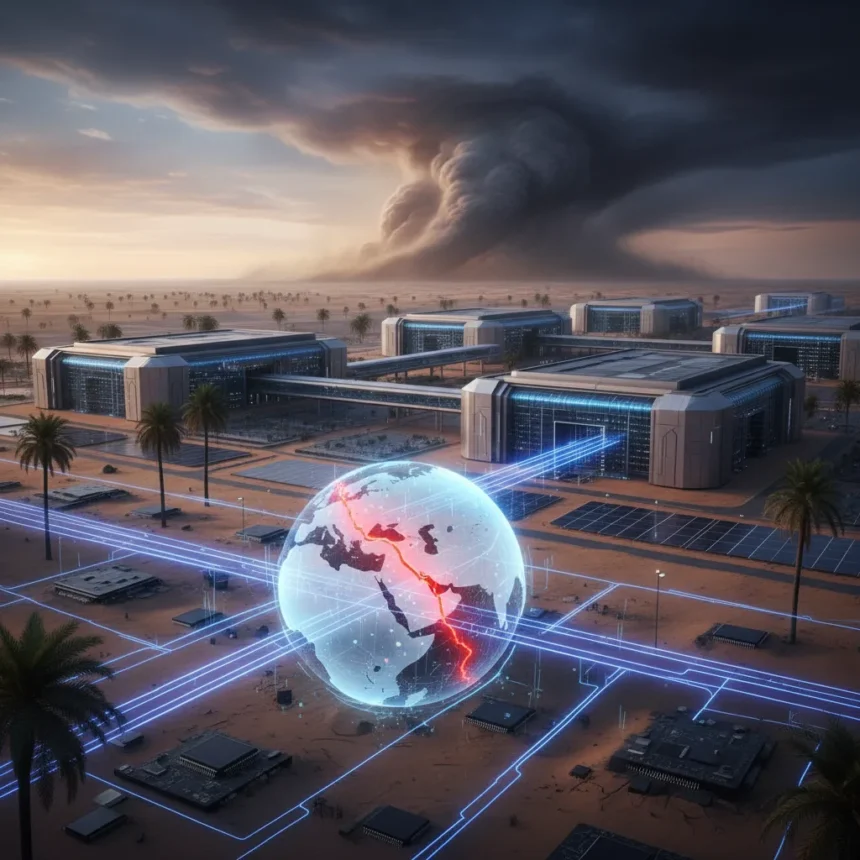
The Middle East data center market was supposed to be the next great AI infrastructure boom. Saudi Arabia and the UAE had assembled every advantage hyperscalers could want: abundant land, cheap renewable power, government incentives worth billions, and sovereign-wealth-fund capital ready to deploy. Then the Iran war escalated, and the entire calculus shifted overnight.
Key Takeaways
- The Middle East hyperscale data center market is valued at USD 4.61 billion in 2025, forecast to reach USD 16.38 billion by 2031.
- Saudi Arabia’s Vision 2030 allocates USD 21 billion for data-center builds targeting 525 MW IT-load by 2030.
- Microsoft, Amazon, Google, and Oracle have billions invested or planned in Middle East AI infrastructure now at risk.
- Escalating Iran conflict is forcing enterprises to reclassify the region as high-risk, threatening capacity stranding.
- Saudi Arabia leads regional preference at 60% opportunity ranking versus UAE’s 36% in recent industry polling.
Why the Middle East was the obvious choice for hyperscalers
Until recently, the region’s appeal was straightforward. The Middle East data center market offered what few other regions could match: governments actively competing to attract infrastructure investment through fast-tracked permitting, tax holidays, and subsidized renewable-energy tariffs. Saudi Arabia and the UAE weren’t just offering land and power—they were offering capital. Vision 2030, Saudi Arabia’s ambitious economic diversification program, allocated USD 21 billion specifically for data-center builds across Riyadh, Jeddah, and Dammam, with a target of 525 MW IT-load by 2030. That is not theoretical planning. That is money committed.
The region’s physical advantages compounded this appeal. Abundant land meant hyperscalers could build the sprawling campuses AI workloads demand. Cheap power—especially renewable capacity—addressed the crushing energy costs that plague data center economics globally. Geographic position mattered too. Jeddah’s submarine cable landing points positioned the city as a latency hub for serving Europe, Africa, and Asia simultaneously. For enterprises tired of waiting months for cloud capacity in the US or Europe, the Middle East promised speed and proximity.
Amazon Web Services (AWS) committed to establishing facilities in the UAE to gain regional dominance. Microsoft announced a multi-billion-dollar data center network across Saudi Arabia months ago. Google and Oracle followed. Equinix launched a 100 MW project in Riyadh. DataVolt announced a 1.5 GW campus in NEOM. These were not speculative ventures—they were billion-dollar bets that the region had stabilized enough to host the infrastructure backbone of global AI.


How geopolitical risk is unraveling the investment thesis
The escalating Iran war, triggered by Israel and United States military action, has shattered the assumption of regional stability that underpinned these investments. Data centers require three things to function: stable power, reliable connectivity, and physical security. War threatens all three. More immediately, it threatens the business case itself.
Enterprises in financial services, healthcare, and government contracting are now reclassifying the Middle East as high-risk territory. That reclassification has real consequences. Companies that committed to storing sensitive data in Saudi Arabia or the UAE now face pressure from boards, regulators, and security teams demanding data relocation. Capacity that was supposed to serve regional and global demand faces the prospect of being stranded—built but unused, as customers migrate workloads elsewhere.



The timing could not be worse. Global demand for data center capacity is surging. AI model training and inference require enormous compute clusters, and enterprises are desperate for capacity. The Middle East was supposed to absorb a significant portion of that demand, relieving pressure on overbooked US and European facilities. Instead, hyperscalers now face a choice between continuing to invest in a region whose political stability is deteriorating, or pausing projects and redirecting capital to safer geographies.
The scale of what is at stake in the Middle East data center market
The Middle East hyperscale data center market was valued at USD 4.61 billion in 2025 and was forecast to reach USD 16.38 billion by 2031—a compound growth trajectory that would have made the region the third global powerhouse for data center capacity behind the US and China. That forecast now looks optimistic at best.
Saudi Arabia and the UAE hold the majority of installed IT load and new-build pipelines across the Gulf Cooperation Council (GCC). In a recent industry webinar, 60% of respondents identified Saudi Arabia as the best opportunity for data center investment, compared to 36% for the UAE. Those rankings reflected confidence in Vision 2030’s execution and the region’s investment climate. That confidence is now being tested.
What makes this disruption particularly acute is timing. The region was in a 2-year surge of project awards and tendering activity. Momentum was building. Governments had committed capital. Hyperscalers had broken ground. And then the conflict escalated, forcing executives to ask uncomfortable questions about whether a facility that takes 18-24 months to build will still make sense once it is operational.



Where demand is shifting as a result
The conflict is already creating spillover effects. Turkey is emerging as a beneficiary, positioned as a Eurasian bridge for AI workloads that might have gone to the Middle East. Khazna, a regional player, is planning an Ankara footprint to capture this displacement demand. The Levant and North Africa remain constrained by grid limitations, but edge deployments near submarine cable landings are seeing interest as enterprises seek redundancy outside the conflict zone.
This fragmentation is precisely what hyperscalers wanted to avoid. The whole appeal of concentrating capacity in Saudi Arabia and the UAE was efficiency—building massive, centralized infrastructure to serve global demand. Distributing that demand across Turkey, North Africa, and secondary markets means higher costs, longer latency, and operational complexity. But it also means spreading risk away from a region now defined by military escalation.
What happens next depends on conflict trajectory
The Middle East data center market’s future hinges on whether the Iran conflict stabilizes or escalates further. If military action remains contained and diplomatic pressure eventually prevails, hyperscalers may resume investments. The region’s fundamental advantages—cheap power, abundant land, government capital—do not disappear because of one geopolitical crisis. Saudi Arabia and the UAE have too much at stake in Vision 2030 to abandon the data center strategy.
But if the conflict deepens, if attacks on infrastructure become routine, or if Western enterprises face regulatory pressure to divest from the region, the calculus changes entirely. Billions in planned capacity could be canceled or indefinitely postponed. The boom becomes a bust. And the global AI infrastructure buildout—already constrained by capacity shortages—suffers another setback.
Is the Middle East data center market still viable long-term?
Yes, but with significant caveats. The region’s structural advantages remain real. Cheap renewable power and abundant land are not going anywhere. However, geopolitical risk is now a permanent factor in the investment thesis. Hyperscalers will demand higher returns to compensate for that risk, or they will demand security guarantees from governments. Either way, the frictionless investment environment that existed six months ago is gone.
How much capacity is actually at risk of being stranded?
The research brief does not provide exact figures on capacity under construction versus capacity already operational, so precise stranding estimates are not available. However, the scale of announced projects—Equinix’s 100 MW Riyadh facility, DataVolt’s 1.5 GW NEOM campus, and Microsoft’s multi-billion-dollar Saudi network—suggests that billions of dollars in partially completed infrastructure could face abandonment if enterprise demand evaporates.
Why does AI demand make this crisis worse?
AI workloads are voracious consumers of compute capacity and power. The global demand for data center infrastructure is already outpacing supply in developed markets. The Middle East was supposed to absorb a significant portion of that demand, relieving bottlenecks in the US and Europe. With Middle East capacity now uncertain, that demand pressure gets redirected to already-constrained regions, driving up costs and extending wait times for enterprises seeking cloud infrastructure.
The Middle East data center market was supposed to be a generational opportunity—a chance for Saudi Arabia and the UAE to position themselves as critical infrastructure hubs for the AI era. Instead, it has become a cautionary tale about the fragility of infrastructure investment in geopolitically volatile regions. Hyperscalers will continue to invest globally, but the era of betting big on the Middle East without pricing in existential geopolitical risk is over.
Edited by the All Things Geek team.
Source: Tom's Hardware




