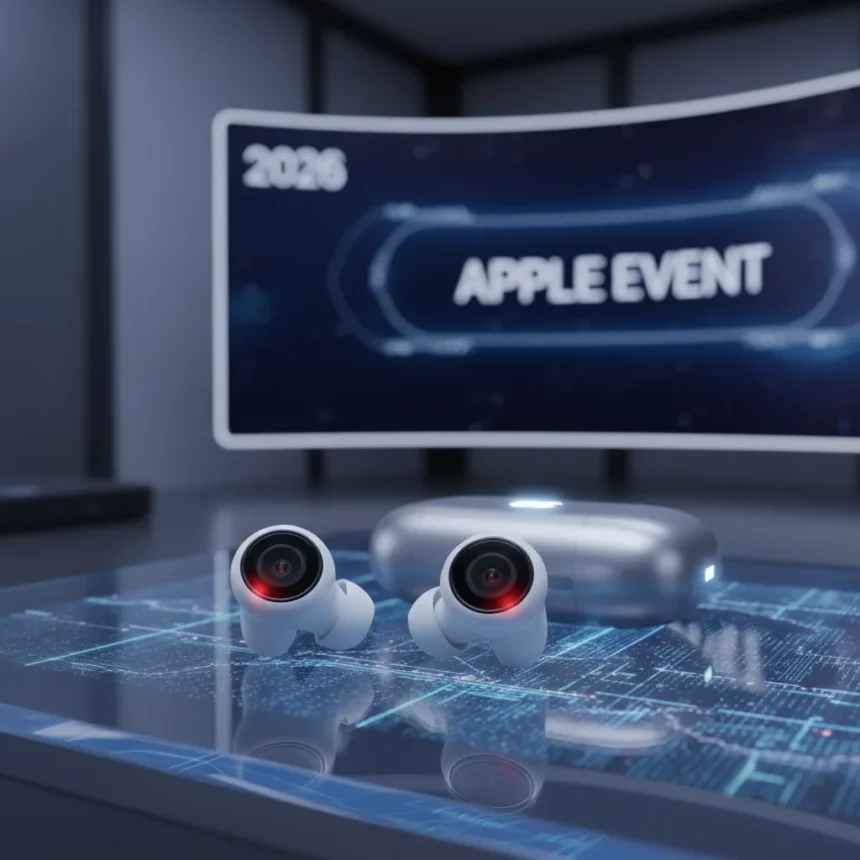
AirPods Ultra with cameras represent Apple’s boldest wearable shift yet, moving earbuds from audio devices into AI-powered spatial awareness platforms. The premium earbuds are nearly ready for launch in September 2026, according to recent reporting from multiple sources converging on the same timeline. Unlike the current AirPods Pro 3 at $249, these will sit atop Apple’s earbud lineup as a distinct “Ultra” tier, powered by infrared cameras and a new H3 silicon chip designed for real-time AI processing.
Key Takeaways
- AirPods Ultra with cameras expected to launch September 2026 alongside iOS 27
- Infrared cameras enable Siri to understand surroundings without voice commands, similar to Face ID technology
- H3 chip handles on-device Apple Intelligence, letting earbuds process visual data locally
- Cameras do not record video or photos, addressing privacy concerns that doomed Google Glass
- Positioned as a premium product above AirPods Pro 3, establishing an “Ultra” tier for earbuds
Infrared Cameras Transform Siri Into a Context-Aware Assistant
The core innovation behind AirPods Ultra with cameras is their infrared vision system, which maps depth, heat, and spatial relationships in real time. These are not standard cameras—they do not capture identifiable faces, record video, or take photos. Instead, they feed passive visual data directly to Siri, allowing the assistant to understand your environment without requiring a voice command. Imagine walking toward your front door: the earbuds detect it, recognize the context, and automatically prompt smart lock integration. This ambient intelligence layer transforms Siri from a reactive voice assistant into a proactive spatial agent that anticipates your needs.
This approach sidesteps the privacy backlash that plagued Google Glass, which failed partly because people feared being secretly recorded. Apple’s IR-only design eliminates that “creepy factor” while preserving the computational benefits of machine vision. Bloomberg’s Mark Gurman described AirPods Ultra with cameras as a “major new product category,” signaling Apple’s confidence in the paradigm.
H3 Chip Powers Local AI Processing Without Cloud Dependency
Running sophisticated computer vision on earbuds demands serious silicon. The new H3 chip handles heavy real-time AI processing, enabling Apple Intelligence to run locally on the device rather than relying on cloud servers. This keeps sensitive spatial data private and reduces latency—critical for features that need to respond instantly to environmental changes. The H3 also coordinates with your iPhone, creating a seamless ecosystem where visual data flows between devices while staying encrypted and on-device.



The H3 represents a generational leap from the current H2 chip in AirPods Pro. By embedding AI horsepower directly into earbuds, Apple positions them as an extension of your iPhone’s intelligence, not just a Bluetooth accessory. This mirrors the company’s strategy with Apple Watch Ultra, where premium positioning justifies more advanced silicon and features.
Premium Pricing and Market Positioning Above AirPods Pro 3
Apple has not announced a price for AirPods Ultra with cameras, but expect a significant premium above the $249 AirPods Pro 3. The “Ultra” designation signals a tier reserved for flagship features and advanced capabilities—a pattern established by Apple Watch Ultra and iPhone Pro Max models. By creating a distinct high-end earbud category, Apple can maintain AirPods Pro as the mainstream option while reserving camera and AI features for users willing to pay for latest technology.



This tiered approach also gives Apple room to iterate. Future AirPods Pro models could eventually inherit camera features, but at launch, AirPods Ultra with cameras will occupy a unique position in the market. No competitor currently offers infrared-camera-equipped earbuds with integrated AI processing, making this a genuine product category first.
Privacy-First Design Avoids the Google Glass Trap
One reason AirPods Ultra with cameras feels different from failed wearable camera products is the deliberate design choice to use infrared only. Standard cameras trigger legitimate privacy concerns—people worry about being photographed or recorded without consent. Apple’s IR approach provides spatial awareness and gesture detection without capturing identifiable information, faces, or video. The cameras map your environment as heat signatures and depth maps, not as photographic images.
This technical distinction matters for adoption. Early wearable cameras like Google Glass faced public backlash partly because bystanders feared being recorded. AirPods Ultra with cameras sidestep that entirely by design. The infrared data stays local, processed by the H3 chip, and never leaves your device unless you explicitly share it. This privacy-first stance could prove critical for consumer acceptance and regulatory approval in markets with strict privacy laws.
What About Gesture Control at Launch?
Early speculation suggested AirPods Ultra with cameras might enable gesture control—waving your hand to skip tracks or answer calls. However, recent reporting clarifies that gesture control is not planned for the initial launch. The cameras are optimized for environmental sensing and Siri context awareness, not hand recognition. Future iterations might add gesture features, but the September 2026 launch will focus on spatial intelligence and smart home integration.



When Will AirPods Ultra with Cameras Actually Launch?
Apple has not officially confirmed a launch date, but multiple sources point to September 2026 as the window, tied to the iOS 27 rollout. This timing makes sense: iOS 27 will introduce a revamped Siri with deeper Apple Intelligence integration, and AirPods Ultra with cameras are designed to showcase Siri’s new context-aware capabilities. A fall announcement aligns with Apple’s historical product cadence and gives the company time to refine the H3 chip and camera calibration before mass production.
How Do AirPods Ultra with Cameras Compare to Current AirPods?
Existing AirPods models—including AirPods 4, AirPods Pro 2, and AirPods Pro 3—support camera-based remote controls and microphone functions via stem press (iOS 26 and later), but they have no built-in cameras. These features rely on your iPhone’s camera, not the earbuds themselves. AirPods Ultra with cameras flip this model entirely: the earbuds become the sensing device, independent of your phone’s camera. This enables ambient intelligence even when your iPhone is in your pocket or across the room.
Will AirPods Ultra with Cameras Work With Non-Apple Devices?
Apple has not detailed cross-platform compatibility, but the tight integration with iOS 27 and Apple Intelligence suggests these earbuds are optimized for iPhone, iPad, and Mac users. Android users will likely miss out on the full spatial awareness experience, as the camera features depend on Apple’s proprietary AI stack and Siri architecture. This reinforces Apple’s ecosystem strategy: premium features that deepen lock-in.
Are Infrared Cameras Safe to Wear in Your Ears?
Infrared light is non-ionizing radiation, the same type used in TV remote controls and thermal imaging cameras. Exposure at the power levels used in AirPods is considered safe for extended wear. Apple’s design keeps the IR emitters and sensors focused outward, not directly at your ear canal. That said, Apple has not released official safety documentation for AirPods Ultra with cameras, so definitive statements await the product’s official unveiling.
AirPods Ultra with cameras are not just incremental updates—they signal Apple’s shift from audio-centric wearables to AI-powered spatial computing. The September 2026 launch will test whether consumers embrace cameras in their ears, or whether privacy concerns and the “creepy factor” prove harder to overcome than Apple’s design choices suggest. Either way, the product represents a watershed moment for earbuds as a computing platform.
Edited by the All Things Geek team.
Source: Tom's Guide