





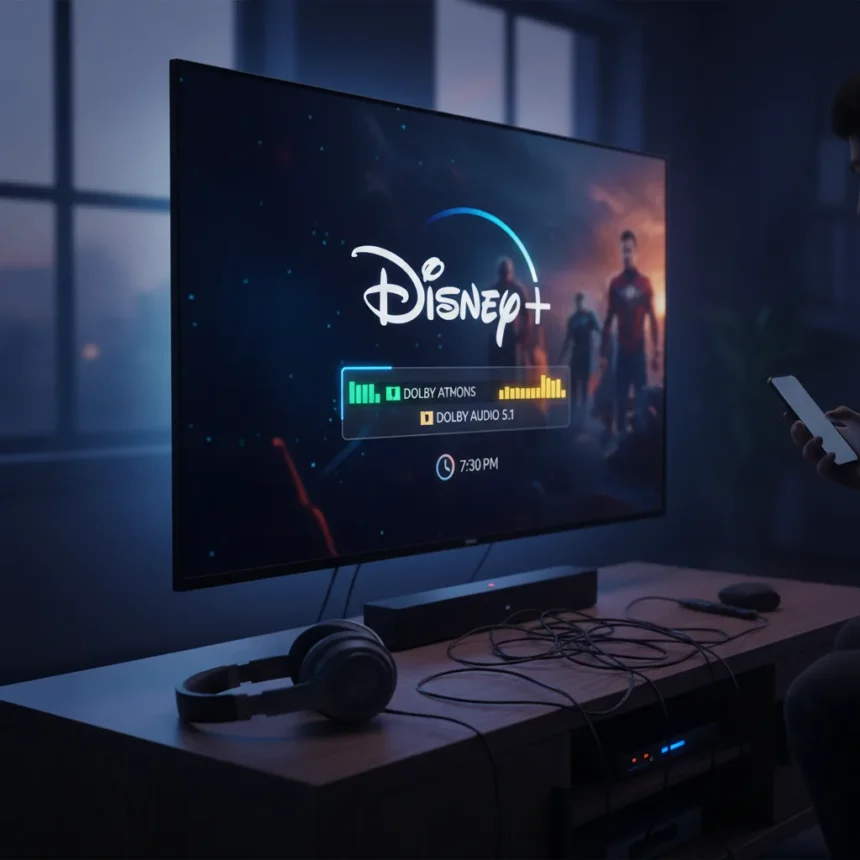
Disney+ Dolby Atmos is vanishing from Premium subscribers’ screens at specific times of day, replaced by lower-quality audio formats like 5.1 Dolby Digital, and the streaming giant refuses to acknowledge the pattern. Users across Reddit, AVForums, and Twitter describe the same frustrating experience: Atmos available in the early morning or late night, gone by evening—even though they’re paying for a Premium plan that explicitly includes the feature.
Key Takeaways
- Disney+ Premium subscribers report Dolby Atmos disappearing during peak evening hours (7-10 PM) on compatible titles.
- The same show plays with Atmos at 3 AM but without it at 8 PM on identical devices and plans.
- Disney support claims Atmos is always available on Premium, offering no explanation for time-based inconsistencies.
- Historical precedent exists: Disney+ reduced bandwidth and disabled 4K/HDR/Atmos during COVID-19 lockdowns in 2020.
- Netflix and Prime Video have faced similar peak-hour throttling accusations, but neither has widespread Atmos complaints.
One Premium subscriber described the experience bluntly: “I thought I was going mad.” That sentiment echoes across forums where users compare notes on which hours deliver Atmos and which don’t. The pattern is consistent enough that users have begun mapping it—Atmos present at 2 AM, absent by 7 PM on the same device, same title, same plan. Reddit user u/StreamingNerd42 summarized the suspicion: “It’s there at 2 AM, gone by 7 PM. Peak hours = no Atmos, even on Premium. Server throttling?”
The Atmos Disappearing Act: What Users Are Experiencing
Disney+ Dolby Atmos is advertised as a core feature of the Premium tier, which costs $13.99 per month or $139.99 per year and includes 4K resolution, HDR, and spatial audio. Yet subscribers report the feature vanishes during evening hours when streaming demand peaks. TechRadar verified the issue on a Premium plan: Atmos was present at 3 AM but absent at 8 PM on the same Apple TV 4K device and the same compatible title. The audio reverted to standard 5.1 Dolby Digital—a significant downgrade in immersion and detail.
Affected titles include major releases like Thor: Ragnarok, The Mandalorian, and Hamilton, which launched with Dolby Vision and Atmos support. Users report the inconsistency across multiple devices and regions, spanning the US, UK, and EU. The behavior suggests selective degradation rather than a technical glitch—if Atmos worked at 3 AM, the infrastructure supports it. The question is why it disappears when most viewers are watching.



Disney support responses offer no clarity. When users file tickets about missing Atmos, the standard reply states: “Dolby Atmos is supported on all Premium plans for compatible devices and titles.” The response ignores the core complaint—that Atmos is available sometimes and unavailable other times. Support does not acknowledge time-based limitations, does not explain peak-hour behavior, and does not offer troubleshooting beyond “restart your device.” That gap between what the company claims and what users observe has left subscribers feeling unheard.
Disney+ Dolby Atmos Throttling: Historical Precedent
Disney has form for this. In March 2020, as COVID-19 lockdowns drove unprecedented streaming demand, Disney+ launched in the UK and EU with at least 25% less bandwidth than planned. The service temporarily disabled 4K, HDR, and Dolby Atmos to reduce server strain during peak hours. The measure was presented as temporary, and the company restored full quality later that year. That precedent matters because it shows Disney is willing to degrade premium features silently when infrastructure is strained—and willing to restore them without fanfare once demand drops.



The 2020 decision was defensible in an emergency. Today’s situation is murkier. Streaming demand has grown since the pandemic, but so has infrastructure investment. Yet users report the same pattern: premium features present off-peak, absent during peak hours. The company has not confirmed whether a similar strategy is in place now, leaving subscribers to reverse-engineer Disney’s behavior through forum posts and time-stamped screenshots.
Why Disney+ Dolby Atmos Matters (And Why Silence Doesn’t Help)
Dolby Atmos is not a minor bonus feature. Subscribers who invest in Atmos-capable home theater systems—soundbars, receivers, headphones—do so partly because streaming services promise consistent access. When that promise breaks at predictable times, it degrades the entire experience. A user with a high-end Atmos setup gets a downgraded 5.1 mix during prime viewing hours, while early-morning viewers enjoy the full immersive mix. That is not a technical failure—it is a design choice, and the silence around it compounds the frustration.
Competitors face similar accusations. Netflix has been accused of variable bitrate throttling during peak hours, though the company denies widespread quality adjustments. Prime Video users report similar peak-time degradation but without Atmos complaints at the same scale. Apple TV+ has maintained consistent Atmos and Spatial Audio availability without widespread user reports of time-based removal. Disney’s refusal to address the issue directly—either confirming or denying peak-hour throttling—leaves Premium subscribers in the dark about whether they are getting what they paid for.
Is Disney Throttling Intentionally, or Is It a Technical Problem?
User speculation points to server stress during peak streaming periods. The theory is plausible: dynamically reducing bitrate and feature availability during high-demand windows reduces infrastructure load. But plausibility is not confirmation. Disney has not stated whether Disney+ Dolby Atmos throttling is intentional, whether it is temporary, or whether it is even happening at scale. The company’s public silence—combined with support responses that deny the issue exists—suggests either ignorance of the problem or deliberate avoidance of transparency.



If Disney is throttling intentionally, transparency would help. A statement like “During peak hours, we prioritize video delivery and may reduce audio quality to ensure streaming stability” would at least acknowledge the trade-off. Subscribers could make informed decisions: accept the limitation or watch off-peak. Instead, Disney leaves users guessing, which breeds frustration and erodes trust in the Premium tier’s value proposition. The company’s unwillingness to confirm or deny the behavior is itself a statement—one that suggests the issue is known but unresolved.
What About the Disney+ With Ads Tier?
Disney+ offers a lower-cost option: the With Ads tier at $7.99 per month, which explicitly excludes Dolby Atmos and IMAX Enhanced. That tier is designed for budget-conscious viewers willing to accept ads and lower audio quality. But Premium subscribers are paying more specifically for Atmos access. If that access is being revoked at certain times, the tier distinction collapses. Premium becomes a conditional feature—available when the server load permits.
FAQ
Is Disney+ removing Dolby Atmos intentionally to save money?
Disney has not confirmed peak-hour throttling of any kind. User reports suggest it happens, but the company’s silence makes the true cause unclear. It could be intentional server management, a software bug, or a regional infrastructure issue. Without an official statement, confirmation remains speculation.
Does this affect all Disney+ Premium subscribers?
Reports come from US, UK, and EU subscribers across multiple device types (Apple TV 4K, Android TV, and others). The pattern appears widespread, but Disney has not released data on how many users experience the issue or in which regions it occurs most.
Will Disney+ Dolby Atmos come back during off-peak hours?
Yes. Users consistently report Atmos returns in early morning and late-night hours. If throttling is intentional, it appears designed to preserve Atmos availability during low-demand periods while reducing it during peak viewing times.
Disney+ Premium subscribers are paying for Dolby Atmos, but they are not getting consistent access to it. Until Disney acknowledges the issue and explains what is happening, Premium tier buyers have every right to feel misled. The silence is the real problem—not the throttling itself, which might be technically necessary, but the refusal to be honest about it.
Edited by the All Things Geek team.
Source: TechRadar




