






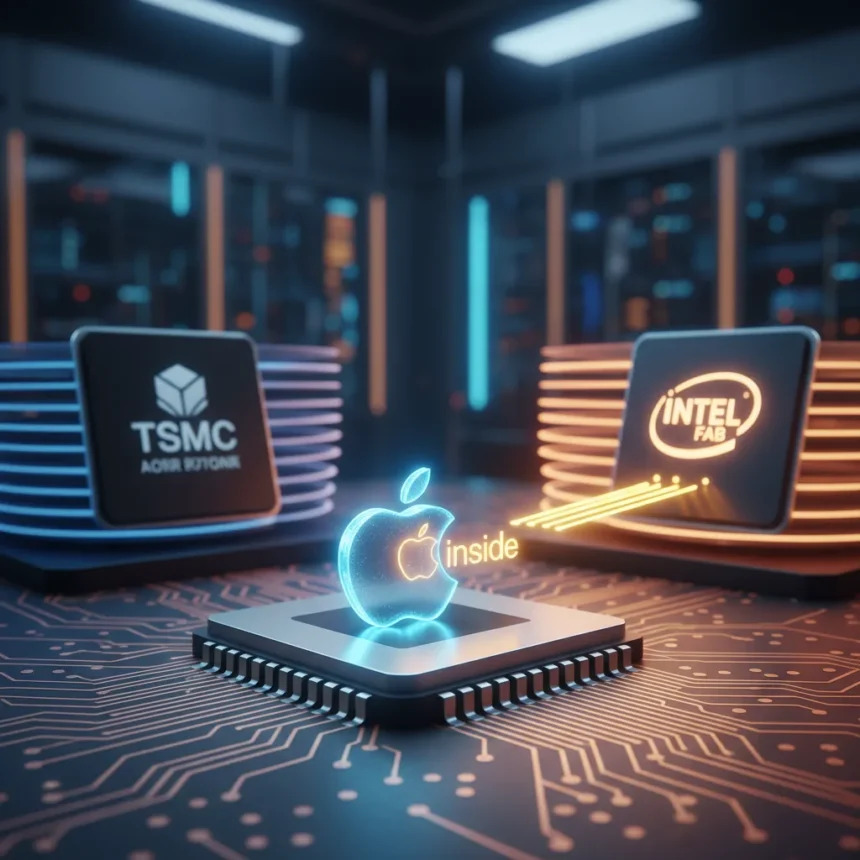
The Apple Intel chip deal refers to a preliminary manufacturing agreement between Apple and Intel, under which Intel would fabricate some of Apple’s processors using its 18A process node. No orders have been placed yet, but the agreement — reported by Bloomberg and corroborated by analysts Ming-Chi Kuo and Pu — marks a clear escalation from the exploratory discussions that circulated earlier. Intel shares jumped 3.4% in premarket trading following the initial reports, signaling that markets see this as more than noise.
Key Takeaways
- Apple and Intel have reached a preliminary manufacturing agreement — no production orders have been placed yet.
- Intel would fabricate entry-level M-series chips for MacBook Air, entry-level MacBook Pro, and iPad Pro, not high-end Pro or Max variants.
- Intel’s 18A process node is the targeted manufacturing technology for future M-series chips.
- TSMC remains Apple’s primary supplier, handling high-end chips and the majority of total production.
- Intel shares rose 3.4% in premarket trading after reports of the deal surfaced.
What the Apple Intel Chip Deal Actually Covers
The agreement targets the lower end of Apple’s chip lineup — specifically the entry-level M processor destined for MacBook Air, the entry-level MacBook Pro, and iPad Pro. Analysts have floated the A22 or A23 as potential candidates too. High-end Pro and Max variants of the M-series will stay with TSMC. Intel is being brought in as a fabricator, not a designer — Apple’s chip architecture team remains entirely in-house.
That distinction matters. Apple isn’t outsourcing chip design to Intel; it’s using Intel’s factories to stamp out silicon it already designed. Under new CEO Lip-Bu Tan, Intel has been aggressively repositioning its foundry business to attract exactly this kind of external customer. Landing Apple — even for entry-level chips — would be a landmark validation of that strategy.
Why Apple Is Diversifying Away from TSMC
Apple’s dependence on TSMC has long been a structural vulnerability. The vast majority of Apple’s chip production still comes from Taiwan, where geopolitical risk is a genuine concern for any company planning five years ahead. TSMC’s Arizona plant is ramping up, delivering around 100 million chips to Apple in 2024, but that’s a fraction of total demand. Capacity constraints projected for 2026 are a real pressure point — and that’s precisely where the Apple Intel chip deal becomes strategically relevant.



Apple executives also visited Samsung’s developing fab in Taylor, Texas, which entered risk production in 2024. No deal with Samsung has been confirmed. The fact that Apple is simultaneously exploring Intel and scouting Samsung suggests this isn’t a one-off hedge — it’s a deliberate effort to build a multi-supplier manufacturing base on US soil.
The geopolitical dimension is impossible to ignore. US government pressure to onshore semiconductor production has intensified, and a company with a $4.1 trillion market cap has both the incentive and the leverage to make domestic chip manufacturing work commercially.



How Intel’s 18A Node Compares to TSMC’s Process Technology
Intel’s 18A process node is the manufacturing technology at the center of this agreement. Intel has positioned 18A as competitive with TSMC’s leading-edge nodes, though it has not yet demonstrated this at scale with external customers. TSMC’s process technology currently handles Apple’s most demanding chips — the M-series Pro and Max variants that power MacBook Pro and Mac Studio — and will continue to do so under any scenario the current reports describe.
The entry-level chips targeted by the Intel deal are less demanding in manufacturing terms, which makes them a sensible starting point for a new foundry relationship. If Intel can deliver yield and performance on lower-complexity Apple silicon, the relationship could expand. If it can’t, Apple’s flagship products are insulated from any production issues. It’s a calculated trial run, not a wholesale supplier switch.
Is the Apple Intel chip deal confirmed or still speculative?
A preliminary agreement has been reached, according to Bloomberg, but no production orders have been placed. The deal is real in the sense that both companies have moved beyond exploratory talks, but it remains early-stage. Calling it a finalized contract would overstate where things stand.
Which Apple chips would Intel manufacture?
The agreement targets entry-level M-series chips — the processors used in MacBook Air, the entry-level MacBook Pro, and iPad Pro. Analysts have also suggested A22 or A23 mobile processors as candidates. High-end Pro and Max chip variants will continue to be produced by TSMC.



Why does Apple want to reduce its reliance on TSMC?
TSMC’s dominance in Apple’s supply chain creates concentration risk, particularly given Taiwan’s geopolitical situation. Projected capacity constraints at TSMC for 2026 add urgency. By cultivating Intel and exploring Samsung as alternative foundries, Apple is building redundancy into its most critical supply chain before a shortage forces its hand.
The Apple Intel chip deal won’t reshape Apple’s silicon strategy overnight — TSMC is too embedded, too capable, and too far ahead on high-end nodes for that. But as a deliberate first step toward supply chain resilience, it’s exactly the kind of move a $4.1 trillion company should be making. The real story isn’t whether Intel can replace TSMC. It’s whether Intel can prove itself capable enough that Apple never has to find out what happens if TSMC can’t deliver.
This article was written with AI assistance and editorially reviewed.
Source: Tom's Hardware