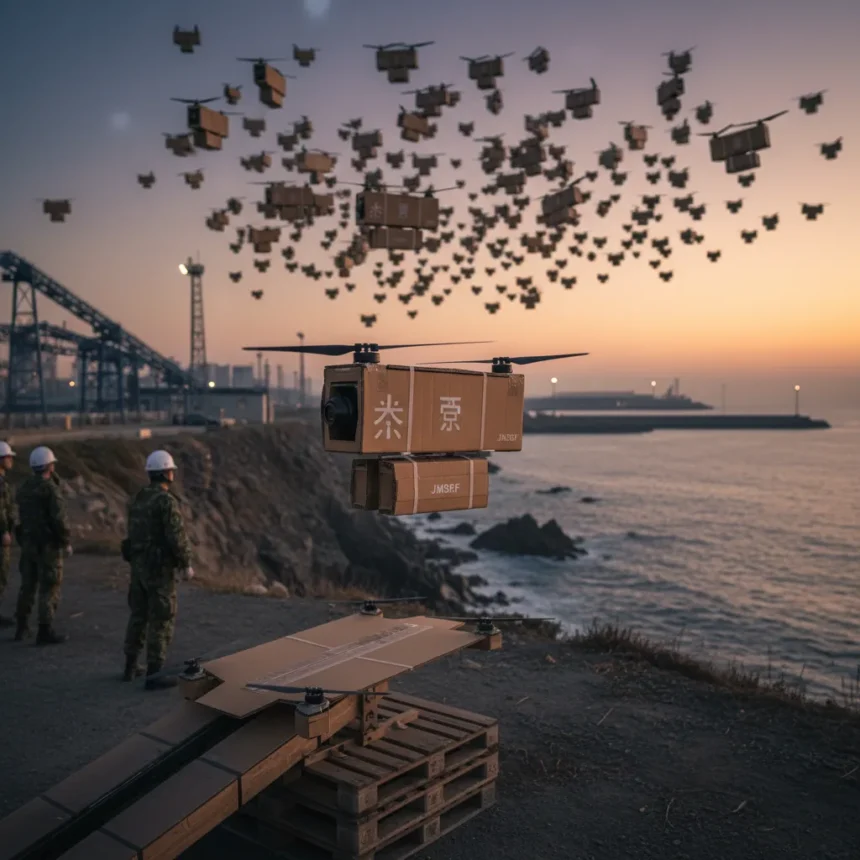
Cardboard drones are no longer a thought experiment. Japan’s Maritime Self-Defense Force is already deploying them, signaling that disposable aerial warfare has moved from concept to operational reality. The AirKamuy 150, built from corrugated cardboard with a water-resistant coating, costs roughly $2,000 to $3,000 per unit and ships flat-packed like IKEA furniture.
Key Takeaways
- Japan Maritime Self-Defense Force operationally deployed AirKamuy 150 cardboard drones as aerial targets and for swarm missions.
- Cardboard drones cost $2,000-$3,000, compared to tens of thousands for conventional fixed-wing aircraft.
- Flat-pack assembly takes approximately 5 minutes; no specialized tools required.
- Lower radar reflectivity than metal or carbon fiber makes cardboard drones harder to detect.
- Biodegradable construction enables rapid mass production at standard cardboard manufacturing facilities.
Why cardboard drones change the economics of aerial warfare
Japan’s Defense Minister Shinjirō Koizumi confirmed in early May 2026 that the JMSDF is already using AirKamuy 150 drones as aerial targets. This operational deployment is significant because it marks the first major military adoption of cardboard aircraft. The cost advantage is staggering: a single cardboard drone costs less than a high-end gaming PC. Conventional fixed-wing drones built from aerospace composites or carbon fiber cost tens of thousands of dollars and require specialized manufacturing infrastructure.
The appeal lies in expendability. One-way missions—reconnaissance, jamming, or swarm attacks—no longer require expensive platforms. If a drone is destroyed during a mission, the financial loss is negligible compared to losing a $50,000 aircraft. This fundamentally changes how militaries think about unmanned tactics. Air Kamui CEO Yamaguchi Takumi emphasized the strategic shift: there is strong demand for low-cost drones that can operate in large numbers and over long distances. A cardboard drone swarm of 100 units costs roughly $200,000 to $300,000—the price of a single conventional combat drone.
Flat-pack design and rapid deployment capability
The AirKamuy 150 ships disassembled in a flat-pack configuration, assembling in approximately 5 minutes without specialized tools. This design choice has profound wartime implications. Traditional drone manufacturing requires dedicated factories, supply chains, and skilled technicians. Cardboard drones can be produced at any standard corrugated cardboard plant, ensuring a robust supply chain that is difficult to disrupt. In a prolonged conflict, a nation could rapidly scale production by converting existing packaging facilities into drone manufacturing centers.

Water-resistant coating protects the cardboard from moisture, though durability in sustained rainfall or humid conditions remains operationally unverified. The lightweight construction enables long-range flight on minimal battery power compared to heavier metal-frame aircraft. Assembly speed matters: a soldier can prepare a cardboard drone for launch faster than setting up more complex systems, reducing deployment time in the field.
Cardboard drones vs. Japan’s competing wooden alternative
Japan is pursuing parallel strategies. The JISDA’s ACM-01 Shiraha drone features a wooden fuselage and costs approximately $450, undercutting the AirKamuy 150 significantly. Both designs prioritize domestic manufacturing and expendability, but the Shiraha is cheaper and uses fully domestic components, reducing foreign supply chain dependency. The AirKamuy 150 offers longer range and larger payload capacity, making it suited for different mission profiles. Australia is developing similar cardboard drones for one-way missions, suggesting this technology is spreading beyond Japan. Global startups are also experimenting with corrugated cardboard for low-cost, expendable aerial roles including training and reconnaissance.



The competition between cardboard and wooden airframes reflects a broader military trend: maximizing capability while minimizing cost per unit. Neither platform attempts to match the performance of advanced fighter drones. Instead, they optimize for mass production, rapid deployment, and acceptable performance in roles where loss is expected.
Radar signature and reconnaissance advantages
Cardboard has lower radar reflectivity than metal or carbon fiber, making cardboard drones harder to detect on radar systems. This advantage applies primarily to older or less sophisticated radar networks. Advanced phased-array systems and modern air defense networks may still track cardboard aircraft effectively, but the reduced signature extends flight duration in contested airspace. For reconnaissance missions where the drone must penetrate defended territory undetected, this matters. For swarm attacks where overwhelming numbers matter more than stealth, the reduced signature is secondary to cost and volume.
The biodegradable nature of cardboard raises environmental questions that militaries have largely ignored. A cardboard drone shot down in friendly territory poses no toxic hazard compared to composite aircraft laden with lithium batteries and epoxy resins. In civilian areas, the environmental footprint is substantially lower, though this consideration rarely influences military procurement decisions.
Is the cardboard drone technology proven in combat?
Operational deployment by the JMSDF confirms that cardboard drones work in controlled conditions—aerial target practice and training exercises. Real combat effectiveness against determined air defense remains unproven. Cardboard is fragile; a direct hit from any air defense system will destroy the aircraft. The question is whether the low cost and high volume offset the vulnerability. Ukraine’s experience with drone swarms suggests yes: cheap drones in large numbers can overwhelm air defense through attrition and saturation. Japan appears to be betting that this principle scales to cardboard aircraft.



Can cardboard drones be mass-produced quickly?
Yes. Air Kamui CEO Yamaguchi Takumi stated that cardboard drones can be manufactured at any cardboard plant, ensuring high mass production capability. In wartime, a nation with a large cardboard manufacturing base could theoretically produce thousands of drones within weeks. This contrasts sharply with conventional drone manufacturing, which requires specialized facilities and longer production cycles. The flat-pack design eliminates complex assembly steps, further accelerating production.
How do cardboard drones compare to conventional military drones?
Conventional fixed-wing drones built from aerospace-grade materials cost significantly more, require specialized manufacturing, and offer better durability and performance. A military-grade reconnaissance drone might cost $50,000 to $100,000 and last for dozens of missions. A cardboard drone costs $2,000 to $3,000 and is designed for one or a few missions before being expended. The choice depends on mission requirements. For high-value reconnaissance over friendly territory, a durable conventional drone makes sense. For swarm attacks, saturation reconnaissance, or one-way missions, cardboard drones are economically superior despite lower individual performance.
Japan’s operational deployment of cardboard drones signals that expendable unmanned warfare is no longer theoretical—it is here. The combination of low cost, rapid assembly, domestic production capability, and acceptable performance in defined roles makes cardboard drones a credible military tool. Whether they prove effective in sustained combat remains to be seen, but the economics are already reshaping how militaries think about drone strategy.
Edited by the All Things Geek team.
Source: TechRadar