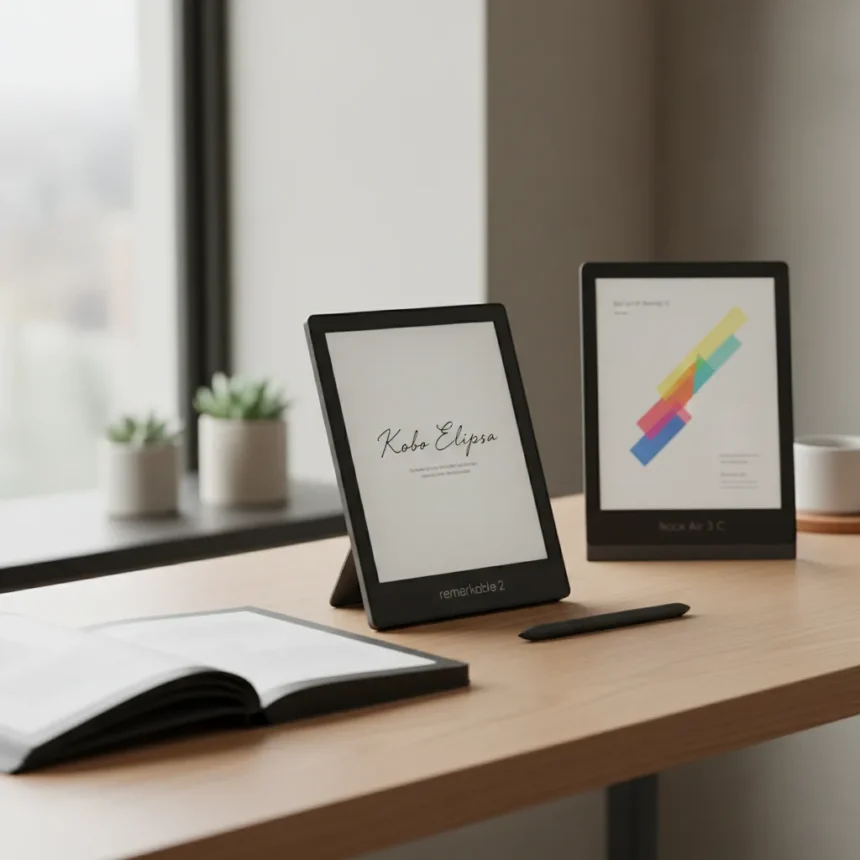
Kindle alternatives are gaining traction among readers who want to escape Amazon’s ecosystem without sacrificing quality or features. While the Kindle Paperwhite remains popular, a handful of lesser-known e-readers deliver premium build, innovative technology, and user experiences that justify switching teams entirely.
Key Takeaways
- Premium Kindle alternatives offer color displays, faster refresh rates, and superior build quality.
- Non-Amazon e-readers provide ecosystem freedom and often undercut Kindle pricing.
- Emerging technologies like Live Paper displays and color E Ink are reshaping the e-reader market.
- Kobo, reMarkable, and Onyx Boox represent the strongest alternatives to Amazon’s lineup.
- 2025 marks a shift toward open-platform e-readers with advanced paper-like displays.
Why Kindle alternatives matter now
Amazon has dominated the e-reader market for over a decade, but 2024 and 2025 have seen a surge in credible competitors. The Kindle Paperwhite, while competent, locks users into Amazon’s ecosystem and lacks features that rivals have already perfected. Color E Ink displays, faster refresh rates, and open software platforms are no longer niche luxuries—they are standard expectations among power readers. Kindle alternatives address these gaps directly.
The shift is driven by consumer demand for choice. Readers want devices that work with their preferred retailers, support multiple file formats, and offer customization beyond Amazon’s walled garden. As color e-reader technology matures and new display innovations emerge, the case for staying loyal to Kindle weakens considerably.
Kobo Libra Colour challenges Kindle’s color strategy
Kobo’s color E Ink offering represents one of the strongest direct challenges to Kindle’s recent Colorsoft launch. The Libra Colour delivers color without the compromises that plague Amazon’s approach, positioning itself as a more versatile reading device for users who want vibrant book covers, color illustrations, and magazine layouts without sacrificing battery life or display quality. Unlike Kindle’s proprietary ecosystem, Kobo supports open standards and integrates with multiple retailers, giving readers genuine freedom in how they source content.

The Libra Colour’s appeal lies in its commitment to being a true alternative rather than a Kindle clone. It prioritizes color accuracy and usability over artificial lock-in, making it attractive to readers who feel constrained by Amazon’s approach. This positioning directly addresses a core frustration with Kindle: the sense that you are buying into a closed system rather than purchasing a neutral reading device.
reMarkable Paper Pro for note-taking beyond Kindle Scribe
reMarkable’s Paper Pro elevates the note-taking e-reader category in ways the Kindle Scribe simply does not. While Kindle Scribe focuses narrowly on basic annotation, the Paper Pro treats note-taking as a primary function with tools, templates, and organizational features that appeal to students, researchers, and professionals. The device bridges the gap between a reading tool and a productivity device, offering functionality that no Kindle variant provides.



For users considering Kindle Scribe, the Paper Pro deserves serious evaluation. It delivers a more mature feature set, better stylus performance, and an ecosystem designed around writing rather than reading with marginal annotation support. This distinction matters for anyone whose e-reader needs extend beyond casual page-turning.
Onyx Boox Tab Ultra C and emerging display innovations
Onyx Boox’s Tab Ultra C represents the aggressive end of the Kindle alternatives spectrum, offering a large-format color e-reader with tablet-like capabilities. The device runs Android, supports sideloading apps, and treats the e-reader as a genuine computing device rather than a closed reading appliance. For users who want flexibility and don’t mind a steeper learning curve, Boox devices eliminate the compromise entirely.
Beyond Boox, emerging technologies like the Daylight DC-1 with its Live Paper display running at 60fps signal where the market is heading. These innovations—faster refresh rates, true color fidelity, and open platforms—represent a fundamental shift away from Kindle’s incremental approach. The DC-1’s 60fps paper-like display technology, while still early, demonstrates that Kindle alternatives are pushing the boundary of what e-readers can do.
Ecosystem freedom and cost advantages
Most Kindle alternatives cost less than comparable Kindle models while offering more flexibility. Kobo’s color devices, for instance, undercut Kindle’s color offerings while supporting DRM-free content and multiple file formats. This combination—lower price plus greater freedom—creates a compelling value proposition that extends beyond pure hardware specifications.



The ecosystem argument matters more than specifications alone. Users who own books from multiple retailers, subscribe to different services, or prefer open formats find that Kindle alternatives remove friction rather than add it. You are no longer forced to purchase through Amazon or convert files to proprietary formats. This freedom has real, tangible value for serious readers.
Should you switch from Kindle to an alternative?
The answer depends on your reading habits and tolerance for change. If you are deeply invested in Amazon’s ecosystem and read primarily through Kindle Unlimited, switching makes less sense. But if you own books from other retailers, want color displays, or simply resent being locked into one company’s approach, Kindle alternatives offer genuine advantages without meaningful drawbacks. The devices are mature, well-reviewed, and supported by companies committed to the e-reader market long-term.
The real question is not whether alternatives exist—they do—but whether Amazon’s convenience advantage still outweighs their limitations. For many readers in 2025, it no longer does.
Do Kindle alternatives support all book formats?
Most Kindle alternatives support significantly more formats than Kindle, including EPUB, PDF, MOBI, and others without DRM conversion. Kobo and Boox devices particularly excel at format flexibility, making them ideal for readers who source books from libraries, independent retailers, or personal collections. Kindle remains more restrictive, though it does support several formats beyond proprietary AZW files.
Are Kindle alternatives cheaper than Kindle?
Generally yes. Kobo’s color e-readers typically cost less than Kindle Colorsoft while offering comparable or superior color performance. Boox devices occupy a premium tier but deliver more features for the price. The exception is reMarkable, which targets a different use case (note-taking) and prices accordingly. Budget-conscious readers will find Kindle alternatives offer better value across most categories.
Will Kindle alternatives work with Kindle Unlimited?
No. Kindle Unlimited is exclusive to Amazon devices and cannot be accessed on competing e-readers. This is the primary constraint for users who rely on Kindle Unlimited’s library. However, most alternatives integrate with other subscription services or work smoothly with DRM-free content from independent retailers, making the loss of Kindle Unlimited less significant for many readers.
The e-reader market has fundamentally shifted. Kindle alternatives are no longer compromises—they are legitimate choices for readers who value freedom, features, and ecosystem diversity. Whether you prioritize color displays, note-taking, format flexibility, or simply want to escape Amazon’s walled garden, 2025 offers more viable options than ever before. The question is not whether alternatives exist, but whether Kindle still deserves your loyalty.
Where to Buy
View at Amazon | View at Amazon
Edited by the All Things Geek team.
Source: T3