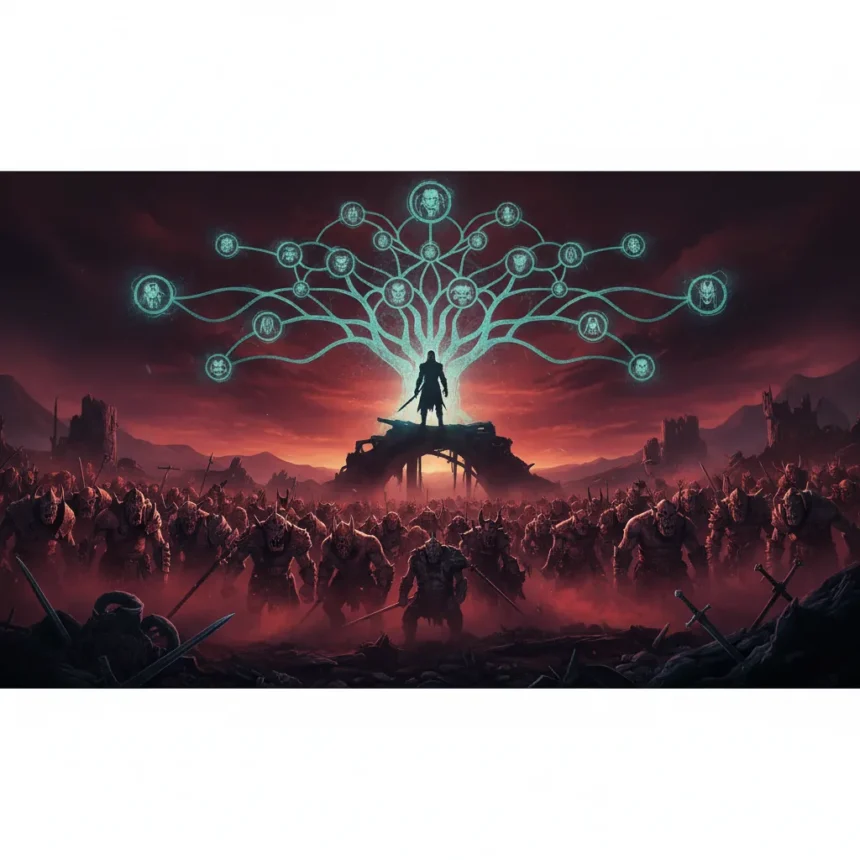
Shadow of Mordor’s Nemesis System remains the most sophisticated dynamic enemy hierarchy ever built into an action game, and twelve years after its September 2014 launch, no competitor has come close to replicating what Monolith Productions achieved. The game tasks you with controlling Talion, a ranger possessed by the wraith Celebrimbor, navigating the open world of Mordor in a third-person action-adventure that would sell over 7 million copies and win a BAFTA for Artistic Achievement in 2015.
Key Takeaways
- Shadow of Mordor launched September 30, 2014 on PS4, Xbox One, and PC, developed by Monolith Productions.
- The Nemesis System generates unique orc enemies with persistent memories, evolving hierarchies, and individual strengths and weaknesses.
- No action game in 12 years (2014–2026) has matched the Nemesis System’s emergent depth and dynamic rival progression.
- The game was delisted from digital stores in 2020 due to expired Lord of the Rings licensing but remains playable for prior owners.
- Sequel Shadow of War expanded the system but faced loot box backlash, cementing the original as the pinnacle design.
What Makes Shadow of Mordor’s Nemesis System Unbeatable
The Nemesis System is not a scripted progression tree. It is a living hierarchy of enemies that remembers every encounter you have with them. Defeat an orc captain and he might return scarred, angrier, and seeking revenge. Spare him and he climbs the ranks through victories against other orcs. Each enemy develops a unique personality, backstory, and set of weaknesses based on how you interact with them. This is emergence—unpredictable storytelling generated by systems, not written by designers. No other action game has nailed this formula.
Assassin’s Creed, the closest rival in scope and setting, lacks any persistent enemy memory. Ghost of Tsushima delivers visceral sword duels but within a rigid narrative framework. Star Wars Jedi: Fallen Order and its sequel Survivor focus on combat mastery without systemic enemy evolution. God of War (2018) features boss progression, but those encounters are scripted set pieces, not emergent encounters shaped by your playstyle. The Nemesis System does what none of these do: it lets the game itself tell stories about your rivalry with individual enemies.
Why the Sequel Couldn’t Recapture the Original’s Magic
Shadow of War (2017) attempted to expand the Nemesis System with fortress sieges and deeper orc politics. On paper, it should have surpassed the original. Instead, it became infamous for aggressive loot box monetization that felt antithetical to the system’s organic design. Warner Bros. Interactive Entertainment eventually removed the loot boxes after backlash, but the damage was done. Players and critics alike recognized that the first game’s elegant simplicity—enemies evolving through genuine conflict rather than cosmetic progression—was the true achievement. The sequel’s bloat exposed why the original’s restraint was genius.


The License Limbo That Froze Shadow of Mordor in Time
Shadow of Mordor was delisted from Steam, PlayStation Store, and Xbox Store in 2020 when Embracer Group’s license to publish Lord of the Rings games expired. If you own the game digitally, you can still play it. If you do not, your only option is a physical used copy, typically between $10 and $30 USD on secondary markets. This licensing catastrophe means no remaster, no port to new platforms, no chance for a new generation to experience the game officially. It is a tragedy for game preservation and a reminder of how corporate licensing can erase even celebrated titles from the market. The Nemesis System may be unbeaten, but the game itself has become harder to access than ever.
Can Modern Open-World Games Learn From the Nemesis System?
Twelve years is an eternity in game design. In that span, open-world action games have become bigger, more detailed, and more cinematic. Yet none have attempted to replicate the Nemesis System’s core insight: that enemies should have agency, memory, and growth independent of the player’s progression. Most modern games treat enemies as encounters to complete, not rivals to build a history with. The Nemesis System understood that the best stories in games come from systems, not cutscenes. Until another studio risks the design complexity and computational overhead required to build a true dynamic rival system, Shadow of Mordor will remain the standard by which all others are measured.

Is Shadow of Mordor worth playing in 2026?
Yes, if you can access it. The core combat is fluid, the open world rewards exploration, and the Nemesis System still generates moments no scripted game can match. The main limitation is availability—you will likely need to buy a used physical copy or hope you own it digitally already. The game has aged visually, but the systems design is timeless.
How does Shadow of War’s Nemesis System compare to the original?
Shadow of War expanded the system with fortress mechanics and deeper orc politics, but the loot box controversy overshadowed these improvements. The original’s elegant simplicity—where enemies evolve purely through conflict—remains superior to the sequel’s more complex but less focused design.
Why was Shadow of Mordor delisted from digital stores?
Embracer Group’s license to publish Lord of the Rings games expired in 2020. Without the license, the game could no longer be sold digitally. Physical copies remain playable, and digital owners retain access, but new players cannot purchase the game officially.
Shadow of Mordor proved that innovation in action games does not require latest graphics or sprawling narratives. It requires systems smart enough to surprise you. Twelve years later, that lesson has been forgotten by an industry chasing spectacle over emergence. Until another game dares to build a rival system as sophisticated as the Nemesis System, Monolith Productions’ 2014 masterpiece will remain unmatched.


Edited by the All Things Geek team.
Source: TechRadar