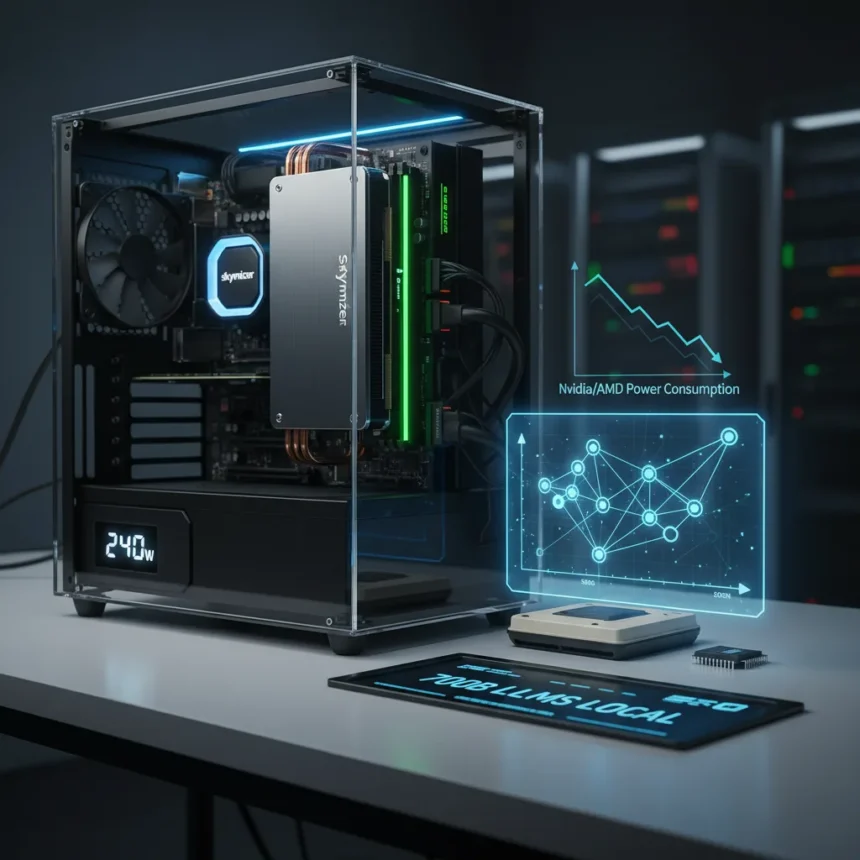
The PCIe AI accelerator from Skymizer represents a radical departure from the datacenter-first thinking that has dominated AI hardware for the past three years. Instead of chasing the latest process nodes and exotic memory architectures, Skymizer built a card that runs 700-billion-parameter language models locally while consuming just 240 watts—a fraction of what Nvidia’s H100 or AMD’s MI300X demand.
Key Takeaways
- Skymizer’s PCIe AI accelerator runs 700B LLMs locally at 240W total power consumption
- Uses decade-old DDR4 memory and 28nm process technology for lower cost and efficiency
- Standard PCIe form factor plugs into any compatible server or workstation
- Directly challenges Nvidia H100/B200 and AMD MI300X, which exceed 700W TDP
- Targets edge AI inference where power budgets and operational costs matter most
This is not a product built on latest fabrication or exotic engineering. It is built on the opposite principle: mature, proven technology that has become cheap and power-efficient precisely because it is old. The DDR4 memory standard, released in 2014, and the 28-nanometer process node, common in server chips throughout the 2010s, form the backbone of an accelerator designed for a market that datacenter giants have largely ignored.
Why Power Efficiency Matters More Than Ever
The conventional AI accelerator market has become a power consumption arms race. Nvidia’s flagship H100 GPUs draw over 700 watts per card. AMD’s Instinct MI300X, designed to compete on raw performance, consumes roughly the same. These cards are optimized for maximum throughput in massive clusters, where the cost of a single card is dwarfed by the cost of the entire system, the power infrastructure, and the electricity bill. But that calculus breaks down the moment you move inference workloads closer to the edge.
Skymizer’s 240-watt design opens a different door entirely. A PCIe AI accelerator that consumes one-third the power of its competitors can run in environments where power budgets are tight: corporate offices, research labs, smaller enterprises, and edge deployment scenarios where a full datacenter build-out is economically irrational. The company leverages older, mature technology—28nm process nodes from foundries like TSMC or GlobalFoundries, DDR4 memory that has been manufactured at scale for over a decade—to achieve this efficiency. Older nodes generate less heat and draw less power, a trade-off that modern chip design has largely abandoned in pursuit of density and speed.


How Skymizer’s PCIe AI Accelerator Stacks Up Against Competitors
Nvidia and AMD have built their AI empires on ecosystem lock-in. Nvidia’s CUDA platform and proprietary NVLink interconnect make switching costs prohibitively high. AMD’s Instinct cards target the same datacenter-first market with similar power demands. Neither company has much incentive to build a low-power alternative when their customers are already accustomed to paying for power-hungry infrastructure.
Skymizer’s PCIe form factor sidesteps this entirely. Any server or workstation with an available x16 PCIe slot can accept the card. No proprietary interconnects, no exotic memory subsystems, no vendor lock-in. This simplicity is a feature, not a limitation. It means the accelerator can integrate into existing infrastructure without wholesale replacement of motherboards, power supplies, or system architectures.



The closest comparison point is Tiny Corp’s TinyBox, a 6-GPU chassis that bundles either AMD or Nvidia GPUs into a complete system. The AMD version costs around $15,000, the Nvidia version $25,000. Skymizer’s single-card approach offers a different value proposition: plug-and-play efficiency for organizations that need local inference without the capital expense of a dedicated AI server. For smaller teams, research groups, or enterprises deploying inference at branch offices, the cost and power profile shift the economics entirely.
The Trade-Off: Quantization Over Precision
Running a 700-billion-parameter language model on 240 watts is theoretically possible only because the model must be quantized—compressed from full precision (typically 32-bit or 16-bit floating point) into lower-bit representations, often 4-bit or 8-bit. The research brief does not specify the exact quantization scheme Skymizer employs, and this matters. Quantized models run faster and consume less memory and power, but they sacrifice some accuracy in the process. The magnitude of that sacrifice depends on the quantization method and the model itself.
This is not a weakness unique to Skymizer. Every practical edge AI deployment involves quantization. The question is whether the trade-off is acceptable for the use case. For many inference scenarios—document classification, summarization, basic question-answering—quantized models perform well enough. For tasks requiring maximum precision, the accelerator may not be the right fit. Skymizer’s design implicitly acknowledges this reality: it optimizes for the 80 percent of inference workloads that do not demand full precision.
Where Skymizer Fits in the AI Hardware Landscape
The PCIe AI accelerator arrives at a moment when energy consumption has become a legitimate concern in AI deployment. Data centers are consuming more electricity, regulators are paying attention, and operational costs are rising. Nvidia and AMD built their dominance on the assumption that performance and ecosystem lock-in outweigh everything else. Skymizer bets that efficiency and simplicity will win in edge scenarios where power budgets are real constraints.



This is not a product designed to replace Nvidia H100s in massive training clusters. It is designed for the inference workloads that are increasingly moving away from the cloud and back toward the edge. As organizations realize that sending every query to a remote API is expensive, slow, and introduces privacy concerns, local inference becomes attractive. Skymizer’s accelerator makes local inference feasible at a power and cost level that Nvidia and AMD have not addressed.
What Remains Unclear
The research brief does not include real-world performance benchmarks—tokens per second, latency, or head-to-head comparisons with competing accelerators running the same models. Without these metrics, it is difficult to assess whether the 240-watt design represents a genuine breakthrough or a marketing claim that sounds impressive in isolation. Skymizer will need to publish independent benchmarks to convince skeptics.
Pricing and availability are also unspecified. The company has introduced the accelerator recently, but no launch date or price point has been announced publicly. For a product positioned as a cost-effective alternative to Nvidia and AMD, transparency on pricing is essential.
Is the PCIe AI accelerator suitable for datacenter deployment?
The PCIe AI accelerator targets edge inference and smaller-scale deployments, not hyperscale datacenters. Nvidia H100s and AMD MI300X cards are optimized for maximum throughput in clustered environments. Skymizer’s design prioritizes power efficiency and simplicity, making it better suited to branch offices, research labs, and organizations deploying inference closer to the data source.
Can the PCIe AI accelerator run full-precision language models?
Running a 700-billion-parameter model on 240 watts requires quantization—compression from full precision into lower-bit representations. The exact quantization method is not specified in available information, but practical inference at this power level almost certainly involves 4-bit or 8-bit quantization rather than 32-bit or 16-bit full precision.
How does the PCIe AI accelerator compare to Nvidia’s consumer GPUs?
Nvidia’s consumer GPUs like the RTX 6000 focus on graphics and general compute, not specialized AI inference. Skymizer’s accelerator is purpose-built for language model inference at low power, making direct comparison difficult. The key difference is intent: Nvidia’s consumer line targets a broad market; Skymizer targets a specific inference use case.
Skymizer’s PCIe AI accelerator challenges the assumption that AI hardware must be power-hungry and expensive. By embracing mature technology and a simple form factor, the company has created a product that solves a real problem for organizations tired of paying datacenter electricity bills to run inference workloads that could run locally. Whether it delivers on that promise depends entirely on real-world benchmarks and pricing—details that remain forthcoming.
Edited by the All Things Geek team.
Source: TechRadar