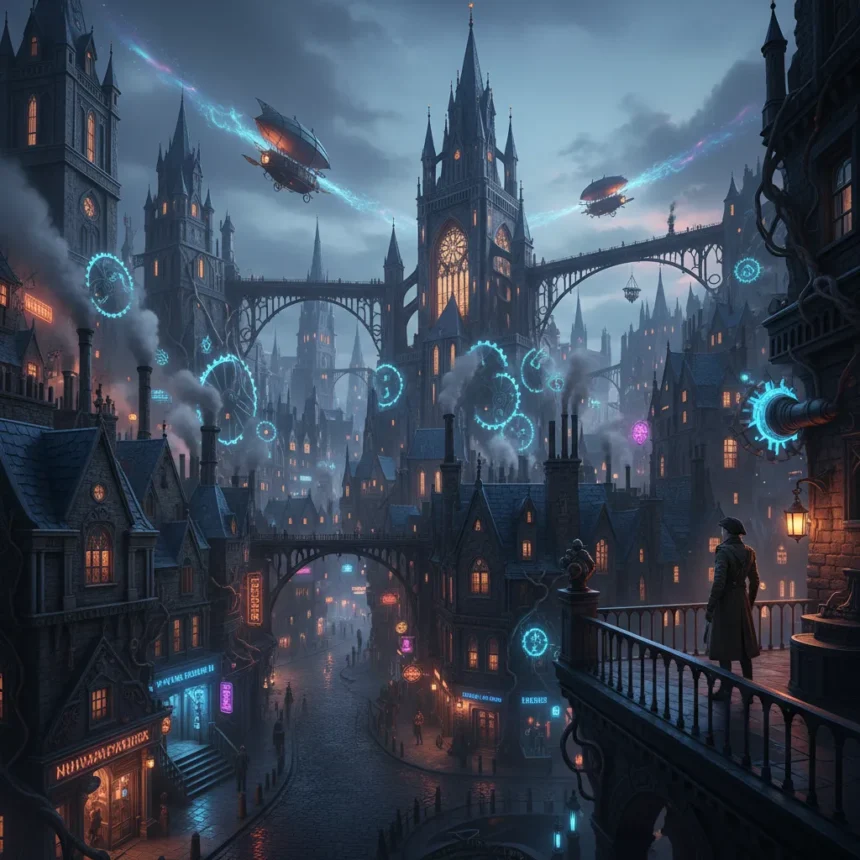
Unreal Engine 5 magic-punk world design has become the technical backbone for indie studios aiming to compete with AAA visual fidelity. Matt Moore, art director at Thick As Thieves, is leading the charge with a game inspired by Edinburgh’s gothic architecture, blending Victorian-era aesthetics with magical technology in an alternate-history setting that pushes what smaller teams can achieve with modern engine tools.
Key Takeaways
- Lumen global illumination eliminated manual lighting bakes, enabling dynamic gothic atmosphere lighting.
- Nanite virtualized geometry handled intricate cobblestone streets and spires without performance penalties.
- Hand-painted textures combined with procedural elements created a stylized painterly visual direction.
- UE5 reduced custom tooling needs compared to alternatives like Unity’s HDRP pipeline.
- The game targets PC with console port optimization considerations in development.
How Lumen Transformed the Gothic Lighting Approach
Dynamic global illumination was the critical breakthrough for Thick As Thieves’ Unreal Engine 5 magic-punk world design. Matt Moore explained that Lumen eliminated the need for baked lighting across the sprawling Edinburgh-inspired environment, a process that would have consumed weeks of iteration on a traditional pipeline. Instead, the team could light the world in real-time, adjusting shadows and reflections as they built, allowing the gothic atmosphere to emerge organically rather than through manual optimization passes.
This approach proved especially valuable for a stylized fantasy world where mood matters as much as technical precision. The magical elements of the setting demanded lighting that felt otherworldly yet grounded in the physical architecture. Lumen’s dynamic nature meant Moore and his team could experiment with how magical light sources—torches, enchanted objects, supernatural phenomena—would interact with stone structures and narrow alleyways without waiting for lengthy bake times. The result is a world where lighting reinforces the magic-punk identity rather than constraining it.
Nanite Geometry: Handling Intricate Detail Without Cost
Unreal Engine 5 magic-punk world design also benefited from Nanite’s virtualized micropolygon geometry system, which allowed the team to load extremely detailed environments without the traditional performance trade-offs. According to Moore, Nanite handled the insane detail in cobblestone streets and towering spires effortlessly, meaning artists could focus on craftsmanship rather than polygon budgets.


In traditional game development, environmental artists must constantly negotiate between visual fidelity and performance. A single street might require aggressive optimization to fit within memory and draw-call constraints. Nanite inverts this equation—artists can sculpt and paint with near-photographic detail, and the engine automatically manages the geometry streaming and rendering. For a gothic fantasy world where texture and weathering communicate history and atmosphere, this capability is transformative. Cobblestones are not generic polygonal blocks but individually detailed surfaces; spires are not simplified silhouettes but architecturally intricate structures.
Stylized Art Direction: Blending Painterly Aesthetics with Punk Grit
The visual identity of Thick As Thieves’ Unreal Engine 5 magic-punk world design rejects photorealism in favor of a hand-painted, stylized approach that feels more like animated concept art than a traditional 3D game. Moore noted that the team blended gothic fantasy with punk elements by combining hand-painted textures with procedural generation, allowing for both artistic control and scalable production. This hybrid approach meant that key hero assets received meticulous hand-crafted treatment while supporting environments could leverage procedural variation to maintain visual coherence across larger spaces.



The magic-punk setting naturally supported this aesthetic choice. A world where magic and technology collide in a Victorian-era setting demands visual language that feels simultaneously grounded and fantastical. Hand-painted textures bring personality and warmth that pure photogrammetry often lacks, while procedural elements ensure consistency without monotony. The result is an environment that reads as cohesive despite the intentional stylization—players recognize it as a unified world rather than a patchwork of different visual approaches.
UE5 Versus Alternatives: Why Thick As Thieves Chose This Engine
Comparing Unreal Engine 5 magic-punk world design tools to alternatives like Unity reveals significant architectural advantages. Unity’s HDRP (High Definition Render Pipeline) offers similar capabilities but requires substantially more custom setup and tooling to achieve equivalent results. Lumen and Nanite ship production-ready in UE5, whereas Unity developers often need to build or license additional solutions to reach feature parity. For a small studio like Thick As Thieves, this difference translates directly to faster prototyping and fewer engineering bottlenecks.
The democratization of high-end visual tools matters for indie development. A decade ago, achieving the visual quality evident in Thick As Thieves’ project would have required either a AAA budget or a proprietary engine developed over years. Modern UE5 puts those capabilities within reach of smaller teams, provided they can navigate the learning curve. This shift is already reshaping the indie game landscape, enabling stylized fantasy worlds that previously existed only in AAA studios’ portfolios.
Platform Optimization: From PC to Console
Development currently emphasizes PC optimization, with console ports under consideration. The Unreal Engine 5 magic-punk world design approach of using Lumen and Nanite introduces complexity when targeting console hardware with different memory and GPU architectures than high-end PCs. Moore’s team is likely evaluating scalability options—potentially using Nanite’s streaming system to manage memory on consoles, or adjusting Lumen’s quality settings to maintain frame rates on fixed hardware.


This is not unique to Thick As Thieves; other studios using similar UE5 techniques face identical challenges. The success of projects like Myrkur Video studio’s work on Echoes of the End, which optimized UE5’s Nanite and Lumen systems for both PS5 and Xbox, demonstrates that console ports are feasible but require deliberate optimization work beyond the PC baseline.
Why Unreal Engine 5 Magic-Punk World Design Matters Now
The timing of Thick As Thieves’ project coincides with UE5 reaching maturity post-5.4 updates. Earlier versions of the engine had rough edges; Lumen had performance quirks, Nanite had memory overhead, and the overall ecosystem lacked polish for production use. By 2025, these tools have stabilized enough that small studios can ship visually competitive games without years of custom engineering. This moment—where technology and accessibility align—is enabling a new generation of indie fantasy games that would have been impossible five years ago.
What Makes the Magic-Punk Aesthetic Compelling
The magic-punk setting itself deserves attention as a narrative and visual framework. Unlike high fantasy, which typically embraces medieval aesthetics, or cyberpunk, which leans into neon and chrome, magic-punk blends Victorian-era technology with magical systems. In visual terms, this means steam-powered machinery coexists with enchanted objects, gaslit streets exist alongside spell-inscribed architecture, and the color palette mixes industrial grays with supernatural purples and golds. Thick As Thieves’ Edinburgh-inspired setting adds a specific geographic flavor—the city’s existing gothic character becomes a foundation for magical world-building rather than a starting point to be abstracted away.
The Broader Shift in Indie Game Visuals
Thick As Thieves is not alone in leveraging Unreal Engine 5 magic-punk world design techniques to punch above their weight class. The accessibility of these tools is reshaping expectations for indie visual quality. Players no longer accept lower-fidelity graphics as a trade-off for indie game innovation; they expect stylized but polished environments, dynamic lighting, and detailed geometry as baseline. Studios that master these tools early gain a competitive advantage, both in attracting players and in securing funding or publisher support.
How Does Unreal Engine 5 Compare to Custom Engines?
Some veteran developers, including former Elder Scrolls creators, have opted to build proprietary engines rather than adopt UE5, citing concerns about licensing, feature bloat, or engine overhead. This choice makes sense for studios with decades of engine development experience and specific technical requirements that UE5 cannot meet. For emerging studios like Thick As Thieves, however, the cost-benefit calculation heavily favors UE5. Building a custom engine competitive with modern UE5 would require years and millions in development—resources most indie teams do not have.
What Challenges Remain for Unreal Engine 5 Magic-Punk World Design?
Despite its strengths, Unreal Engine 5 magic-punk world design still faces hurdles. Lumen’s real-time global illumination can introduce artifacts in certain lighting scenarios; developers must learn to work within its constraints rather than expecting perfect results from every setup. Nanite, while powerful, can struggle with certain material types or animated geometry, requiring artists to understand which assets benefit from virtualized geometry and which should use traditional rendering. These are not showstoppers but rather learning curves that studios must navigate.
Is Thick As Thieves’ Game Releasing Soon?
The project appears to be in early development or pre-alpha stage based on available information. No launch date, pricing, or regional availability has been announced. The focus at this stage is on establishing the visual foundation and core gameplay mechanics, with Unreal Engine 5 magic-punk world design serving as the technical and aesthetic framework.
Can Small Studios Really Compete with AAA Games Using UE5?
In terms of visual fidelity and technical sophistication, yes—provided they have the artistic talent and time to execute. What small studios cannot match is production scale; a AAA game might feature dozens of unique environments, hundreds of characters, and years of iteration. A smaller project might focus on a single city or region, perfecting it rather than sprawling across continents. Within that scope, Unreal Engine 5 magic-punk world design tools enable indie teams to achieve visuals that rival or exceed AAA standards. The constraint becomes creativity and resources, not technology.
Thick As Thieves’ project exemplifies how modern game development engines have democratized visual quality. A decade ago, the gothic fantasy aesthetic they are pursuing would have been exclusive to well-funded studios. Today, the right combination of engine features, artistic direction, and focused scope allows smaller teams to create worlds that captivate players. The Unreal Engine 5 magic-punk world design approach Matt Moore and his team are pioneering will likely influence indie game aesthetics for years to come, setting new expectations for what stylized fantasy games can achieve.
Edited by the All Things Geek team.
Source: Creativebloq