





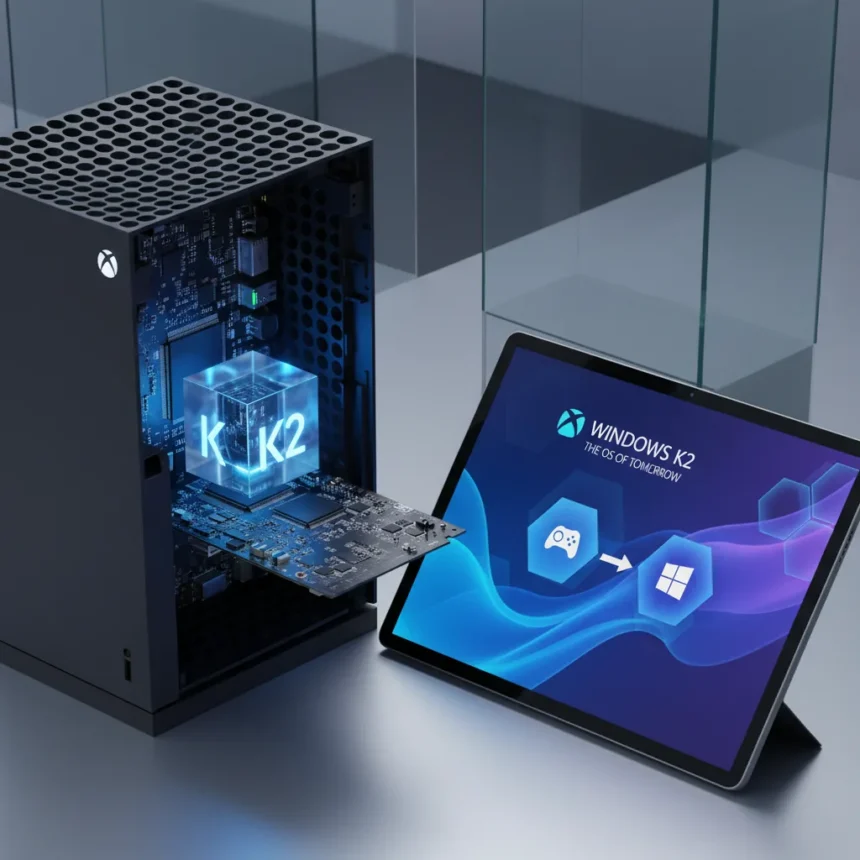
Windows K2 Xbox integration is reshaping how Microsoft approaches its gaming ecosystem. The next-generation Xbox, expected to launch in late 2027 at the earliest, will be a full Windows PC—not a dedicated console. This architectural shift forces Microsoft to confront a painful reality: Windows 11 must become a gaming platform worthy of the Xbox brand, or the entire strategy collapses.
Key Takeaways
- Windows K2 is an ongoing initiative to fix Windows 11 quality, reliability, and performance across all hardware tiers
- The next Xbox will run full Windows, making OS quality directly tied to console success
- Xbox Mode, launched April 30, 2026, brings console-style gaming UI to Windows 11 PCs
- Microsoft benchmarks Windows gaming performance against SteamOS, aiming for parity within one to two years
- Windows 10 support ends October 14, 2025, forcing rapid Windows 11 improvements
What Windows K2 Actually Is
Windows K2 is not a new operating system release. It is an ongoing initiative to ensure Windows quality remains consistently high across current and future versions. Microsoft’s focus areas are brutally specific: performance optimization, removing bloat, improving memory efficiency at idle, and ensuring the OS works reliably on both low-end and high-end hardware. After years of Windows 11 criticism—sluggish performance, intrusive ads, feature creep—Microsoft is essentially admitting the OS lost its way.
The timing matters. Windows 10 support ends October 14, 2025, forcing users to upgrade to Windows 11. But user dissatisfaction persists. Windows K2 represents Microsoft’s attempt to make that forced migration feel justified. According to Microsoft’s statement on the Windows Insider program, the company frames this as a collaborative effort: when quality improves, users celebrate; when it falls short, users push for fixes. This is a culture shift for a company that spent years chasing AI integration while the foundation cracked.
How Xbox Mode Signals the Real Strategy
Xbox Mode launched April 30, 2026, rolling out with the May 2026 Security Update (versions 25H2 and 24H2). Originally called the Xbox Full Screen Experience, this feature brings a console-style gaming interface to Windows 11 PCs. It is the visible proof of Windows K2’s gaming-first philosophy.

But here is the catch: Xbox Mode is still a work in progress and will require substantial refinement before the next Xbox ships. This is not a finished product. It is a test bed. Every bug fixed, every performance gain achieved, every UI refinement made to Xbox Mode on Windows 11 directly feeds into the next Xbox’s development. The console and the OS are now inseparable.
The Next Xbox Problem: Windows as a Console Platform
Making the next Xbox a full Windows PC solves one problem and creates another. Windows PC gaming is fragmented. Hardware varies wildly. Driver support is inconsistent. User expectations differ from console players who expect uniform performance and experience. A console buyer expects the same game to play identically on their device as everyone else’s. A Windows PC gamer expects to tweak settings, install mods, and deal with driver updates.


Microsoft views SteamOS as the performance benchmark for Windows gaming. SteamOS is Valve’s Linux-based OS optimized exclusively for gaming. It is lean, fast, and purpose-built. Windows is none of those things—yet. Microsoft aims to achieve comparable gaming performance on identical hardware within one to two years. This is where Windows K2 becomes existential. If Windows cannot match SteamOS’s gaming performance, the next Xbox will feel like a compromised PC, not a proper console.
The Windows 10 Legacy Problem
Windows 10 is often found to be faster than Windows 11 in certain benchmarks. This is a catastrophic messaging problem for Microsoft. Users are literally choosing to stay on an older OS because it performs better. Windows K2 must reverse this trend entirely. By the end of 2026 and into 2027, Windows 11 needs to be demonstrably faster, more reliable, and less bloated than Windows 10. Otherwise, the next Xbox will launch on an OS users actively distrust.
Why This Matters Right Now
The convergence of three deadlines creates urgency. Windows 10 support ends October 2025. Xbox Mode rolled out April 2026. The next Xbox arrives late 2027. Microsoft is compressed into an 18-month window to prove Windows 11 can be both a gaming platform and a general-purpose OS without compromising either. Fail, and the next Xbox launches on an OS with reputation damage that no amount of hardware power can overcome.
Can Windows K2 Actually Succeed?
Microsoft has the resources and motivation. The company is establishing a dedicated quality task force, prioritizing OS fundamentals over AI integration for the first time in years. But culture change is slow. Windows 11 accumulated its problems through years of neglect. Fixing them in 18 months is ambitious. The controlled feature rollout approach Microsoft uses means features may take months to reach all users, compressing the timeline further.


The real test is whether Xbox Mode feels like a native console experience or like Windows 11 wearing a costume. If it feels like the latter, users will notice immediately. And if Xbox Mode feels compromised, confidence in the next Xbox will suffer before it even launches.
Is Windows K2 just about gaming?
No. Windows K2 aims to improve Windows 11 across all use cases—productivity, general computing, and gaming. However, the next Xbox launch makes gaming the most visible and critical priority. Success on gaming will determine whether users trust Windows 11 for other tasks.
When will the next Xbox launch?
Microsoft expects the next Xbox to launch in late 2027 at the earliest. This timeline gives Windows K2 roughly 18 months to prove Windows 11 can be a competitive gaming platform before the console arrives.
How does SteamOS compare to Windows for gaming?
SteamOS is optimized exclusively for gaming and typically outperforms Windows on identical hardware. Microsoft views SteamOS as the performance benchmark it must match within one to two years. Windows must achieve this while remaining a full general-purpose operating system, which is a harder problem than SteamOS faces.
Windows K2 is Microsoft’s bet that an OS can be both a flexible computing platform and a competitive gaming platform simultaneously. The next Xbox will either validate that bet or expose it as wishful thinking. The stakes are enormous, and the timeline is unforgiving.
Edited by the All Things Geek team.
Source: Windows Central




