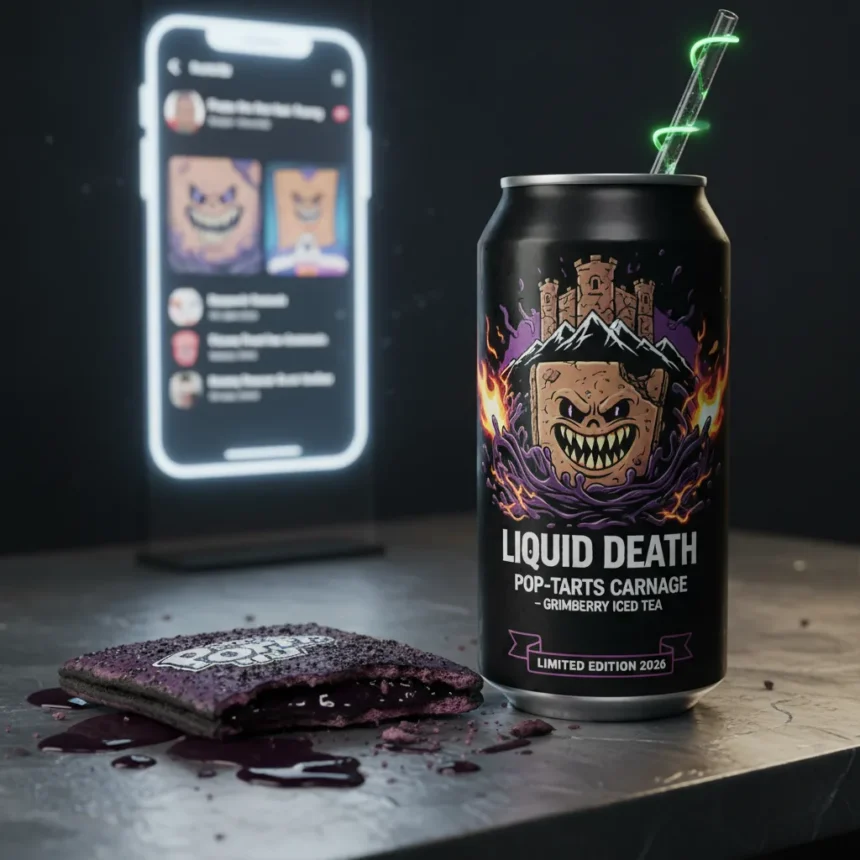
Nostalgia marketing brands are having a moment, and Liquid Death’s April 2026 partnership with Pop-Tarts proves why absurdist humor paired with childhood memories creates irresistible buzz. The collaboration launched a limited-edition sparkling iced tea called Pop-Tarts Carnage, flavored like Frosted Strawberry Pop-Tarts and served in Liquid Death’s signature tall boy can with death metal imagery. This is not a accident—it is a calculated play on the “kidult” market, where adults aged 25-45 spend premium dollars on nostalgic collectibles that feel transgressive and fun.
Key Takeaways
- Pop-Tarts Carnage launched April 16, 2026, as a limited-edition sparkling iced tea with strawberry flavor and 75% less sugar than competing iced teas.
- Liquid Death’s campaign positions the drink as an escape from boring adulthood via chaotic, comedic marketing featuring a promo video with product transformations.
- This is Liquid Death’s fourth major collaboration in 18 months, following Fruity Pebbles, e.l.f. Cosmetics, Spotify, and Burton.
- The kidult market for premium nostalgic collectibles is growing at record pace, with influencer and brand collaborations projected at a $34 billion industry in 2026.
- 66% of marketers report that funny content drives the highest engagement, validating the campaign’s comedic core.
Why Nostalgia Marketing Brands Work Right Now
The brilliance of nostalgia marketing brands lies in emotional shorthand. Pop-Tarts are instantly recognizable to anyone who grew up in the 1990s or 2000s, and Liquid Death weaponizes that familiarity by wrapping it in irreverent branding that signals “this is not for your parents.” The sparkling iced tea itself contains green tea caffeine and B vitamins with no artificial sweeteners, positioning it as a functional beverage disguised as junk food nostalgia. That contradiction—premium health ingredients wrapped in a childish, chaotic aesthetic—is the entire appeal. You are not buying a drink. You are buying permission to reject boring adulthood.
Andy Pearson, VP of Creative at Liquid Death, told Adweek that the team spent last year exploring breakfast-themed collabs for its iced tea line, and Pop-Tarts immediately resonated because the brand “has been making great creative work over the past few years”. This is a crucial detail: Liquid Death did not just grab a famous name. They partnered with a brand that already speaks the language of absurdist marketing. Pop-Tarts has been leaning into irreverent humor for years, making them a natural cultural ally rather than a corporate transaction.
How Liquid Death Built a Collab Empire
Pop-Tarts Carnage is not Liquid Death’s first rodeo with licensed flavors. The company has executed a Fruity Pebbles iced tea in 2025, collaborated with e.l.f. Cosmetics on a Corpse Paint makeup collection, partnered with Spotify on an Eternal Playlist urn, and worked with Burton on a coffin-shaped snowboard. Each collab follows the same formula: take an iconic brand or product, recontextualize it through Liquid Death’s death metal lens, and create enough chaos to drive social media conversation. The strategy works because it signals that Liquid Death is not a serious beverage company trying to be edgy—it is a brand that genuinely enjoys the absurdity.


The broader trend reveals something important about 2026’s influencer and brand collab landscape. Licensed collaborations have shifted from energy drinks and protein powders to unexpected beverage pairings, because novelty drives instant curiosity. However, one critical question remains unresolved: whether these collabs create lasting consumer habits or just fleeting collector’s items. Liquid Death’s simultaneous Feastables collaboration—a chocolate-peanut-butter sparkling water—targets the same curiosity-driven audience but with a different flavor profile, suggesting the brand is hedging its bets.
The Mechanics of Viral Nostalgia Marketing Brands
The campaign’s promo video is deliberately chaotic, showing people transforming into “toaster-pastry-loving degenerates” in scenes that feel like a parody of corporate wellness videos. This inversion is key: instead of selling you a product that will make you better, Liquid Death sells you a product that will make you weirder and happier about it. The messaging positions Pop-Tarts Carnage as an escape hatch from the demands of responsible adulthood—a small, affordable rebellion available on Amazon.



The limited-edition scarcity model amplifies urgency. Pop-Tarts Carnage is not a permanent menu addition; it is a collector’s item with accompanying merch like branded shirts and stickers. This scarcity-driven approach taps into the kidult market’s psychology: adults who grew up with abundance now crave exclusivity and novelty as markers of cultural participation. They want to own something their peers do not have yet. Nostalgia marketing brands succeed when they pair childhood memory with adult purchasing power and social currency.
Is This Strategy Actually Genius, or Just Hype?
The honest answer is both. The collab demonstrates sophisticated understanding of viral mechanics and audience psychology. Marketing data shows that 66% of marketers report funny, irreverent content drives the highest engagement, and Liquid Death’s absurdist tone aligns perfectly with that insight. The influencer and brand collab industry is projected to hit $34 billion in 2026, meaning Liquid Death is surfing a genuine wave rather than inventing one.
However, the distinction between instant curiosity and long-term success matters. A limited-edition drop can sell out in days while failing to create repeat customers. Liquid Death’s track record suggests it understands this: the company has moved beyond its original canned water product into sparkling teas, energy drinks, and licensed collaborations, building a platform rather than relying on a single gimmick. Pop-Tarts Carnage works because it fits into a larger ecosystem of Liquid Death products and marketing moves, not because the collab alone is genius.
How Pop-Tarts Carnage Fits the Broader 2026 Beverage Landscape
The beverage industry is crowded, and nostalgia marketing brands offer a shortcut to attention. Instead of building brand awareness from scratch, companies license iconic products and recontextualize them through unexpected brand lenses. Pop-Tarts Carnage benefits from decades of Pop-Tarts brand equity while Liquid Death contributes its distinctive visual and cultural identity. Neither brand could have achieved the same impact alone.


The 75% less sugar positioning also matters in a health-conscious market. Liquid Death can claim functional benefits—caffeine, B vitamins, no artificial sweeteners—while maintaining the junk food nostalgia. This allows adult consumers to rationalize the purchase as a premium beverage rather than pure indulgence, even though the appeal is fundamentally emotional.
Does Pop-Tarts Carnage actually taste good?
The research brief does not include taste testing data or consumer reviews, so this question cannot be answered with certainty. What matters for the collab’s success is not whether the drink tastes exceptional, but whether it tastes interesting enough to justify the novelty purchase and share-worthy enough to generate social media conversation. Liquid Death’s track record suggests the company prioritizes cultural impact over taste refinement.
Why did Liquid Death choose Pop-Tarts over other breakfast brands?
Andy Pearson explained that Pop-Tarts came up during the team’s exploration of breakfast-themed collabs, and the brand resonated because it already speaks the language of creative, irreverent marketing. Pop-Tarts has been making bold creative work in recent years, making them a cultural fit rather than just a famous name. The partnership felt like a natural pairing rather than a forced corporate transaction.
Will Pop-Tarts Carnage become a permanent flavor?
The sources describe Pop-Tarts Carnage as a limited-edition drop, suggesting it will not become a permanent menu item. Liquid Death’s strategy relies on scarcity and exclusivity to drive urgency. Once the limited run sells out, the drink becomes a collector’s item rather than a commodity, which is exactly the point for the kidult market.
Liquid Death’s Pop-Tarts Carnage succeeds because it understands that nostalgia marketing brands work best when they pair authentic brand alignment with cultural irreverence and scarcity-driven urgency. The collab is not genius because it invented a new marketing category—it is genius because it executed an existing category with precision and self-awareness. In a beverage market flooded with functional drinks and premium water, absurdist humor and childhood memory remain the most reliable tools for cutting through noise and driving conversation.
Edited by the All Things Geek team.
Source: Creativebloq