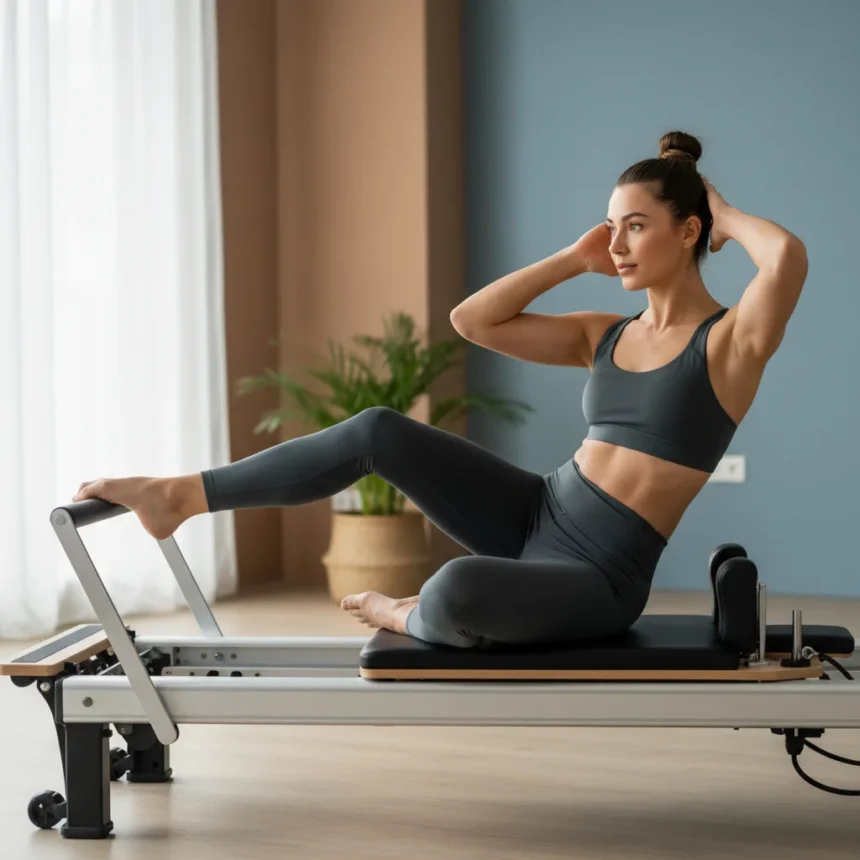
The Pilates bicycle crunch is a slow, controlled movement that targets your internal and external obliques while building deep core strength, all without the spinal compression of traditional crunches and sit-ups. Performed lying on your back with legs in tabletop position, this bodyweight exercise demands precision over speed—exactly what makes it so effective for sculpting definition and stability.
Key Takeaways
- The Pilates bicycle crunch targets internal and external obliques plus transverse abdominis with minimal spinal stress.
- Slow tempo (2-4 seconds up, 1-3 second hold, 2-4 seconds down) maximizes muscle engagement and control.
- Requires no equipment; progressions include ankle weights, medicine balls, or single-leg variations.
- Recommended 3-4 sets of 10-15 reps per side, 2-3 times weekly for best results.
- Safer alternative to traditional crunches, Russian twists, and high-impact abs routines.
Why the Pilates bicycle crunch outperforms traditional crunches
Traditional crunches and sit-ups rely on spinal flexion—repeatedly bending your spine forward—which concentrates stress on your lumbar discs and neck. The Pilates bicycle crunch takes a different approach. By combining controlled rotation with flexion while your legs remain in tabletop position, you engage your obliques dynamically without the repetitive spine compression. Your deep stabilizer muscles, particularly the transverse abdominis, fire throughout the entire movement, building functional strength that translates to better posture and injury prevention.
The key difference lies in intent. Crunches chase reps; the Pilates bicycle crunch prioritizes control. A 2-4 second lift, a 1-3 second pause at the top, and a deliberate 2-4 second lower create constant tension on your muscles. This slow tempo forces your obliques to work harder because you cannot use momentum. The result is more muscle fiber recruitment in fewer reps, making it far more efficient than rushing through twenty sloppy crunches.
How to perform the Pilates bicycle crunch with proper form
Start by lying flat on your back with knees bent and feet flat on the floor. Engage your core by drawing your navel toward your spine—this braces your deep abdominals before you even move. Place your hands lightly behind your head with elbows wide, or rest them at your temples. Critically, avoid pulling on your neck; your hands should provide minimal support, not traction.

Lift your feet off the floor into tabletop position: knees bent at 90 degrees directly over your hips, shins parallel to the floor. Keep your low back pressed into the mat throughout. Inhale to prepare. Exhale as you slowly curl your head, neck, and shoulders off the mat over 2-4 seconds. Simultaneously rotate your torso to the right, bringing your left elbow toward your right knee while extending your left leg straight out at a 45-degree angle—hover it without touching the floor. Hold this position for 1-3 seconds, squeezing your obliques hard. Keep your gaze forward and your neck long; do not crane your chin toward your chest.
Inhale as you slowly return to the starting position over 2-4 seconds, then immediately switch sides. Bring your right elbow toward your left knee while extending your right leg. Complete 10-15 reps per side, focusing on control and oblique engagement rather than speed. The movement should feel deliberate and challenging, not rushed.



Progressions to intensify your Pilates bicycle crunch
Once you master the basic form, five progressions allow you to increase difficulty without changing the core movement. First, slow your eccentric (lowering) phase to a full 4 seconds—this extended time under tension amplifies muscle activation. Second, pause for 3 full seconds at peak contraction, squeezing your obliques maximally before returning. Third, extend your leg lower, bringing it parallel to the floor instead of at 45 degrees; this increases the lever arm and demands more core stability.
For weighted progressions, hold a light medicine ball at your chest during the crunch, or add ankle weights to your extended leg. Start light—a 3-5 pound medicine ball or 2-3 pound ankle weights—and focus on maintaining perfect form. Finally, try the single-leg variation: keep your non-working leg in tabletop position while extending the other leg, forcing your obliques to stabilize asymmetrically. This variation builds rotational strength and addresses muscle imbalances.
Pilates bicycle crunch vs. other core exercises
Russian twists, a popular oblique exercise, demand more rotational stress on your spine and less controlled range of motion. Side planks excel at building lateral stability but lack the dynamic muscle-sculpting action of the bicycle crunch. Traditional crunches, as discussed, compress your spine repeatedly. The Pallof press, an anti-rotation hold, strengthens your core’s ability to resist rotation but does not create the same visual oblique definition as the bicycle crunch’s combination of flexion and rotation.
Bird dog crunches balance core activation across multiple planes but are less oblique-specific than the Pilates bicycle crunch. For pure oblique sculpting and deep core strength, the bicycle crunch stands out because it targets both your external obliques (the visible muscles on the sides of your abdomen) and your internal obliques (the deeper stabilizers beneath them) in a single, efficient movement.



Recommended frequency and rep scheme
Perform the Pilates bicycle crunch 2-3 times per week, allowing at least one rest day between sessions. Complete 3-4 sets of 10-15 reps per side. If you are new to the movement, start with 2 sets of 8-10 reps per side and build up as your control improves. Never sacrifice form for higher reps; a set of 10 perfect, slow bicycle crunches beats 20 sloppy ones. Rest 30-60 seconds between sets to maintain quality.
Pair the Pilates bicycle crunch with complementary core work—planks for stability, dead bugs for coordination, or pallof presses for anti-rotation strength. This balanced approach prevents imbalances and builds a truly functional core.
What equipment do you need for the Pilates bicycle crunch?
None. The Pilates bicycle crunch is a pure bodyweight exercise requiring only your body and a mat or soft surface. Optional progressions like ankle weights (typically $10-20 USD) or a medicine ball ($15-30 USD) are widely available at fitness retailers and online, but they are not necessary to see results. The slow, controlled tempo of the basic movement is challenging enough for most people.
Can beginners do the Pilates bicycle crunch safely?
Yes, but form is essential. Before attempting this exercise, ensure you can perform a basic crunch without neck strain and hold a plank for at least 20 seconds. If you are returning from a back injury, pregnant, postpartum, or new to exercise, consult a qualified fitness professional or physical therapist before starting. Start with 2 sets of 8 reps per side and prioritize slow, controlled movement over higher rep counts. Avoid pulling on your neck, arching your low back off the mat, or rushing the tempo.
How long before you see results from the Pilates bicycle crunch?
Visible oblique definition typically appears after 4-6 weeks of consistent training, assuming you combine this exercise with a balanced diet and overall core routine. You will feel core activation immediately, but muscular changes take time. Consistency matters far more than intensity; three focused sessions weekly with perfect form outperforms sporadic high-rep attempts.
The Pilates bicycle crunch represents a fundamental shift in how people think about core training. Rather than chasing high-rep ab work that stresses your spine, this slow, controlled movement builds the strength and definition you actually want while protecting your back. If you have abandoned crunches because they hurt your neck or lower back, this is your answer.
Edited by the All Things Geek team.
Source: Tom's Guide