





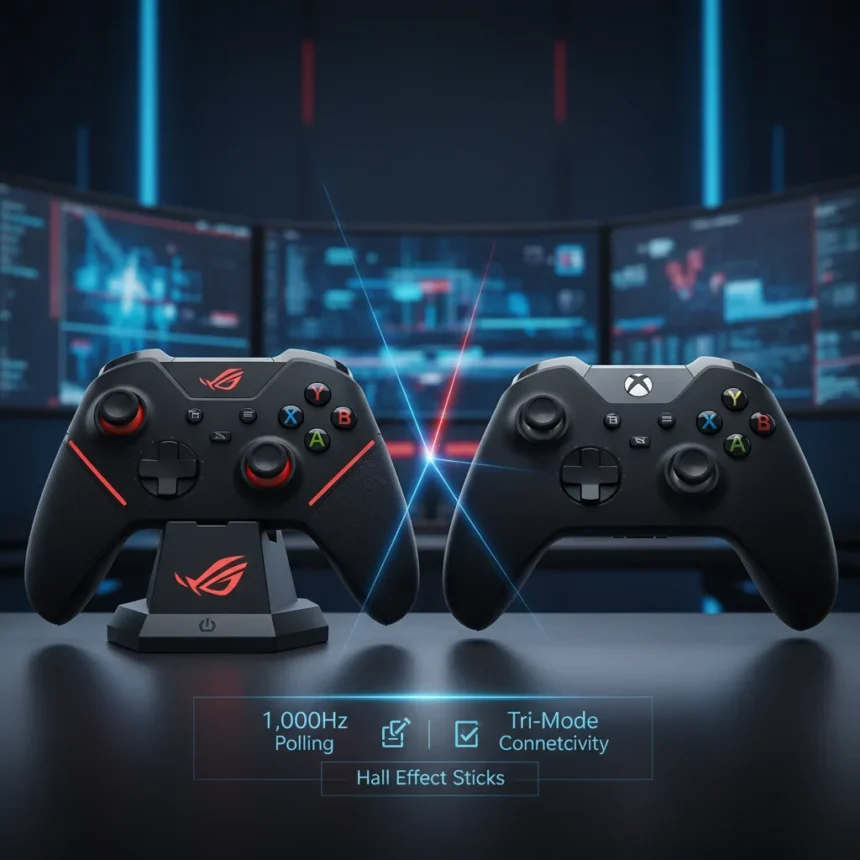
The Asus ROG Raikiri II is a premium gaming controller built for competitive play, featuring Hall Effect sticks, TMR triggers, 1,000Hz polling rate technology, and tri-mode connectivity designed to challenge the Xbox Elite 2’s dominance in the high-end controller market.
Key Takeaways
- 1,000Hz polling rate delivers sub-millisecond input latency for esports performance
- TMR Hall Effect sticks and triggers eliminate traditional potentiometer drift concerns
- Tri-mode connectivity (Bluetooth, low-latency RF, wired USB-C) provides flexibility across gaming setups
- 1.3-inch OLED display inherited from ROG Raikiri Pro adds customization and status monitoring
- Xbox-style form factor with 3.5mm headphone jack and integrated ESS DAC
What Makes the Asus ROG Raikiri II Stand Out
The Asus ROG Raikiri II represents a serious push into premium controller territory, directly positioning itself against the Xbox Elite 2 by addressing the exact pain points competitive players care about: stick longevity, input responsiveness, and connectivity flexibility. Where traditional controllers rely on potentiometer-based analog sticks that degrade over months of heavy use, the Raikiri II’s TMR Hall Effect technology uses magnetic sensors instead—eliminating the mechanical wear that causes drift. The same durability advantage applies to the triggers, which use TMR mechanisms rather than traditional contact-based designs.
The 1,000Hz polling rate is the headline specification here. Most mainstream gaming controllers poll at 125Hz, meaning they report stick and button inputs eight times per second. The Raikiri II’s tenfold increase means input data refreshes every millisecond—critical for fighting games, first-person shooters, and rhythm titles where frame-perfect inputs matter. In a competitive esports context, that latency reduction can mean the difference between landing a crucial ability or missing the window entirely.
Connectivity and Display Features
The Raikiri II’s tri-mode connectivity system—Bluetooth, low-latency RF via USB dongle, and wired USB-C—gives players genuine flexibility that the Xbox Elite 2 cannot match. Bluetooth works for casual couch gaming but introduces variable latency; the proprietary RF mode locks in sub-5ms latency for competitive play; wired USB-C eliminates any wireless uncertainty for tournament settings. The 1.3-inch OLED display, carried over from the original ROG Raikiri Pro announced at CES 2023, lets players customize button mapping, adjust stick sensitivity curves, and monitor battery status without touching a PC.

The integrated ESS digital-to-analog converter is an unusual inclusion for a controller—typically found in high-end audio gear. It handles the 3.5mm headphone jack, meaning players can connect headsets directly to the controller without relying on separate dongles or console audio routing. For streamers and esports athletes managing multiple audio sources, that integration simplifies cable management.
How It Compares to the Xbox Elite 2
The Xbox Elite 2 remains the reigning standard for premium console controllers, offering extensive customization, replaceable stick modules, and solid build quality at a similar price tier. However, the Raikiri II’s Hall Effect sticks are inherently more durable than the Elite 2’s potentiometer-based design—the Elite’s replaceable sticks actually acknowledge that drift is inevitable, whereas the Raikiri II’s architecture aims to prevent it entirely. The Raikiri II also supports PC gaming natively without requiring Xbox app middleware, making it a cleaner solution for Steam and other PC platforms where the Elite 2 works but feels like a console peripheral forced into a PC ecosystem.
The polling rate difference is stark: 1,000Hz versus the Elite 2’s standard 125Hz input reporting. For esports players, that’s a tangible advantage. The Elite 2 compensates with customizable stick tension and trigger sensitivity, but those are software tweaks—the Raikiri II’s hardware advantage in polling rate is not something firmware updates can replicate on competing controllers.
Build Quality and Everyday Use
The Raikiri II maintains an Xbox-style form factor, so players familiar with Microsoft’s controller layout will feel at home immediately. The button placement, stick positioning, and trigger curve all follow conventions that millions of gamers already know. That familiarity matters—a controller with superior specs is useless if the ergonomics feel alien. The tri-mode connectivity means you can switch between RF mode for competitive play, Bluetooth for portability, and USB-C for wired reliability without swapping hardware.
Battery life is not detailed in available specifications, but the OLED display and 1,000Hz polling rate suggest players should expect moderate runtime—likely comparable to other wireless gaming controllers in the 20-30 hour range. The RF dongle adds one USB port to your PC, though that is a minor inconvenience for the latency gains.
Is the Asus ROG Raikiri II Worth the Investment?
For competitive esports players, the Raikiri II is a no-brainer upgrade path. The combination of Hall Effect durability, 1,000Hz polling, and low-latency RF connectivity addresses the three biggest limitations of mainstream controllers. For casual gamers, the premium price tag and specialized features offer diminishing returns—a standard controller handles single-player games and relaxed multiplayer just fine. But if you are grinding ranked matches in fighting games, competitive shooters, or rhythm titles, the Raikiri II’s hardware advantages are real and measurable.

The tri-mode connectivity is also a practical win for players who game across multiple devices. Switching from PC to mobile to handheld without swapping controllers or re-pairing is a quality-of-life improvement that the Xbox Elite 2 simply does not offer.
How does the Asus ROG Raikiri II compare to the original ROG Raikiri Pro?
The Raikiri II builds directly on the ROG Raikiri Pro announced at CES 2023, inheriting the 1.3-inch OLED display and core Hall Effect stick architecture. Specific improvements in the Raikiri II variant are not detailed in available information, but the progression from Pro to II typically indicates refined trigger response, improved connectivity stability, or enhanced firmware features. If you own the original Raikiri Pro, upgrading depends on whether the specific improvements matter to your play style.
Can you use the Asus ROG Raikiri II on Xbox Series X?
Yes, the Raikiri II is compatible with Xbox Series X and Series S through the standard Xbox controller protocol. However, some advanced features like the OLED display and custom button remapping may have limited functionality on console compared to PC, where the full feature set is accessible through Asus’s control software.
What makes the 1,000Hz polling rate important for gaming?
A 1,000Hz polling rate means the controller reports input data to your PC or console 1,000 times per second, compared to 125Hz on standard controllers. In competitive games where milliseconds determine outcomes, that tenfold increase in input frequency translates to noticeably faster response times. Fighting game players, esports competitors, and precision-focused gamers benefit most from this specification.
The Asus ROG Raikiri II is not a gimmick—it is a purpose-built tool for players who demand every millisecond of advantage. Whether you need it depends entirely on your competitive ambitions, but for serious esports players, it delivers measurable improvements over the Xbox Elite 2 where it matters most.
Where to Buy
$149.99 at Amazon | $160.99 at Amazon | $189 | $189 | £180
Edited by the All Things Geek team.
Source: Tom's Guide




