





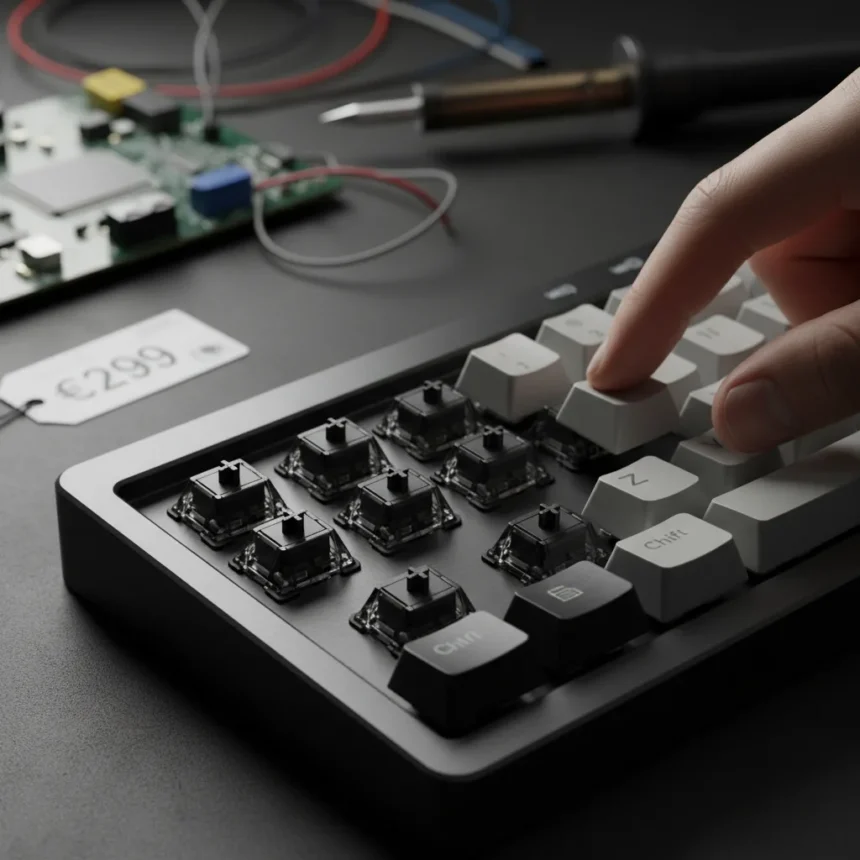
The Cherry KW 300 MX is a mechanical keyboard with responsive Cherry MX switches and a thocky sound profile, designed for typists and Mac users seeking premium typing feel. It includes macOS keycaps for seamless compatibility and delivers a genuinely lovely typing experience. Yet at its price point, the KW 300 MX stumbles on details that should be non-negotiable for a premium board.
Key Takeaways
- Cherry KW 300 MX features responsive MX switches with a satisfying thocky sound profile.
- Includes macOS keycaps, making it a natural fit for Apple ecosystem users.
- Delivers excellent typing quality but has drawbacks that undermine its premium positioning.
- Competitors like Cherry KW X ULP and Keychron V6 offer better value at lower price points.
- Premium pricing demands perfection—this board leaves room for improvement.
What Makes the Cherry KW 300 MX Stand Out
The Cherry KW 300 MX’s defining strength is its switch quality and acoustic signature. The responsive Cherry MX switches deliver the kind of tactile feedback that makes typing feel deliberate and satisfying. The thocky sound profile—that deep, resonant bottom-out tone—is exactly what mechanical keyboard enthusiasts chase. For anyone who spends hours writing, coding, or messaging, the KW 300 MX makes each keystroke feel intentional.
The inclusion of macOS keycaps is a thoughtful touch that sets this board apart from generic mechanical keyboards. Rather than forcing Mac users to mentally translate Windows-centric legends, the KW 300 MX speaks their language out of the box. This attention to ecosystem compatibility shows Cherry understands its audience.
Where the Cherry KW 300 MX Fails to Justify Its Price
Premium pricing demands near-perfection. The Cherry KW 300 MX falls short in ways that leave a lot to be desired. The research brief does not specify which particular aspects disappoint, but the gap between its excellent switch performance and its overall execution is the real story here. When you are paying more than comparable boards, every element—build quality, stabilizers, case construction, software—must deliver.


This is where the KW 300 MX stumbles. It asks you to pay premium prices while accepting compromises that competitors have already solved. The Cherry KW X ULP, for instance, offers sleek low-profile MX ULP tactile switches with superior typing feel, though at a higher price point. Meanwhile, the Cherry MX 3.1 delivers full-size MX2A switches at just $119, undercutting the KW 300 MX significantly. If you are willing to explore beyond Cherry’s own lineup, the Keychron V6 offers more customization at an even lower price, suggesting the mechanical keyboard market has moved past the KW 300 MX’s value proposition.
How Cherry KW 300 MX Compares to Real Alternatives
The mechanical keyboard market has fragmented into clear tiers. At the budget end, the Cherry MX 3.1 at $119 provides solid MX2A switches in a full-size format, though it lacks gaming-focused features. The Cherry KW X ULP at $187 steps up with low-profile tactile switches and a sleeker design, but its non-adjustable backlighting becomes a frustration if you care about RGB customization. For portability, the Cherry KW 7100 Mini BT trades mechanical switches for rubber dome SX Scissor switches, making it better suited for commuting than serious typing sessions.



Outside Cherry’s ecosystem, alternatives abound. The Keychron V6 delivers more customization at a lower price than the MX 3.1. The Lemokey L4 pairs smoother switches than Cherry MX Reds with an all-metal construction and dampening system, addressing the very compromises the KW 300 MX seems to embody. Even budget options like the Logitech MX Keys Mini at $99 and Keychron K11 Max at $94 challenge the KW 300 MX’s positioning by delivering solid typing experiences without the premium markup.
Should You Buy the Cherry KW 300 MX?
The answer depends on your priorities. If macOS compatibility is non-negotiable and you value thocky switch feedback above all else, the KW 300 MX delivers on those fronts. The typing experience is genuinely excellent, and the native Mac keycaps save you from workarounds. But if you are price-conscious or willing to tolerate Windows keycaps on a Mac, the Cherry MX 3.1 offers better value. If you want a low-profile board, the KW X ULP is the stronger choice despite its higher cost. The KW 300 MX occupies an awkward middle ground—too expensive to ignore alternatives, yet not quite perfect enough to command premium loyalty.
What makes the Cherry KW 300 MX thocky?
The thocky sound comes from the Cherry MX switch design combined with the keyboard’s case construction and stabilizer tuning. Thocky refers to that deep, resonant bottom-out tone that sounds more like a wooden block than a clicky switch. The KW 300 MX’s switches are engineered to produce this profile, making it appealing to enthusiasts who view sound quality as part of the typing experience.
Is the Cherry KW 300 MX worth the price?
Not unconditionally. While the responsive switches and thocky sound are genuinely excellent, the compromises elsewhere do not justify premium pricing when alternatives like the Cherry MX 3.1, Keychron V6, and Lemokey L4 solve similar problems at lower costs or with better overall execution. If macOS keycaps are essential and you prioritize switch feel above all else, the KW 300 MX makes sense. Otherwise, you are paying for brand prestige more than tangible superiority.



How does the Cherry KW 300 MX compare to the KW X ULP?
The KW X ULP offers a sleeker low-profile design with MX ULP tactile switches, delivering superior typing feel in a more compact form factor. However, it costs more and lacks adjustable backlighting. The KW 300 MX is a full-size board with standard-height switches, making it better for users who prefer traditional keyboard proportions. Choose the KW X ULP if you value portability and tactile feedback; choose the KW 300 MX if you want a standard layout with thocky acoustics.
The Cherry KW 300 MX is a keyboard that nails the fundamentals—switch quality, sound, and Mac compatibility—but falters on the details that separate premium boards from merely good ones. In a crowded market where competitors offer better value or better execution, premium pricing alone is not enough. Cherry built an excellent typing instrument but priced it into irrelevance.
Where to Buy
$149.99 at Amazon | $149 | £139 | $149 | £139
Edited by the All Things Geek team.
Source: Tom's Guide




