





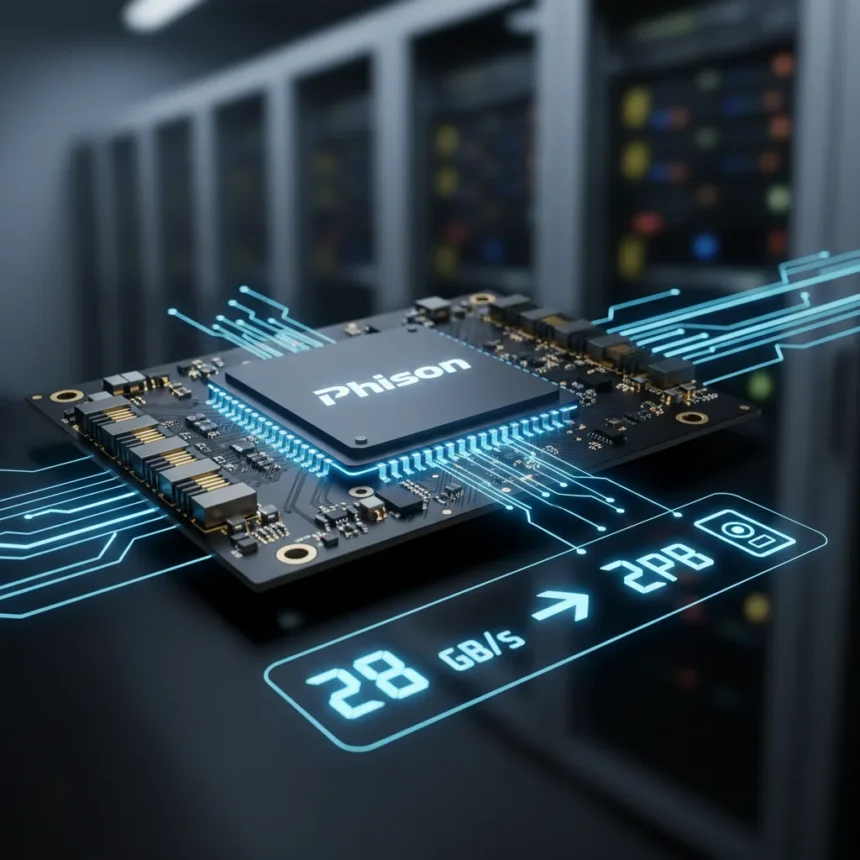
The PCIe 6.0 SSD controller race is on, and Phison has just put its hand up with the X3 — a controller demonstrated at Computex that claims up to 28 GB/s of sequential throughput, 6.8 million IOPS, and support for drives as large as 2 petabytes. Phison is a Taiwan-based storage controller specialist, and the X3 represents its push into the next generation of high-speed enterprise storage. Alongside the X3, Phison also showed the E37T, a new SSD targeting PCIe 5.0 systems with a low 4.5W power envelope.
Key Takeaways
- Phison’s X3 PCIe 6.0 SSD controller claims 28 GB/s sequential throughput and 6.8 million IOPS.
- The X3 supports drives up to 2 petabytes in capacity, pointing squarely at enterprise and data-center use.
- Silicon Motion’s SM8466 is a rival PCIe 6.0 controller targeting similar 28 GB/s speeds, with a claimed 7 million IOPS.
- Phison’s E37T SSD for PCIe 5.0 systems consumes just 4.5W, making it a low-power option for existing platforms.
- Both products were shown at Computex as demonstrations — commercial specs and pricing have not been confirmed.
What the Phison X3 PCIe 6.0 SSD Controller Actually Claims
The Phison X3 is a PCIe 6.0 SSD controller demonstrated at Computex, claiming 28 GB/s sequential throughput and 6.8 million IOPS in random read/write workloads. It also supports capacities up to 2 petabytes per drive. These are vendor-stated figures from a Computex demonstration, not independently validated benchmarks — a distinction worth keeping in mind before anyone starts rewriting their storage procurement plans.
That 28 GB/s figure is significant context. PCIe 5.0 drives currently top out at roughly half that bandwidth in the best consumer implementations, so PCIe 6.0 doubles the theoretical ceiling once again. The jump from PCIe 5.0 to 6.0 follows the same doubling pattern the interface has maintained across generations, and the X3’s claimed numbers sit at the upper end of what that new headroom allows.
The 2 petabyte per drive capacity claim is where the X3’s enterprise intent becomes obvious. No consumer or prosumer workload needs 2PB on a single drive. This is a controller built for data centers, AI training clusters, and large-scale storage arrays — not for gaming rigs or workstations. Phison has been on the PCI-SIG integrators list for PCIe 5.0 SSD controllers since May 2022, so the jump to Gen 6 is a natural progression of an established roadmap.


How the X3 Compares to Silicon Motion’s SM8466
The Phison X3’s closest announced rival is Silicon Motion’s SM8466, which also targets high-end PCIe 6.0 enterprise storage and is reported to reach 28 GB/s sequential throughput and 7 million IOPS. On raw headline numbers, the SM8466 edges out the X3 by 200,000 IOPS — a gap that sounds dramatic but may be irrelevant depending on workload type, firmware maturity, and the NAND each controller is paired with.
What matters more than a 3% IOPS difference is ecosystem and availability. Neither controller has confirmed commercial specifications at this stage. Both are in the demonstration-and-positioning phase that typically precedes a 12-to-18-month runway to actual product launches. The real competition between these two will play out in the drives that storage brands build around them, not in Computex booth claims.



Phison E37T: Why Low-Power PCIe 5.0 SSDs Matter Right Now
The E37T is a PCIe 5.0 SSD that consumes just 4.5W — and that number deserves more attention than it’s getting. Early PCIe 5.0 drives shipped with power consumption figures that alarmed system builders, with some controllers running hot enough to require heatsinks that dwarfed the drive itself. A 4.5W envelope changes that conversation entirely for PCIe 5.0 systems that are already deployed and in production.
PCIe 5.0 is the current mainstream high-performance standard, with platform support across recent Intel and AMD desktop and server platforms. The E37T isn’t chasing headline speeds — it’s targeting the large installed base of PCIe 5.0 systems where thermal and power budgets are real constraints. For dense server configurations or compact workstations, shaving watts per drive slot compounds quickly across dozens of units.
This dual announcement at Computex tells a deliberate story: Phison is playing both the future (X3 for Gen 6 enterprise) and the present (E37T for Gen 5 efficiency). That’s a smarter product strategy than chasing a single headline.
Should You Care About PCIe 6.0 SSD Controllers Yet?
Honestly? Not yet — unless you’re specifying storage infrastructure that won’t ship for another two years. PCIe 6.0 host support isn’t broadly available in commercial platforms, and controller demonstrations at trade shows have a long road between silicon and shipping product. The Phison X3 and its rivals like the SM8466 represent where enterprise storage is heading, not where you can buy today.



For anyone making near-term decisions, the E37T is the more actionable news. PCIe 5.0 is here, the platforms exist, and a low-power drive option addresses a real pain point in current deployments. The X3 is a roadmap signal worth tracking — but tracking, not purchasing.
What is PCIe 6.0 and when will it be available in SSDs?
PCIe 6.0 is the sixth generation of the PCI Express interface standard, doubling the bandwidth of PCIe 5.0. Controllers like the Phison X3 have been demonstrated at trade shows such as Computex, but commercial products with confirmed specifications and availability have not been announced. Enterprise deployments typically follow controller demonstrations by a significant period.
How does the Phison E37T differ from other PCIe 5.0 SSDs?
The Phison E37T targets PCIe 5.0 systems with a 4.5W power consumption figure, which positions it as a low-power option compared to earlier PCIe 5.0 drives that drew considerably more power. This makes it relevant for dense server configurations and compact systems where thermal budgets are constrained. Full commercial specifications have not been confirmed from the Computex demonstration.
Is 6.8 million IOPS from the Phison X3 a verified figure?
The 6.8 million IOPS claim comes from Phison’s own Computex demonstration and has not been independently validated by third-party testing. Silicon Motion’s rival SM8466 claims 7 million IOPS under similar conditions. Both figures should be treated as vendor claims until drives built on these controllers are available for independent review.
The Phison X3 and E37T together make a clear statement: Phison intends to compete at both ends of the performance curve, from future-generation bandwidth records to present-day power efficiency. The X3’s 28 GB/s and 2PB capacity claims are genuinely impressive on paper, but the E37T’s 4.5W figure may be the number that actually ships into real systems first. Watch the E37T — it’s the one that solves a problem people have right now.
Edited by the All Things Geek team.
Source: Tom's Hardware




