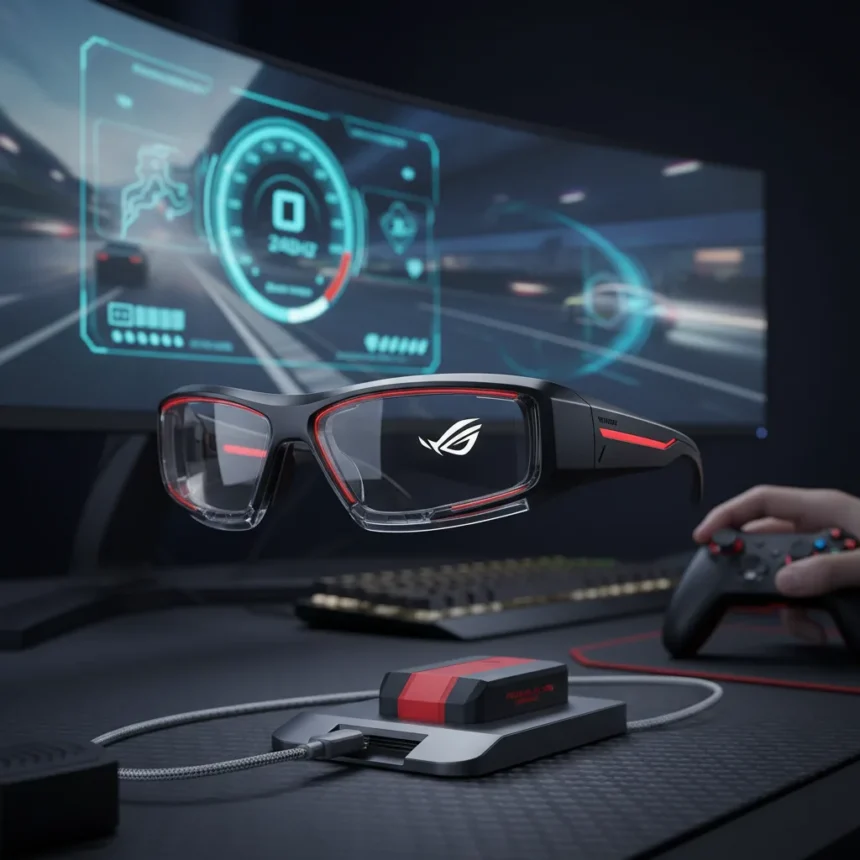
The ROG XREAL R1 AR glasses represent a rare moment in wearable gaming: hardware that actually prioritizes what gamers want instead of chasing productivity features nobody asked for. This collaboration between ASUS ROG and XREAL delivers a 240Hz refresh rate on dual micro-OLED displays, positioning these glasses as the first AR device built specifically for gaming rather than spatial computing or enterprise use.
Key Takeaways
- 240Hz refresh rate on dual micro-OLED displays, the highest in consumer AR glasses.
- 57-degree field of view with optical transparency borrowed from XREAL’s flagship lineup.
- Viewing experience equivalent to a 171-inch display visible only to the wearer.
- Weighs 91 grams with integrated Bose stereo speakers and electrochromic dimming.
- Includes 3DoF tracking but lacks 6DoF support and spatial computing features.
Why 240Hz Matters for Gaming AR
The ROG XREAL R1 AR glasses hit 240Hz refresh rates, a specification that separates gaming hardware from everything else in the AR space. Most AR devices target 60Hz or 90Hz, treating motion smoothness as secondary to battery life and thermal management. ASUS and XREAL flipped this priority. At 240Hz, fast-paced games—shooters, racing sims, action titles—display with the fluidity gamers expect from high-end monitors, not the stuttering compromise typical of mobile AR.
Dual micro-OLED displays power this performance. Micro-OLED technology delivers pixel-perfect blacks and instant response times because each pixel produces its own light. This matters for gaming because there’s no ghosting, no motion blur from LCD backlighting lag. The 57-degree field of view keeps the visual window intimate without feeling claustrophobic, and XREAL‘s optical design—borrowed from their flagship glasses—ensures the image stays sharp across the viewing area.
The viewing experience is equivalent to watching a 171-inch display that only you can see. That scale sounds absurd until you’re in a game where peripheral awareness matters. Racing games benefit from wider visual real estate. Tactical shooters gain from the immersive scope. This is why the ROG XREAL R1 positions itself as a gaming device first and a general-purpose AR tool second.


What the ROG XREAL R1 Sacrifices
These glasses make deliberate trade-offs. The ROG XREAL R1 does not include the XREAL X1 spatial computing chip, which means no advanced object recognition or spatial anchoring. It also does not support the XREAL Eye attachment that enables 6DoF (six degrees of freedom) tracking. Instead, you get 3DoF tracking, which handles head rotation and tilt but not full positional movement through space.
For gaming, 3DoF is sufficient. Most AR games don’t require walking around your living room while the glasses track your exact position in 3D space. They need fast, responsive head tracking so turning your head feels natural in-game. 6DoF tracking and spatial computing are productivity features—useful for pinning virtual windows to walls or anchoring objects to furniture. The ROG XREAL R1 deliberately excludes these to keep cost, weight, and power consumption down.


At 91 grams, they’re about 4 grams heavier than the XREAL One Pro, the flagship model from which XREAL borrowed much of the optical design. That minimal weight difference reflects a focused engineering choice: optimize for gaming performance, not feature bloat. The glasses include Bose stereo speakers for immersive audio and electrochromic dimming, which adjusts the lens tint electronically—useful for controlling ambient light without removing the device.
How They Compare to Other AR Options
The ASUS AirVision M1, ASUS’s previous AR glasses venture, was a productivity play that fell short on both fronts. The ROG XREAL R1 is significantly better because it commits to a single use case instead of trying to be everything. You’re not buying these for email or spreadsheets. You’re buying them for gaming.
The XREAL One Pro remains the flagship for mixed-reality work and spatial computing. It has the X1 chip, 6DoF support, and a broader ecosystem. But the One Pro is not optimized for gaming refresh rates or gaming-specific features. The ROG XREAL R1 wins on gaming performance because it’s not divided between gaming and productivity demands. This is the rare case where specialization beats versatility.
Most AR glasses on the market target either enterprise (Microsoft HoloLens) or general consumers (Apple Vision Pro). The ROG XREAL R1 sits in a narrower lane: gaming-focused AR for people who want high-refresh-rate immersion without the price or spatial computing overhead. That positioning is refreshingly clear.



The Gaming AR Shift
The ROG XREAL R1 signals a market realization that AR gaming was being ignored. For years, AR development focused on spatial computing, productivity, and enterprise use cases. Meanwhile, gamers—who actually buy AR hardware in volume—got scraps. A 60Hz AR game experience is unplayable compared to a 144Hz monitor or a 120Hz mobile game.
ASUS and XREAL recognized this gap. By targeting 240Hz and gaming-specific features, they’re not just releasing another AR device. They’re saying AR gaming is viable as a primary use case, not a secondary feature tacked onto productivity hardware. The 171-inch display equivalent and immersive audio support this thesis. These aren’t specs borrowed from productivity devices—they’re specs built for gaming.
Whether the broader market agrees remains to be seen. AR glasses are still niche. But the ROG XREAL R1 makes a compelling argument that gaming is where AR adoption happens first, not productivity or spatial computing.
Is the ROG XREAL R1 Worth Upgrading To?
If you own the XREAL One Pro or another AR device and game regularly, the ROG XREAL R1 is a meaningful upgrade. The 240Hz refresh rate and gaming-optimized design eliminate the compromises you’ve been tolerating. If you’re new to AR glasses and gaming is your primary interest, these are the device to buy—they’re built for exactly that use case.
If you need spatial computing, 6DoF tracking, or productivity features, stick with the XREAL One Pro or wait for a future gaming device that adds those capabilities. The ROG XREAL R1 is uncompromising in its focus, which is its strength and its limitation.
What makes the ROG XREAL R1 different from the XREAL One Pro?
The ROG XREAL R1 prioritizes gaming performance with a 240Hz refresh rate and gaming-optimized optics. The XREAL One Pro includes the X1 spatial computing chip and 6DoF tracking support, making it better for productivity and spatial anchoring. The ROG XREAL R1 trades those features for faster gaming refresh rates and lighter weight.
Do the ROG XREAL R1 glasses support 6DoF tracking?
No. The ROG XREAL R1 includes 3DoF tracking, which handles head rotation and tilt. It does not support the XREAL Eye attachment that enables 6DoF positional tracking, a deliberate trade-off to optimize for gaming performance instead of spatial computing features.
How do the ROG XREAL R1 compare to the ASUS AirVision M1?
The ROG XREAL R1 is significantly better than the ASUS AirVision M1. The M1 was a productivity-focused device that underperformed in both gaming and work applications. The ROG XREAL R1 commits entirely to gaming with 240Hz refresh rates, superior optics, and gaming-specific features that the M1 lacked.
The ROG XREAL R1 proves that AR gaming doesn’t need to compromise. By focusing exclusively on what gamers actually want—high refresh rates, immersive visuals, and responsive tracking—ASUS and XREAL have created the AR device that should have existed years ago. Whether it becomes mainstream depends on price and availability, but the hardware itself makes the case for gaming-first AR.
Edited by the All Things Geek team.
Source: Android Central