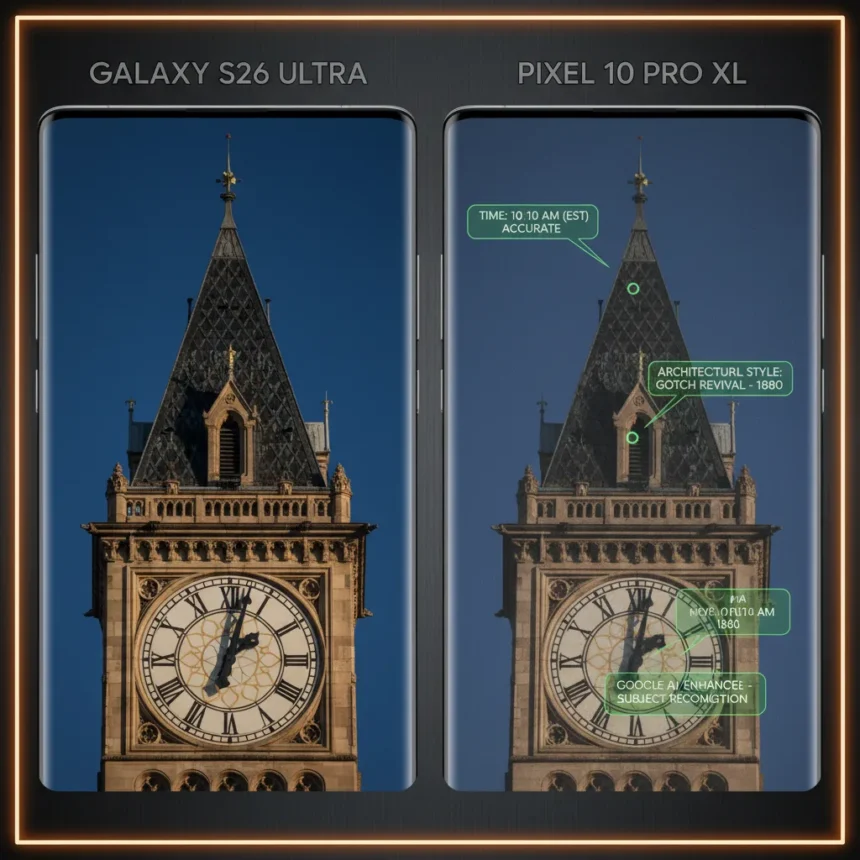
The 100x zoom camera comparison between the Samsung Galaxy S26 Ultra and Google Pixel 10 Pro XL exposes a fundamental tension in mobile photography: raw hardware clarity versus algorithmic refinement. When both flagships push their telephoto capabilities to maximum zoom, one emerges with noticeably sharper, more vibrant shots—but the winner depends entirely on whether you value original images or processed results.
Key Takeaways
- Galaxy S26 Ultra delivers clearer, more colorful 100x zoom photos with less noise in original captures.
- Pixel 10 Pro XL’s AI processing cleans up artifacts at 100x, but original photos lag behind Samsung’s.
- Samsung’s dedicated 3x and 5x telephoto lenses provide flexibility; Pixel relies on AI for consistency.
- At lower zoom levels (ultrawide to 5x), both phones produce nearly identical results.
- Pixel excels in tricky lighting and background detail; Galaxy wins on zoom clarity and color saturation.
100x Zoom Camera Comparison: Raw Performance at Maximum Magnification
At maximum 100x zoom, the 100x zoom camera comparison reveals stark differences in how each phone handles extreme magnification. The Galaxy S26 Ultra, equipped with a 50 MP 5x telephoto lens and 10 MP 3x telephoto, captures images with noticeably greater clarity and color pop compared to the Pixel 10 Pro XL. The Samsung’s zoom photos appear sharper, with more saturated colors and fewer visible artifacts in the original captures. The Pixel 10 Pro XL, which extends its 48 MP 4.5x telephoto through Super Res Zoom and AI upscaling to reach 100x magnification, initially struggles to match Samsung’s raw output. However, when Google’s computational photography processes these shots, much of the noise and distortion disappears, creating a deceptive improvement that masks the original image’s limitations.
This distinction matters because most users viewing their photos on social media or printing them will never see the unprocessed originals. The Pixel’s AI aggressively cleans up the messiness that Samsung leaves visible, which can appear superior to the untrained eye. Yet side-by-side comparisons reveal that Samsung’s approach—prioritizing hardware clarity over post-processing—delivers more authentic detail at 100x magnification.
Why Lower Zoom Levels Show No Clear Winner
Below 10x magnification, the 100x zoom camera comparison becomes irrelevant because both phones perform nearly identically. At ultrawide, standard wide, and even moderate zoom ranges up to 5x, the Galaxy S26 Ultra and Pixel 10 Pro XL produce visually equivalent results. The Pixel’s 50 MP wide camera with an f/1.68 aperture and 1/1.3-inch sensor captures excellent detail, as does Samsung’s 200 MP wide f/1.4 shooter. Where Samsung pulls ahead—through dedicated 3x and 5x telephoto lenses—the Pixel compensates with consistent AI processing that ensures reliable results across varying lighting conditions.


The real divergence emerges at 10x zoom and climbs sharply toward 100x. At these extreme magnifications, Samsung’s hardware advantage becomes undeniable, while Pixel’s computational approach reveals its limitations without aggressive post-processing.
Pixel 10 Pro XL’s Strengths: AI, Consistency, and Tricky Lighting
The Pixel 10 Pro XL does not lose the 100x zoom camera comparison on every metric. Google’s flagship excels where hardware alone cannot: in variable lighting, shadow recovery, and background detail preservation. The Pixel’s multi-zone LDAF (laser detection autofocus) and spectral/flicker sensors enable it to lock focus reliably in challenging conditions where the Galaxy might struggle. At 100x zoom, Pixel’s original photos show more visible shadow detail and sharper contrast, bringing out subtle background elements that Samsung’s processing sometimes flattens.



Additionally, Pixel’s AI-driven noise reduction at 100x is genuinely effective. While the original 100x capture may trail Samsung’s, the processed result often surpasses it in perceived quality for viewers who prioritize a clean, artifact-free image over raw color accuracy. For photographers shooting in unpredictable lighting—sports events, wildlife, dimly lit venues—the Pixel’s reliability and consistent exposure handling make it the more practical choice, even if the Galaxy wins on peak zoom performance.
Galaxy S26 Ultra’s Hardware Advantage and Flexibility
Samsung’s approach to the 100x zoom camera comparison centers on dedicated telephoto optics rather than pure computational prowess. The Galaxy S26 Ultra weighs 214 grams and measures 7.9 mm thick, housing multiple dedicated zoom lenses that provide true optical clarity at intermediate magnifications. This hardware-first strategy means Samsung does not rely as heavily on AI upscaling to achieve usable results at 100x. The Galaxy’s colors display noticeably more saturation and pop, making zoom photos feel more alive and vibrant than Pixel’s more neutral rendering.
The trade-off is flexibility. Samsung’s zoom photos can occasionally appear slightly processed or airbrushed in the background, whereas Pixel’s computational approach maintains more uniform detail across the frame. Yet for users who value color accuracy and immediate visual impact—common priorities for social media sharing—Samsung’s zoom performance wins decisively at extreme magnifications.
Physical Design and Battery Differences
The Galaxy S26 Ultra edges ahead in form factor, weighing 214 grams against the Pixel 10 Pro XL’s 232 grams. Samsung’s phone is also noticeably thinner, making it more pocketable despite housing more zoom optics. Battery capacity slightly favors the Galaxy as well, with a 5,000 mAh cell compared to Pixel’s 5,200 mAh—a negligible difference in real-world use.



Frequently Asked Questions
Which phone wins the 100x zoom camera comparison for everyday users?
The Galaxy S26 Ultra wins if you want visibly sharper, more colorful zoom photos. The Pixel 10 Pro XL wins if you prioritize consistent, reliable performance in mixed lighting and do not mind Google’s more neutral color science. For pure 100x zoom quality, Samsung takes the crown.
Does the Pixel 10 Pro XL’s AI processing make it competitive at 100x zoom?
Yes, but only after processing. The Pixel’s original 100x captures lag behind Samsung’s, but Google’s AI cleans up noise and artifacts effectively, narrowing the gap for final results. If you never view unprocessed images, the Pixel’s output appears more polished.
Are there zoom levels where the Pixel 10 Pro XL is clearly better?
The Pixel excels at lower zoom ranges (ultrawide to 5x) and in challenging lighting conditions where its autofocus and AI exposure handling prevent blown highlights and lost shadow detail. For everyday zoom photography below 10x, the Pixel is equally capable and sometimes more reliable.
The 100x zoom camera comparison ultimately hinges on your priorities. If you demand maximum clarity and color saturation at extreme magnification, the Galaxy S26 Ultra is the obvious choice. If you value consistency, reliability in variable light, and processed-image quality, the Pixel 10 Pro XL remains a formidable competitor—one that processes its way to respectability despite trailing in raw hardware performance.
Edited by the All Things Geek team.
Source: Tom's Guide