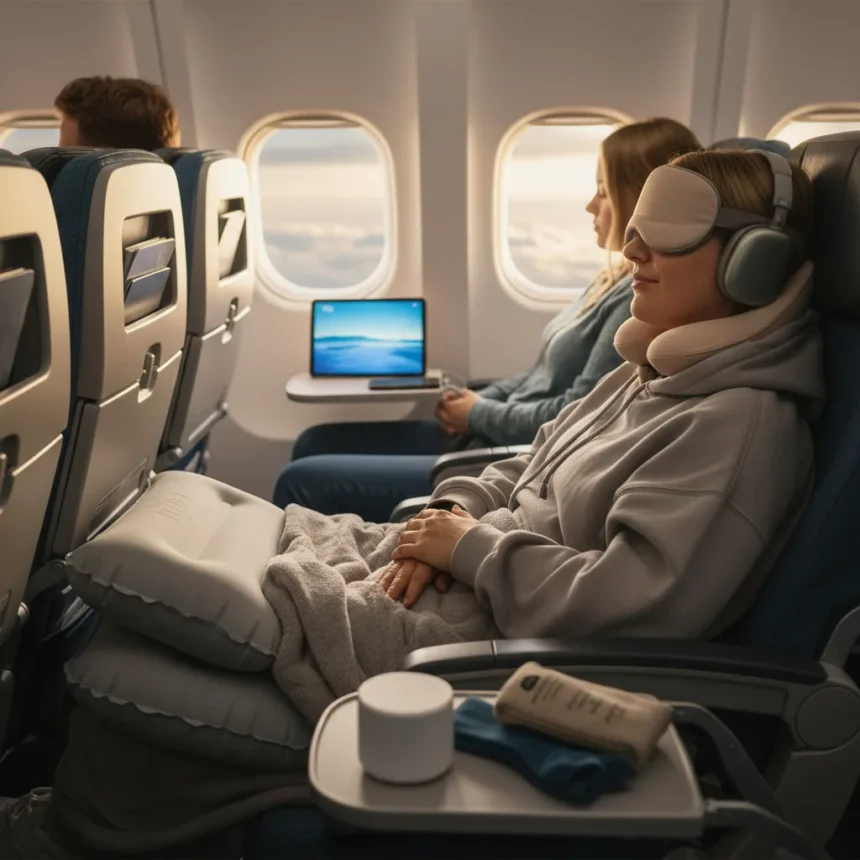
How to sleep on planes is one of the most common travel frustrations, but a recent discovery shows that the right support system can transform your in-flight rest. A foot hammock—a simple device that suspends your feet during flight—has emerged as a significant shift for travelers struggling to find comfort at 35,000 feet. This insight came from a traveler’s recent trip to Taiwan, where the combination of a long flight and strategic positioning revealed what many airlines and sleep experts have long understood: proper body support is the foundation of better plane sleep.
Key Takeaways
- Foot support devices like hammocks can significantly improve comfort during long flights.
- Expert advice on plane sleep includes positioning, timing, and environmental adjustments.
- Common mistakes like fighting your body’s natural sleep rhythm worsen in-flight fatigue.
- Combining multiple hacks—foot support, neck positioning, and timing—yields better results than relying on one method alone.
- Long-haul flights require different strategies than short regional flights.
The Foot Hammock significant shift for In-Flight Comfort
The foot hammock works by suspending your feet and lower legs, reducing pressure on your lower back and preventing the blood pooling that occurs when legs hang unsupported for hours. This simple mechanism addresses one of the biggest complaints travelers make: the inability to find a neutral spinal position in a narrow airplane seat. By elevating and supporting the feet, the hammock allows your lumbar spine to relax into a more natural curve, mimicking the support you’d get from a proper bed pillow.
What makes this approach effective is that it tackles a root cause of plane sleep failure rather than just masking symptoms. While neck pillows and eye masks address specific discomforts, foot support addresses the foundational posture problem that prevents deep sleep. Travelers who’ve adopted this method report falling asleep faster and waking with less stiffness—particularly on flights longer than six hours, where cumulative discomfort compounds.
The Five Core Hacks for Better Plane Sleep
Beyond foot support, travelers and sleep experts recommend a multi-layered approach to in-flight rest. The most effective strategies combine environmental control, timing, positioning, and equipment in a coordinated system rather than relying on any single trick. This integrated approach acknowledges that plane sleep isn’t about one perfect solution—it’s about removing as many barriers as possible.


Timing matters more than most travelers realize. Your body’s circadian rhythm doesn’t shut off just because you’re on a plane, so sleeping when your body expects to be awake creates internal conflict. Aligning your sleep attempt with your destination’s local time—or at minimum, with a consistent sleep window—helps your brain accept that rest is appropriate. This is why sleeping on the outbound leg of a long-haul flight often fails, while sleeping on the return journey succeeds: your body is already primed for the new time zone.
Environmental adjustments—temperature control, noise blocking, and light management—form the second pillar. Airplane cabins are deliberately kept cool to prevent overheating during flight, but this means your body needs extra insulation to feel comfortable. A travel blanket or hoodie creates a microclimate that your nervous system recognizes as a sleep space. Noise-canceling headphones or earplugs eliminate the constant white noise that keeps your brain in a semi-alert state, while an eye mask signals to your brain that it’s nighttime regardless of the cabin’s actual lighting.



Common Mistakes That Sabotage Plane Sleep
Many travelers unknowingly work against their own sleep goals. Fighting your body’s natural inclination to stay awake during a flight—by forcing yourself to close your eyes without addressing underlying discomfort—is one of the biggest mistakes. Your body isn’t being stubborn; it’s responding to legitimate physical signals: a numb leg, a strained neck, or pressure on your lower back. Ignoring these signals and expecting sleep to arrive anyway is a losing strategy.
Another widespread error is over-relying on sleep aids without addressing physical comfort. A sleep medication or melatonin supplement might help you fall asleep initially, but if your body wakes up due to neck pain or lumbar strain after two hours, the chemical help becomes irrelevant. The supplement doesn’t fix the posture problem—it just delays the inevitable discomfort. This is why combining physical support (like foot hammocks and proper pillows) with timing and environment yields better results than medication alone.
Travelers also frequently underestimate hydration and movement. Dehydration thickens your blood and makes it harder for your body to relax, while sitting motionless for eight hours stiffens your muscles and creates the very discomfort that prevents sleep. A simple walk to the lavatory every two hours, plus regular water intake, addresses both issues without requiring equipment or planning.
Expert Perspective on Long-Haul Sleep Strategy
Sleep experts emphasize that plane sleep is a skill, not a talent. Some people naturally fall asleep anywhere; others require deliberate preparation. The difference lies not in willpower but in removing obstacles. Airlines and sleep researchers have observed that passengers who succeed at in-flight sleep share common habits: they arrive at the airport rested (not exhausted), they avoid alcohol and heavy caffeine, they dress in comfortable clothing that doesn’t restrict movement, and they bring equipment that addresses their specific discomfort points.



The foot hammock exemplifies this expert-aligned approach because it targets a specific, widespread problem without adding significant weight to luggage or requiring complicated setup. Compare this to a full-body pillow system or an inflatable mattress topper—both well-intentioned but impractical for most travelers. The foot hammock occupies minimal space, works with any seat, and addresses the lumbar support gap that standard airplane seats create.
Is a foot hammock necessary for better plane sleep?
No, but it addresses a real problem that many travelers face. If you naturally sleep well on planes or have no lower back discomfort, a foot hammock may be unnecessary. However, if you wake with stiffness, struggle to find a comfortable position, or have existing lower back issues, the foot support can be transformative. The device is inexpensive and lightweight, making it worth testing on a long flight before dismissing it.
What’s the best time to sleep on a long-haul flight?
Sleep when it aligns with your destination’s local time, not your departure city’s time. On an eastbound flight (e.g., from North America to Europe), sleeping early in the flight matches the destination’s nighttime. On a westbound flight, sleeping later in the journey aligns better with the destination’s evening. This strategy helps your body adjust to the new time zone faster and produces deeper, more restorative sleep than fighting your internal clock.
Can you sleep well without specialized equipment?
Yes, but it requires more conscious effort. Proper positioning—knees bent, lower back supported by a rolled blanket, head supported by a pillow or jacket—can replicate what equipment provides. The challenge is maintaining this position for six or more hours without your body shifting and creating new discomfort. Equipment like foot hammocks and neck pillows simply automate the comfort maintenance, freeing your brain to focus on sleep rather than position adjustment.
The lesson from the Taiwan trip isn’t that a foot hammock is a miracle cure—it’s that addressing the specific ways airplane seats fail your body transforms your ability to sleep. Whether you use a hammock, a rolled blanket, or a custom pillow, the principle remains the same: identify where your body loses support, fill that gap, and your nervous system becomes willing to rest. Long-haul travel doesn’t require suffering through sleepless nights when practical, inexpensive solutions exist.
Where to Buy
BlueSkye Travel Foot Rest/Foot Hammock: | BASIC CONCEPTS Airplane Foot Hammock: | Gritin 100% Blackout Sleep Mask: | Gritin 100% Blackout Sleep Eye Mask: | Alpine Silence Ear Plugs for Sleep:
Edited by the All Things Geek team.
Source: Tom's Guide