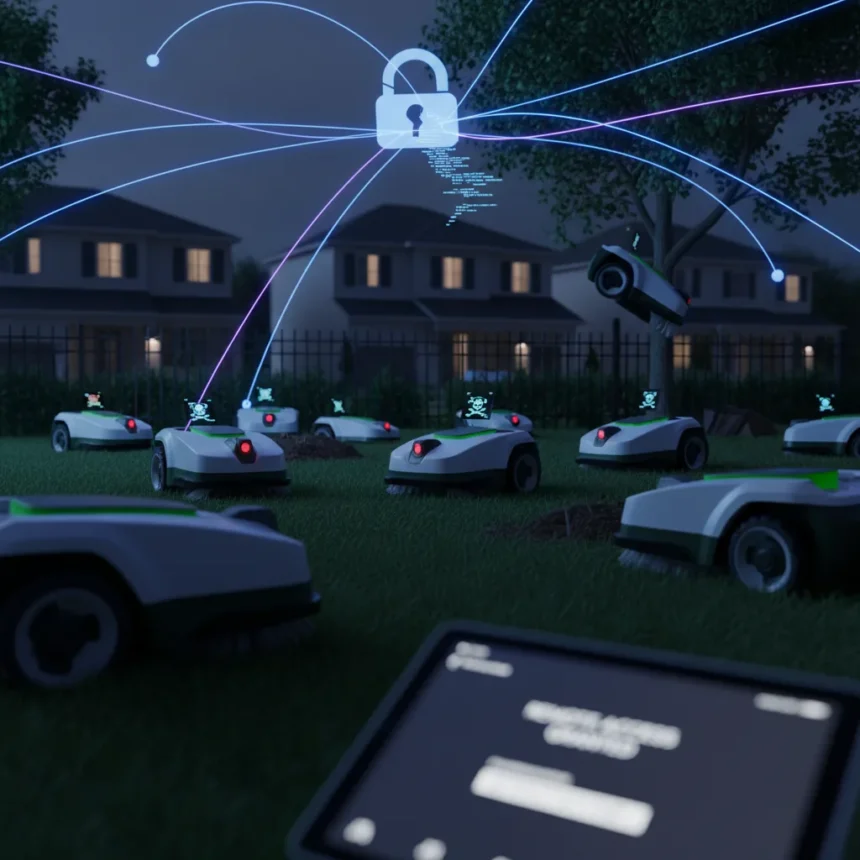
Yarbo robot lawnmowers hijacking has exposed a critical flaw in how consumer IoT manufacturers handle security. Researcher Andreas Makris discovered a method to remotely compromise thousands of Yarbo yard robots worldwide, revealing vulnerabilities that span weak credential management, insecure remote access, and unprotected messaging protocols.
Key Takeaways
- Shared hardcoded root passwords across all Yarbo devices enabled fleet-wide remote access
- Open diagnostic tunnels and persistent backdoors allowed attackers to bypass user visibility and control
- Compromised devices could expose GPS coordinates, Wi-Fi passwords, email addresses, and camera feeds
- Remote hijacking enabled attackers to re-arm mowers after emergency stops, creating physical safety risks
- Yarbo responded with credential resets, tunnel disablement, and plans for unique per-device authentication
How Yarbo Robot Lawnmowers Hijacking Works
The Yarbo robot lawnmowers hijacking attack chain exploits three layers of weakness in the system architecture. First, every Yarbo device shipped with the same hardcoded root password, turning any internet-connected mower into a potential entry point for attackers. Second, persistent remote diagnostic tunnels left the devices accessible even after users thought they had disabled remote features. Third, the MQTT messaging protocol used to communicate between devices lacked meaningful authentication, allowing a single compromised mower to become a bridge into the wider fleet.
Once an attacker gains access to one device, the consequences escalate rapidly. The vulnerability exposes GPS coordinates showing where homeowners live and travel patterns. It harvests Wi-Fi passwords from the mower’s memory, giving attackers credentials to the home network itself. Camera feeds built into the robots become remote surveillance tools. Most alarmingly, attackers can re-arm the blade after a user triggers an emergency stop—transforming a safety mechanism into a liability.
The attack does not require sophisticated exploitation. The shared credentials and open tunnels mean any attacker with basic networking knowledge can reach thousands of devices simultaneously. This is not a zero-day requiring custom malware or deep reverse engineering. It is a design failure that treats security as an afterthought.


Why Yarbo Robot Lawnmowers Hijacking Matters Beyond One Brand
This incident reveals a systemic problem in consumer IoT. Yarbo makes modular yard robots—lawn mowers, leaf blowers, snowblowers, trimmers, and edgers—all sharing the same vulnerable architecture. But Yarbo is not unique in these failures. Shared hardcoded credentials, persistent backdoors, and weak remote access are industry-wide practices. When a manufacturer prioritizes remote diagnostics and serviceability over security, they create a fleet-wide attack surface that grows with every device sold.
The physical component makes this worse than a typical data breach. A compromised smartphone leaks information. A compromised mower can injure someone. The ability to re-arm a blade after an emergency stop crosses from cybersecurity into physical safety. This is why IoT security failures in yard equipment, home automation, and connected vehicles demand different scrutiny than software-only vulnerabilities.



Yarbo’s response, while more transparent than many IoT vendors, also illustrates how reactive the industry remains. The company disabled remote diagnostic tunnels, reset root passwords globally, locked down unauthenticated endpoints, and removed unnecessary legacy access paths. It committed to implementing unique per-device credentials and over-the-air credential rotation. These are fixes that should have been in place at launch, not applied after a security researcher publicly exposed the flaws.
What Yarbo Robot Lawnmowers Hijacking Reveals About IoT Design
The vulnerability chain reflects a common pattern: remote diagnostics and serviceability were prioritized over user control and security. Manufacturers include persistent backdoors because they make it easier to troubleshoot devices in the field. They use shared credentials because unique per-device passwords require more complex manufacturing workflows. They leave telemetry unencrypted because it simplifies data collection. Each decision makes sense in isolation. Together, they create a system where thousands of devices can be hijacked in parallel.
The MQTT messaging weakness is particularly telling. MQTT is a lightweight protocol designed for IoT, but it requires careful configuration to be secure. When implemented without strong authentication, a single compromised device can become a pivot point into the entire fleet. This is not a flaw in MQTT itself—it is a failure of implementation and architecture review. A security audit would have caught this. Yarbo apparently did not conduct one before shipping.
What makes Yarbo robot lawnmowers hijacking a cautionary tale is that it is not exotic. No zero-day exploits. No supply chain attacks. No nation-state involvement. Just basic security hygiene failures that any competent code review would have flagged. The fact that thousands of devices shipped with these flaws suggests security was either deprioritized or absent from the development process entirely.



Is Yarbo’s Response Sufficient?
Yarbo’s mitigation steps address the immediate vulnerabilities but do not fully restore confidence. Disabling remote tunnels and resetting passwords stop the current attack. Locking down unauthenticated endpoints prevents casual access. But the company’s commitment to unique per-device credentials and audited allowlist-based diagnostics is forward-looking—it describes what will happen next, not what has already been fixed. For existing devices in the field, the patches may be incomplete. Users have no way to verify that all backdoors have been closed or that future firmware updates will not reintroduce similar flaws.
The company’s mention of a possible bug bounty program is a step toward accountability, but it comes after the vulnerability was publicly disclosed. A robust bug bounty should have been in place before launch. This is not about punishing Yarbo retroactively—it is about recognizing that consumer IoT security requires structural change, not just incident response.
What Should Yarbo Owners Do Now?
Users with Yarbo robots should ensure their devices are running the latest firmware with the security patches applied. Disable any remote diagnostic features if the option is available. Change the root password if the reset procedure allows user-configured credentials. Most importantly, do not assume the patches have eliminated all risk. The vulnerability exposed that Yarbo’s security model was fundamentally broken. Patches can fix known issues, but they cannot guarantee that other weaknesses do not exist.
Are other robot lawnmower brands vulnerable to similar attacks?
The research brief does not provide specific information about competing brands’ security practices. However, the vulnerabilities in Yarbo—shared credentials, persistent backdoors, weak remote access—are common across consumer IoT products. Any connected yard robot or smart home device using similar design patterns could face comparable risks. Users should scrutinize the security practices of any brand they consider, not assume that Yarbo’s failures are isolated.
Will Yarbo robot lawnmowers hijacking affect the company’s reputation?
The incident has exposed Yarbo to significant reputational damage. Consumers expect smart home devices to be secure, especially equipment with moving blades. The discovery that thousands of devices could be remotely hijacked, with attackers able to manipulate blades and access home networks, will make potential buyers hesitant. Yarbo’s relatively transparent response may help restore some trust, but rebuilding credibility after a security failure of this scale typically takes years, not months.
The Yarbo robot lawnmowers hijacking incident is a watershed moment for consumer IoT accountability. It proves that connected yard equipment is not exempt from the security standards applied to other networked devices. Manufacturers cannot hide behind the assumption that lawn mowers are low-value targets. When thousands of devices can be compromised simultaneously and used to surveil homes or cause physical harm, the security model has failed. Yarbo’s response shows that change is possible, but only after public exposure forces the issue. The industry needs to move toward security-first design before the next researcher finds similar flaws.
Edited by the All Things Geek team.
Source: TechRadar