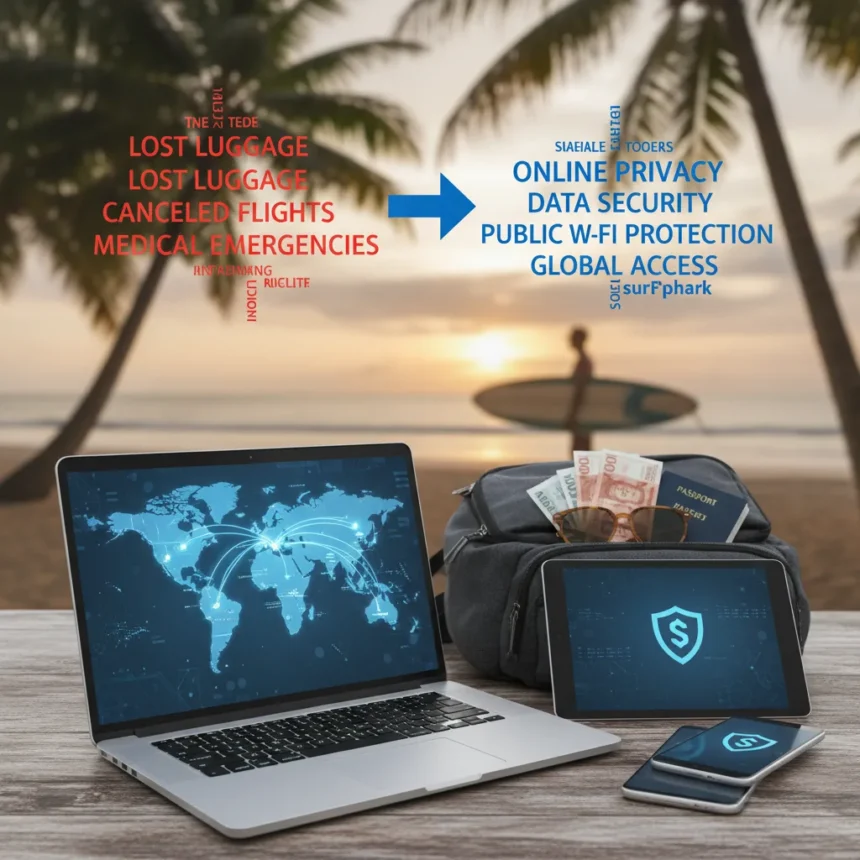
Surfshark VPN is a subscription-based virtual private network service designed to encrypt your internet connection and protect your data while traveling abroad. Most travelers assume conventional travel insurance covers their digital safety, but standard policies focus on trip cancellations, lost luggage, and medical emergencies—leaving data and privacy vulnerabilities unprotected. Surfshark fills that gap, offering encrypted browsing for families and solo travelers at a competitive subscription rate starting at $2.
Key Takeaways
- Travel insurance does not cover digital privacy risks abroad, creating a gap in vacation protection.
- Surfshark VPN encrypts your connection on public Wi-Fi, protecting sensitive data while traveling.
- Unlimited simultaneous device connections make Surfshark ideal for families traveling together.
- Starting price of $2 makes digital protection affordable alongside traditional travel insurance.
- Summer travel season is peak time for data theft on unsecured public networks.
Why Travel Insurance Leaves Data Unprotected
Standard travel insurance protects against trip disruptions and physical emergencies, but it does not cover data breaches, identity theft, or compromised financial information. When you connect to a public Wi-Fi network at an airport, café, or hotel abroad, your unencrypted traffic becomes visible to anyone on the same network. Cybercriminals specifically target travelers because they are accessing banking apps, email, and payment systems on unfamiliar networks. Travel insurance policies explicitly exclude these digital risks because they fall outside the scope of trip protection and medical coverage. This creates a genuine blind spot in vacation safety planning that most travelers overlook until too late.
The distinction matters because data theft abroad can have consequences lasting months or years after your trip ends. A compromised credit card discovered after returning home means disputing fraudulent charges and replacing cards. Stolen login credentials expose email accounts, cloud storage, and social media profiles to unauthorized access. Travel insurance will not reimburse you for these losses because they are classified as cybersecurity incidents, not travel-related claims. This is where a VPN becomes essential—it encrypts your connection regardless of the network’s security level, making your data unreadable to anyone intercepting your traffic.
Surfshark VPN’s Unlimited Device Advantage for Families
Surfshark distinguishes itself from competitors through its unlimited simultaneous device connections policy, a feature particularly valuable for family travel. When multiple family members travel together, each person carries multiple devices—phones, tablets, laptops—that need protection on the same public networks. Traditional VPN services limit concurrent connections to 5 or 6 devices, forcing families to choose which devices get protected and which remain vulnerable. Surfshark removes this constraint entirely, allowing every family member to connect every device simultaneously without hitting a connection cap. This means parents protecting smartphones and work laptops, teenagers streaming on tablets, and grandparents checking email all stay encrypted at the same time, without one person’s connection displacing another’s.


The unlimited device policy also applies after your trip ends. If you purchase Surfshark to protect your family during summer vacation, you retain that unlimited access for all your devices at home indefinitely. This makes the subscription valuable year-round, not just as a travel-specific tool. You can protect your home Wi-Fi network, secure devices used by household members, and maintain encryption across personal and work devices without managing connection limits or deciding which device to prioritize.
Surfshark VPN Pricing and Summer Travel Timing
Surfshark’s subscription starts at $2, positioning it as an affordable addition to your vacation budget. The timing matters because summer is peak travel season, when public networks are most congested and cybercriminals are most active. Airports, hotels, and tourist attractions see millions of travelers connecting to shared Wi-Fi, creating ideal conditions for data interception. By securing your connection before summer travel season, you protect your data during the months when risks are highest. The low entry price removes the objection that digital security is too expensive to justify alongside other travel costs.



The affordability of Surfshark makes it practical to enable protection for every family member without significant expense. A family of four spending two weeks abroad faces genuine data risks on shared networks, but traditional security solutions often cost more than a modest vacation budget allows. At $2, Surfshark becomes a negligible add-on cost compared to flights, accommodation, and activities—yet it provides continuous protection that travel insurance explicitly does not cover.
How Surfshark VPN Differs From Travel Insurance
Travel insurance and VPN protection serve entirely different functions and should be viewed as complementary, not interchangeable. Travel insurance is a financial safety net—it reimburses you if your flight is cancelled, your luggage is lost, or you need emergency medical treatment abroad. A VPN is a preventive security tool—it stops data theft and privacy breaches before they happen by encrypting your connection. You need both because one does not address the risks the other covers. A VPN will not reimburse you for a cancelled hotel booking, and travel insurance will not protect your credit card number on a compromised airport network. The article’s premise—that travel insurance covers only half the risks—reflects this reality: the financial half, but not the digital half. Surfshark addresses the digital half that traditional insurance ignores.
Should You Buy Surfshark VPN for Travel?
If you travel internationally and use public Wi-Fi for banking, email, or shopping, Surfshark VPN is worth the investment. The unlimited device policy makes it especially valuable for families where multiple people need simultaneous protection. The $2 entry price is low enough that even budget-conscious travelers can justify the cost as insurance against data theft. If you primarily use your phone for messaging and streaming, and you avoid sensitive transactions on public networks, the protection is less critical—but still worthwhile as a precaution. The real question is not whether you can afford Surfshark, but whether you can afford the consequences of not using it.
Does Surfshark VPN work on all devices while traveling?
Yes, Surfshark’s unlimited simultaneous connections policy means you can protect smartphones, tablets, laptops, and other devices at the same time without hitting connection limits. This applies whether you are using iOS, Android, Windows, or macOS devices, making it practical for mixed-device families traveling together.



Can travel insurance and VPN protection be used together?
Absolutely. They serve different purposes—travel insurance covers trip disruptions and medical emergencies, while Surfshark VPN protects your digital data on public networks. Using both together gives you comprehensive vacation protection: financial coverage for trip problems and security coverage for data risks.
Is $2 the permanent price for Surfshark VPN?
The $2 rate appears to be a promotional or introductory price tied to summer travel season. Subscription pricing for VPN services typically varies by plan length and promotional periods, so confirm current pricing when purchasing to understand the full terms of your subscription.
Travel insurance and VPN protection are not competing solutions—they are complementary layers of vacation security. While travel insurance handles the financial and medical aspects of trip protection, Surfshark VPN addresses the digital risks that standard policies ignore. For summer travelers using public networks abroad, adding Surfshark to your vacation planning closes the gap that travel insurance leaves open. The unlimited device connections make it practical for families, and the low entry price makes it affordable for any traveler concerned about data security abroad.
Edited by the All Things Geek team.
Source: Tom's Guide