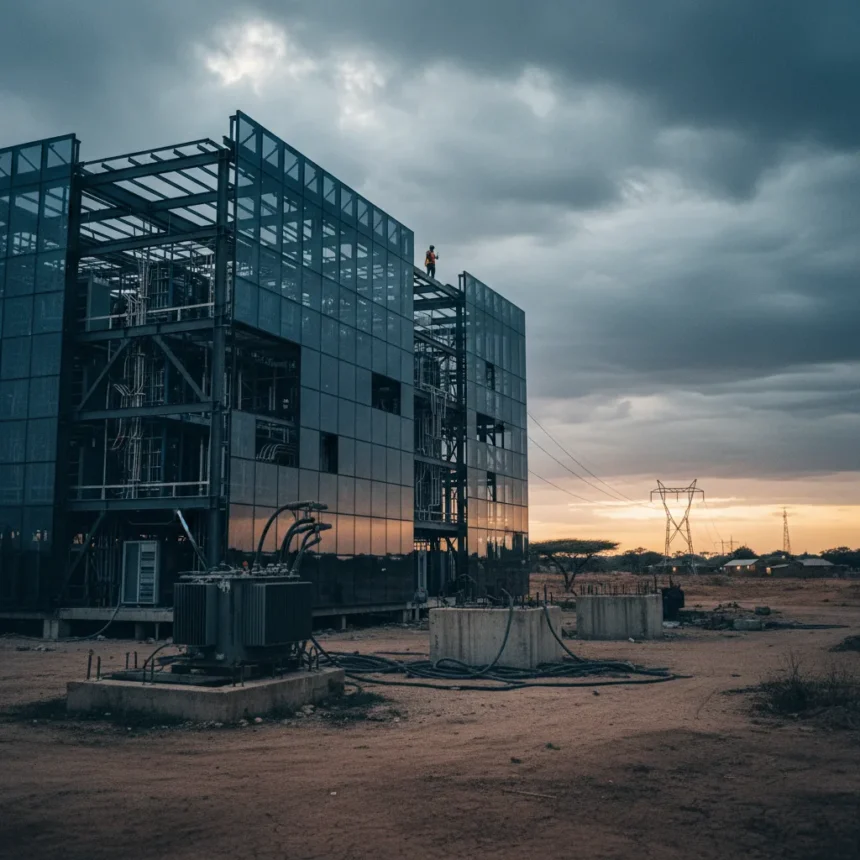
Kenya AI data center power constraints have brought one of Africa’s most high-profile tech investments to a standstill. The proposed $1 billion Microsoft-G42 facility, announced during President William Ruto’s state visit to Washington in May 2024 and planned for a site roughly 100 kilometres northwest of Nairobi, has stalled after Kenya’s government determined the national grid simply cannot support it. Ruto’s own words cut to the heart of the problem: “To switch on that one data centre, we would need to shut off power for half the country.”
Key Takeaways
- The Microsoft-G42 data center project in Kenya is valued at $1 billion and was announced in May 2024.
- Kenya’s installed electricity capacity is about 3,000 megawatts; the proposed facility would consume roughly one-third of that supply.
- President Ruto confirmed the project would miss its original May 2026 completion target.
- A concept note submitted to Kenya’s National Treasury did not receive funding clearance, effectively halting progress.
- Ruto has cited the stalled project to support a national target of increasing power capacity to 10,000 megawatts by 2030.
Why Kenya AI data center power demand is an existential problem
Kenya’s total installed electricity capacity sits at approximately 3,000 megawatts. The proposed Microsoft-G42 facility would have required roughly one-third of that entire supply on its own. That is not a marginal strain on the grid — it is a structural impossibility given current infrastructure, and it explains why Ruto’s reaction was blunt: “That’s when I knew there was a problem”.
The facility was designed to run largely on geothermal energy, which Kenya has in abundance relative to many African nations. That makes the power problem even more striking. It is not that Kenya lacks a viable energy source in principle — it is that the installed generation and distribution capacity has not scaled anywhere near fast enough to accommodate hyperscale computing loads. The gap between ambition and infrastructure is measured in gigawatts.
A concept note for the project was prepared by Kenya’s technology ministry and submitted to the National Treasury for funding approval. It did not receive clearance. Without that green light, construction could not advance, and by August 2025, meetings between Kenyan officials and Microsoft executives had already confirmed the project would miss its original May 2026 completion target. Neither Microsoft nor G42 provided immediate public comment on the situation.

What the stalled project reveals about Africa’s cloud infrastructure gap
The Kenya situation is not an isolated case — it is a warning signal for the entire continent. Demand for AI and cloud services across Africa is rising faster than the infrastructure needed to support them. Hyperscale data centers require not just land and fibre but reliable, high-capacity power delivery at a scale that most African grids were never designed to provide.
Compare this to markets where Microsoft’s Azure expansion has moved faster. In regions with mature grid infrastructure and deregulated energy markets, a data center drawing a third of national electricity capacity would be an engineering challenge, not a political crisis. In Kenya, it becomes a question of whether hospitals, factories, and households keep their lights on. That trade-off is real, and it cannot be engineered away without years of grid investment.



The broader African AI infrastructure story is one of genuine demand colliding with genuine constraint. Kenya’s data center market is projected to grow significantly, but the pace of energy infrastructure development has not matched that trajectory. The Microsoft-G42 project was supposed to deliver Azure cloud services to Kenyan businesses and government institutions — a genuinely useful outcome. The grid is what stopped it, not appetite.
How Kenya plans to close the energy gap
Ruto has not treated the stalled project as an embarrassment. He has used it as a political argument for accelerating Kenya’s national power capacity target: 10,000 megawatts by 2030, more than triple the current installed base of roughly 3,000 megawatts. Whether that target is achievable within the timeline is a separate question, but the logic is sound. Without that kind of capacity expansion, Kenya cannot host hyperscale infrastructure at any meaningful scale.
Geothermal energy remains Kenya’s most credible path to large-scale, low-carbon power generation. The country sits on the East African Rift Valley, one of the world’s most geothermally active zones. Expanding that capacity is a long-term project measured in years and billions of dollars of infrastructure investment — which is exactly why the 2030 target matters, and exactly why a single $1 billion data center cannot simply plug in and go.
Is the Microsoft-G42 Kenya project cancelled?
The project has not been formally cancelled. Progress has stalled because the concept note did not receive National Treasury clearance and because the power supply constraints identified by President Ruto have not been resolved. As of August 2025, the original May 2026 completion target was already considered unachievable. The project remains in limbo rather than officially dead.



Why do AI data centers need so much power?
AI data centers run dense clusters of high-performance processors that generate enormous heat and require continuous power for both computation and cooling. A hyperscale facility can draw hundreds of megawatts continuously — far more than conventional office or industrial loads. That is why a single facility can represent a meaningful fraction of a national grid’s total output in countries where installed capacity is limited.
What does this mean for other African countries pursuing AI investment?
The Kenya case is a template for what other African nations will face as they compete for hyperscale investment. Announcing a flagship tech project is the easy part. Delivering the grid capacity to power it is the hard part. Countries that invest in energy infrastructure now will be better positioned to attract and actually operate the next generation of AI and cloud facilities — those that do not will keep announcing projects that stall at the power question.
The Microsoft-G42 Kenya project was a genuine opportunity: a billion-dollar investment, geothermal energy, and a fast-growing market for cloud services. The grid killed it, not the idea. Until Africa’s energy infrastructure catches up with its digital ambitions, that pattern will repeat — and the continent will keep watching hyperscale investment flow to markets that already have the watts to spare.
Edited by the All Things Geek team.
Source: TechRadar