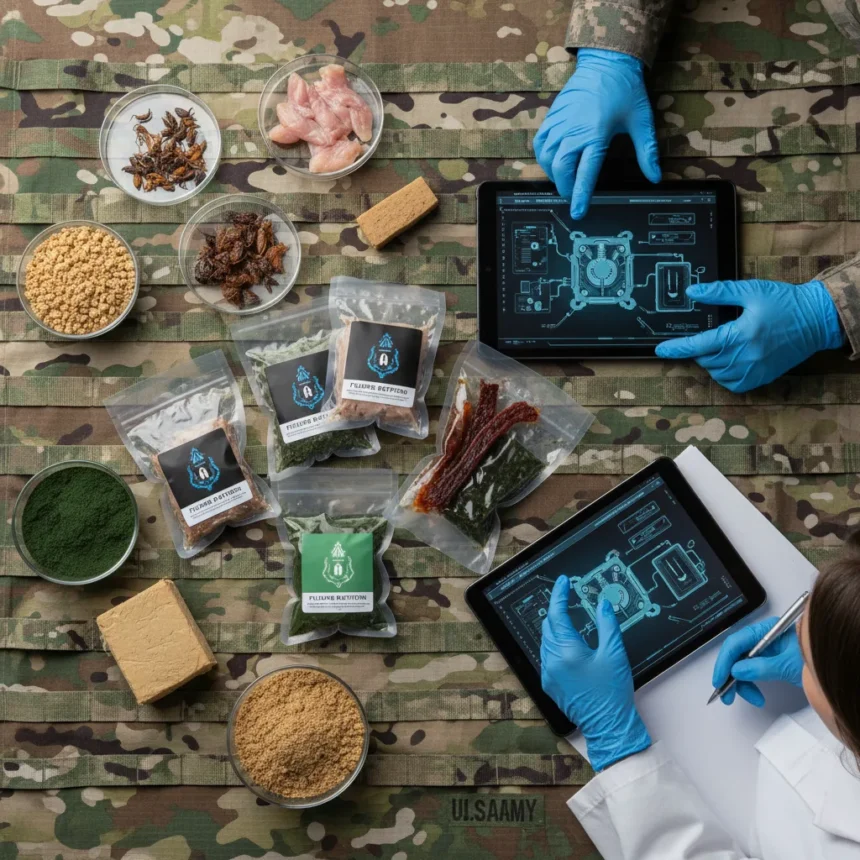
The US Army is actively investigating alternative protein technologies to redesign how soldiers eat in the field. The military’s push reflects a fundamental challenge: combat effectiveness depends on logistics, and every kilogram of supply matters when troops operate far from resupply lines. Lighter, more nutrient-dense rations could free up transport capacity, reduce fatigue from carrying heavier loads, and extend operational range.
Key Takeaways
- The US Army is studying gels, powders, and fermentation-based protein technologies for future field rations.
- Alternative protein technologies aim to reduce ration weight while maintaining soldier nutrition requirements.
- The research phase suggests these technologies are not yet deployed as standard Army rations.
- Military logistics prioritize weight reduction, shelf stability, and field practicality alongside nutrition.
- The shift toward alternative proteins in military feeding reflects broader defense innovation in food systems.
Why the Army is investigating alternative protein technologies
Weight kills soldiers. A standard combat load already exceeds 20 kilograms before adding food. Traditional military rations, while calorie-dense, add significant mass to a soldier’s pack. Alternative protein technologies—including gels, powders, and fermentation-derived proteins—promise to deliver equivalent nutrition in a fraction of the volume. The Army’s investigation focuses on whether these formats can meet field requirements: they must survive extreme temperatures, resist spoilage without refrigeration, require minimal preparation, and deliver sustained energy without causing digestive distress during high-stress operations.
The appeal extends beyond weight reduction. Fermentation-based proteins and powder formulations offer longer shelf lives than conventional rations, reduce packaging waste, and potentially lower logistics costs across the supply chain. For a military operating in remote theaters where resupply cycles stretch weeks, these advantages compound. A lighter ration that lasts longer and requires less cold-chain infrastructure transforms how far troops can operate independently.
What alternative protein formats the Army is evaluating
The Army’s research encompasses three primary formats. Gels deliver concentrated calories and protein in small, portable packages—think of them as military-grade energy supplements engineered for combat conditions rather than gym workouts. Powders offer flexibility: soldiers can mix them with water or field rations to boost protein content without adding weight. Fermentation-based proteins, the most novel category, use microorganisms to produce protein-rich compounds that can be dried, stored, and reconstituted. Each format addresses different operational needs: gels suit rapid-deployment scenarios where preparation time is zero; powders work for units with access to water and basic equipment; fermentation products could eventually replace entire ration categories if they prove palatable and stable enough.

The headline’s ironic tone hints at a real problem: soldier acceptance. Ration palatability affects morale, and morale affects combat effectiveness. The Army cannot simply impose unappetizing food and expect compliance in high-stress environments. Any alternative protein technology that reaches deployment must taste acceptable enough that soldiers actually eat it, not discard it in favor of purchased civilian food or skip meals entirely.
How alternative protein technologies compare to current Army rations
Conventional Army Meals Ready to Eat (MREs) pack roughly 1,250 calories per unit and weigh around 500 grams. They are designed for shelf stability and require zero preparation—a significant advantage in combat. However, their weight and bulk create logistics friction. A soldier carrying three days of rations adds 1.5 kilograms just to food. Alternative protein technologies could theoretically reduce this by 40-60 percent if formulated as high-calorie-density gels or powders. The trade-off is preparation: a powder requires water and mixing; a gel requires nothing but acceptance of an unfamiliar texture. For units in sustained combat, the weight savings might justify the palatability compromise. For garrison or training, traditional rations may remain preferable.



The comparison also hinges on supply chain resilience. MREs depend on established food manufacturing, packaging, and distribution networks. Alternative protein technologies, especially fermentation-based ones, could eventually be produced domestically or near forward bases, reducing dependence on long supply lines. This strategic advantage—the ability to manufacture nutrition locally—may ultimately matter more than individual ration weight.
What happens next with Army ration research
The Army’s investigation phase suggests these technologies are not yet standardized or deployed. Research typically precedes pilot programs, which precede limited field trials, which eventually lead to procurement decisions. The timeline is measured in years, not months. Before alternative protein technologies reach soldiers’ packs, the Army must conduct extensive testing: nutritional analysis, shelf-life validation, palatability trials, and field performance under realistic conditions. Soldiers will have to eat these products in controlled tests and provide feedback. Logisticians will model supply chains. Commanders will assess whether the weight savings translate to measurable tactical advantages.
The broader context matters too. The US military is not alone in exploring alternative proteins for defense applications. Militaries worldwide face similar logistics challenges, and the intersection of food technology and defense innovation is becoming a recognized domain. Success here could influence how allied forces design their own rations, potentially creating interoperability advantages in multinational operations.
Could alternative protein technologies change military logistics permanently?
If the Army successfully deploys alternative protein technologies, the ripple effects extend beyond individual soldiers. Lighter rations mean smaller supply convoys, which means fewer vehicles, less fuel consumption, reduced logistics footprint, and lower exposure to supply-line attacks. A 30-percent reduction in ration weight could translate to 20-30 percent fewer logistics personnel required to sustain a given force size. Over a large deployment, that becomes a meaningful force multiplier. The technology would also align with broader defense priorities: reducing environmental impact, improving supply chain resilience, and leveraging biotechnology as a strategic advantage.



However, adoption is not guaranteed. Military institutions change slowly. Soldiers trust familiar food, and introducing unfamiliar rations carries cultural and morale risks. The Army will deploy alternative protein technologies only if they prove nutritionally equivalent, taste acceptable enough, and deliver measurable logistics benefits. The investigation phase is the Army’s way of answering these questions before committing resources to large-scale procurement.
Will alternative protein rations taste better than traditional MREs?
The headline’s skeptical tone reflects a fair question: will gels, powders, and fermented proteins taste good? History suggests caution. Early MREs were notoriously unpalatable, and decades of refinement were required to reach current acceptability. Alternative protein formats face the same challenge. A gel designed for maximum calorie density and shelf stability may taste like a chemically engineered brick. Powders can be gritty or bitter. Fermented proteins may carry unfamiliar flavors. Taste improvement will require investment in flavoring, texture engineering, and soldier feedback loops.
Could alternative protein technologies replace MREs entirely?
Unlikely in the near term. MREs serve multiple roles: primary nutrition, morale booster (certain items are prized), and psychological comfort. Soldiers eat MREs not just for calories but for familiarity and variety. A complete replacement would require alternative protein technologies to match not just nutrition but also the psychological satisfaction of eating recognizable food. More likely, the Army will use alternative proteins to supplement MREs—replacing certain components or creating specialized ration packs for specific operations where weight savings are critical.
When will soldiers actually eat these alternative protein rations?
The research phase is ongoing, and no deployment timeline has been publicly announced. Based on typical military procurement cycles, initial field trials might occur within 2-3 years, with limited deployment potentially following within 5-7 years. However, military timelines are notoriously unpredictable. Budget constraints, competing priorities, or technical setbacks could delay adoption indefinitely. Conversely, a major conflict or operational need could accelerate deployment. For now, the Army is gathering data, and soldiers will continue eating traditional rations.
The Army’s investigation into alternative protein technologies reflects a realistic recognition that military logistics must evolve. Lighter, longer-lasting, locally producible nutrition could reshape how forces operate globally. Whether gels, powders, and fermented proteins become standard issue depends on the next phase: rigorous testing, honest soldier feedback, and a willingness to change decades-old ration traditions if the data supports it. Until then, the future of Army rations remains under investigation.
Edited by the All Things Geek team.
Source: TechRadar