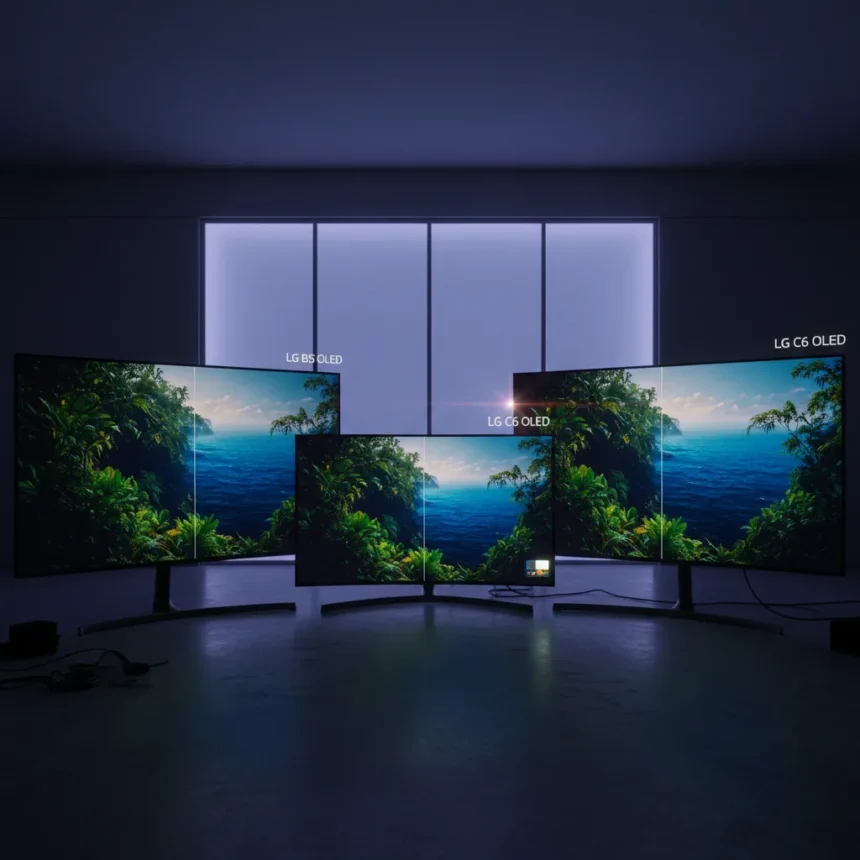
The LG B6 vs B5 OLED comparison sounded straightforward on paper: pit two budget-tier OLED televisions against each other and declare a winner. In practice, the test became a masterclass in how narrow the gap between entry-level models can be—and how that narrowness actually undercuts both of them. The real story emerged only when the higher-tier LG C6 entered the frame, making clear what LG’s budget lineup was genuinely missing.
Key Takeaways
- LG B5 earned top-tier recognition as one of 2025’s best OLED TVs before the B6 arrived.
- LG B6 vs B5 OLED comparison revealed minimal meaningful differences between the two models.
- The test exposed fundamental trade-offs in LG’s budget OLED strategy rather than a clear winner.
- LG C6 emerged as the more compelling option, offering upgrades that justify stepping up from the budget tier.
- Side-by-side testing proved more revealing about what budget OLED models lack than what they offer.
What the LG B6 vs B5 OLED Test Actually Revealed
The LG B6 arrived as a successor to the B5, carrying similar DNA but promising incremental improvements. Testing them back-to-back exposed a fundamental problem: the improvements felt marginal at best. Where you might expect a new generation to meaningfully address weaknesses from its predecessor, the B6 largely carried forward the same compromises. The test setup revealed that comparing two budget models side by side highlights their shared limitations rather than meaningful differentiation between them. Both televisions occupy the same market space, target the same budget-conscious audience, and inherit similar design and performance characteristics from LG’s entry-level OLED philosophy.
This is not necessarily criticism of either TV individually. The B5 earned genuine praise as one of the reviewer’s favorite OLED televisions of 2025. The problem is that the B6, rather than leapfrogging its predecessor, settled into an uncomfortable middle ground. When two products in the same tier feel nearly interchangeable, the comparison becomes less about which one to buy and more about whether the tier itself justifies the investment. The test forced a reckoning with that question.
Why Budget OLED Models Struggle Against Step-Up Competition
The real turning point came when the LG C6 entered the comparison. Suddenly, the gaps that seemed minor between B6 and B5 became irrelevant. The C6 represents the step-up tier in LG’s 2026 OLED lineup, and its positioning reveals why budget models face an uphill battle. When a viewer can spend incrementally more and gain access to features and performance that feel genuinely different, the budget option’s value proposition collapses. This is not a flaw unique to LG’s budget lineup—it is a structural problem in any product category where the entry level and step-up tier are too close in price but too far apart in capability.



Testing all three models in sequence made clear that the C6 was not just a minor upgrade. The difference between B-tier and C-tier OLED televisions is material enough that direct comparison becomes almost unfair to the budget models. The budget tier’s job is to offer OLED technology at a lower price point. But if that lower price barely undercuts the next tier, and the next tier delivers substantially more, the budget tier stops being a smart choice and becomes a trap for buyers who do not realize what they are missing.
The Gaming Features Question in LG B6 vs B5 OLED Showdown
Both the B6 and B5 carry gaming features expected in modern OLED televisions, a category where LG’s budget lineup has traditionally held its own. Testing these features side by side did not reveal dramatic differences, reinforcing the pattern that emerged throughout the comparison. Gaming performance depends heavily on the underlying panel technology and processing power, areas where budget models necessarily cut corners relative to step-up tiers. The B6 and B5 share enough DNA that their gaming capabilities feel nearly identical in practical use. For gamers, this similarity is actually useful information: it means either model will deliver comparable gaming performance, so the choice becomes purely about price and availability rather than capability.



However, this also highlights a weakness in the budget tier’s positioning. If gaming features feel identical across the B-tier lineup, there is no reason to buy a B6 over a B5 if the older model is cheaper. And if a buyer is willing to spend more, the C6’s additional features and processing power become increasingly attractive. The budget tier gets squeezed from both directions: older budget models undercut it on price, and step-up models justify their cost with real capability differences.
What the Messy Test Taught Us About OLED Buying Strategy
The headline promised a mess, and the test delivered one—but not in the way a casual reader might expect. The mess was not that the B6 and B5 were confusing or poorly designed. The mess was that comparing them exposed the fundamental awkwardness of LG’s budget OLED positioning. Neither television is bad. Both are competent OLED sets that deliver the core appeal of the technology: superior contrast, perfect blacks, and excellent color. The problem is that they deliver these qualities in nearly identical ways, making the comparison feel like splitting hairs. And once the C6 entered the frame, those hairs stopped mattering entirely.
For buyers actually shopping in LG’s OLED lineup, the lesson is clear: do not get caught in the budget tier unless price is the absolute deciding factor. If you have room in the budget to step up to the C6, the upgrade is worth the cost. The B5 remains a solid OLED television, and the B6 does not meaningfully improve upon it, which means the B5 is the smarter buy if you are committed to the budget tier—it will be cheaper and perform nearly identically. But the real smart move is recognizing that the gap between budget and step-up is narrow enough that stretching the budget often makes sense.
Is the LG B6 worth buying over the B5?
Not if the B5 is still available at a lower price. The LG B6 vs B5 OLED comparison revealed minimal meaningful differences, making the older model the better value. If the B6 is significantly cheaper due to clearance or regional pricing, it becomes defensible, but generational improvements are not substantial enough to justify paying more for the newer model.



Should I buy an LG budget OLED or step up to the C6?
If your budget allows for the C6, step up. The testing revealed that the gap between budget and step-up tiers is meaningful enough that the additional cost often delivers real capability improvements. Budget OLED models are solid, but the C6 represents a genuinely different class of television.
What makes the LG C6 different from the budget B-tier models?
The C6 is positioned as LG’s step-up OLED tier, offering upgrades in processing power and features that create a noticeable gap between it and the B6 or B5. This gap is substantial enough to shift the value equation entirely in favor of stretching the budget toward the C6 if possible.
The LG B6 vs B5 OLED test ultimately became a lesson in product positioning rather than a straightforward comparison. Neither budget model is deficient, but their similarity to each other exposes the real problem: the budget tier is too narrow to justify its own existence when the step-up option is close enough to reach. For buyers, the takeaway is simple: do not get trapped in the budget OLED space. Either commit to the B5 at its lowest available price, or spend the extra money and buy the C6. The middle ground is where the mess lives.
Where to Buy
$1,599.99 | $896.99 | No price information
Edited by the All Things Geek team.
Source: TechRadar