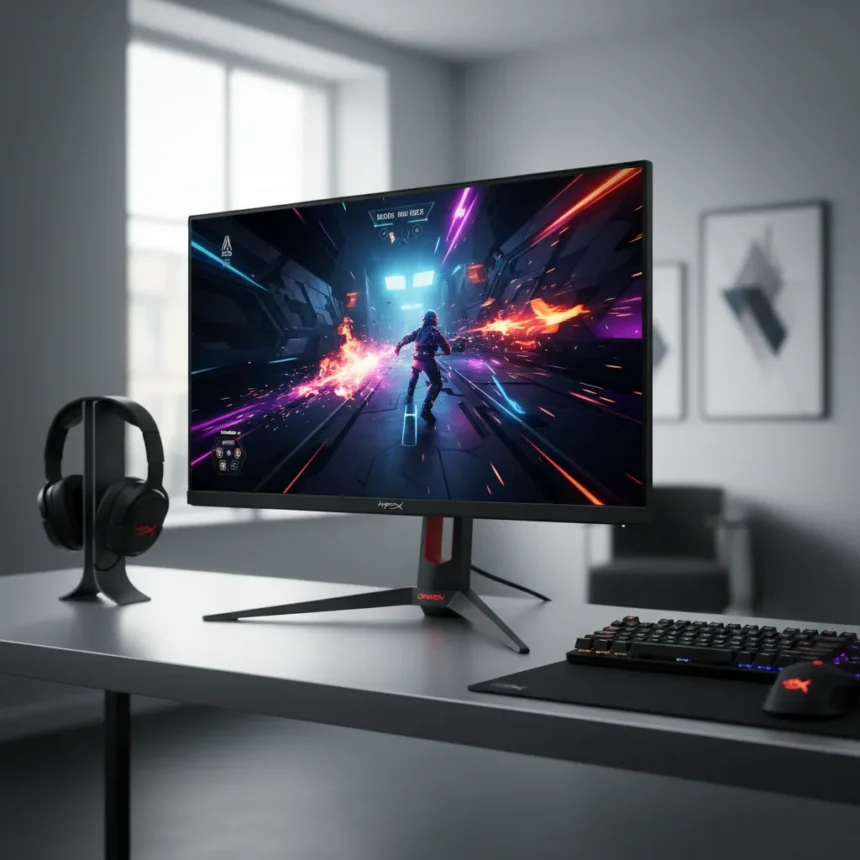
The HyperX OMEN OLED 27q is a gaming monitor that brings QD-OLED panel technology and 240Hz refresh rates to a price point below $500, making premium display tech accessible to esports players and competitive gamers who previously had to choose between affordability and latest performance.
Key Takeaways
- QD-OLED panel technology delivers superior contrast and color accuracy compared to traditional LCD gaming monitors.
- 240Hz refresh rate targets esports titles where frame smoothness directly impacts competitive performance.
- Sub-$500 pricing positions this monitor against mid-range LCD alternatives, not budget displays.
- OLED gaming monitors historically command premium pricing; this model represents a significant value shift in the category.
- 27-inch 1440p resolution balances screen real estate with GPU accessibility for high refresh rates.
Why the HyperX OMEN OLED 27q Matters Right Now
OLED gaming monitors have been the exclusive domain of five-figure displays and specialty products. The HyperX OMEN OLED 27q breaks that pattern by delivering QD-OLED panel technology—the same advanced display substrate used in flagship premium monitors—at a price that doesn’t require a second mortgage. For competitive gamers, this timing is crucial: esports tournaments and ranked online play reward frame-perfect responsiveness, and the monitor’s 240Hz refresh rate directly supports that demand.
The market context matters here. Traditional LCD gaming monitors at this price point dominate the sub-$500 category, offering 144Hz or 165Hz refresh rates with IPS or VA panels. The HyperX OMEN OLED 27q disrupts that expectation by introducing OLED’s superior contrast ratio, faster pixel response times, and deeper blacks—features that were previously locked behind displays costing two to three times as much. For esports players, the speed advantage is measurable; for single-player and story-driven games, the visual fidelity jump is immediately noticeable.
QD-OLED Technology and What It Delivers
QD-OLED refers to a quantum-dot OLED panel architecture that combines the self-emissive properties of OLED (each pixel generates its own light) with quantum-dot color technology for enhanced brightness and color volume. The HyperX OMEN OLED 27q leverages this architecture to achieve response times and contrast ratios that LCD panels simply cannot match. When you’re tracking fast-moving targets in competitive shooters or fighting games, the difference between a 1ms LCD response and the sub-millisecond OLED response translates to a tangible competitive edge.

The real value proposition emerges when you compare this monitor to similarly priced alternatives. A $400–$500 LCD gaming monitor typically offers a 1440p resolution at 144Hz or 165Hz with an IPS panel. The HyperX OMEN OLED 27q matches the resolution and exceeds the refresh rate while delivering OLED’s superior visual characteristics—infinite contrast, perfect blacks, and color accuracy that rivals professional displays. That combination at this price represents a fundamental shift in how OLED gaming monitors are positioned in the market.
Performance for Esports and Competitive Gaming
The 240Hz refresh rate is the headline spec that matters most for competitive players. In fast-paced esports titles—Counter-Strike 2, Valorant, Overwatch 2, fighting games—every frame counts. A 240Hz monitor displays 240 individual frames per second, compared to 144Hz monitors that show 144. The jump from 144Hz to 240Hz is noticeable in motion clarity and input responsiveness, especially if your GPU can consistently push frame rates above 144fps. For players with RTX 4070 or newer hardware, or AMD’s equivalent, hitting 200+ fps in esports titles is achievable, making the 240Hz refresh rate a practical advantage rather than theoretical overkill.


The HyperX OMEN OLED 27q’s 27-inch, 1440p resolution hits a sweet spot for competitive gaming. The screen size is large enough to see detail and track targets across the entire display without excessive head movement, while 1440p is demanding enough to challenge modern GPUs without requiring flagship-tier hardware to maintain high frame rates. Compared to 4K gaming monitors at the same price, which would throttle frame rates significantly, this resolution-refresh balance prioritizes the competitive player’s actual needs.
Value Against Premium Competitors
Premium OLED gaming monitors from established brands typically start at $800 and climb toward $1,200 for 4K models. The HyperX OMEN OLED 27q undercuts that market by more than half. However, direct comparisons require honesty: this is not a budget monitor pretending to be premium. It is a premium-technology monitor priced aggressively. That distinction matters because it sets expectations correctly. Buyers are getting genuine OLED performance, not a compromised version with reduced color gamut, lower brightness, or slower response times to hit a price target.
The monitor competes most directly against mid-range LCD gaming displays in the $300–$500 range, where it offers measurable advantages in contrast, response time, and visual fidelity. Against ultra-premium OLED displays at double or triple the price, the HyperX OMEN OLED 27q trades some features—likely brightness in SDR mode, possibly HDR peak luminance, or additional ergonomic adjustment options—to achieve the lower price. For the target audience—competitive gamers and enthusiasts who prioritize 240Hz performance and OLED image quality over maximum brightness or 4K resolution—those trade-offs are acceptable.
Practical Considerations for Buyers
OLED monitors require informed ownership. The technology is susceptible to image persistence and burn-in if a static image remains on-screen for extended periods. The HyperX OMEN OLED 27q almost certainly includes pixel-shift technology, screen savers, and burn-in mitigation features, but buyers should confirm these protections before purchase and practice good habits: use the monitor’s built-in protections, avoid leaving static UI elements on-screen indefinitely, and enable power-saving features during breaks. For esports players who regularly change games and scenes, burn-in risk is minimal. For players who leave the same game UI visible for 12 hours daily, the risk is real.

Brightness is another practical point. OLED displays excel in dark rooms and controlled lighting environments. In bright rooms with direct sunlight, an OLED monitor’s peak brightness may feel less impressive than an LCD alternative. The HyperX OMEN OLED 27q is best suited for gaming in typical indoor lighting—dimmed rooms, evening play, or standard office lighting. If your gaming space is a bright living room with windows, this monitor’s strengths diminish.
Who Should Buy This Monitor?
The HyperX OMEN OLED 27q is purpose-built for competitive gamers and esports players who value 240Hz refresh rates, fast response times, and visual fidelity equally. It suits players with mid-to-high-end GPUs (RTX 4070 and above, or AMD equivalent) capable of sustaining 200+ fps in esports titles. Streamers and content creators who game competitively also benefit from the OLED image quality and fast response times. Casual gamers or players with older GPUs (RTX 3060 or below) may not extract full value from the 240Hz refresh rate and might be better served by a less expensive 144Hz alternative.
If your gaming mix includes story-driven single-player games, VR, or creative work like video editing, the OLED panel’s superior color accuracy and contrast make this monitor a strong choice. The 1440p resolution is practical for productivity tasks, and the monitor’s size is comfortable for extended work sessions. This is not a monitor that excels in only one use case—it is genuinely versatile within the gaming and creative categories.
Is the HyperX OMEN OLED 27q worth buying at under $500?
Yes, if you game competitively or want OLED image quality without premium pricing. The monitor delivers QD-OLED technology and 240Hz performance that would cost significantly more from other brands. The trade-off is accepting OLED’s burn-in risk and preferring performance over maximum brightness. For esports players and enthusiasts, the value is compelling.
How does the HyperX OMEN OLED 27q compare to LCD gaming monitors at the same price?
The HyperX OMEN OLED 27q offers superior contrast, faster response times, and better color accuracy than LCD alternatives in the same price range. Typical $400–$500 LCD gaming monitors deliver 144Hz or 165Hz with IPS panels; this OLED monitor matches or exceeds their resolution while adding 240Hz refresh and OLED’s visual advantages. The trade-off is OLED’s burn-in risk, which LCD panels do not face.
What GPU do I need to take advantage of 240Hz on this monitor?
To consistently hit 240+ fps in esports titles, you need a GPU capable of sustained high-frame-rate output. Mid-to-high-end cards like RTX 4070 or AMD equivalent are practical starting points. Lower-end GPUs (RTX 3060 or older) will struggle to reach 240 fps in modern games, making the 240Hz advantage academic. Match your GPU capability to the refresh rate you plan to use.
The HyperX OMEN OLED 27q represents a genuine market shift: premium display technology reaching competitive gamers at an accessible price. For esports players, content creators, and enthusiasts willing to manage OLED’s quirks, it is a compelling choice that does not require compromise between performance and affordability.
Edited by the All Things Geek team.
Source: Tom's Guide