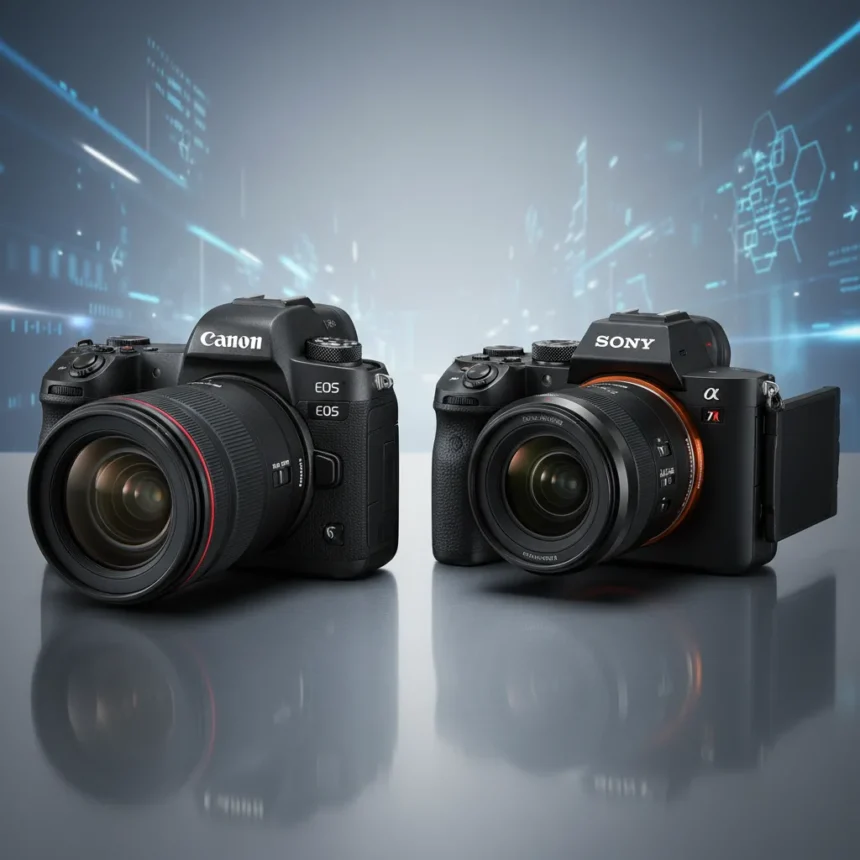
The Canon EOS R6 V and Sony A7R VI both landed this week, and both bring impressive feature sets to the high-end mirrorless market. Yet the question every photographer is asking is simple: which one actually matters more?
Key Takeaways
- Canon EOS R6 V and Sony A7R VI launched the same week with competing flagship specs
- Both cameras target professional photographers and serious enthusiasts
- The choice between them hinges on your existing lens ecosystem and shooting priorities
- Canon and Sony’s mirrorless strategies diverge on autofocus philosophy and video capabilities
- Neither camera is objectively superior—your workflow determines the winner
Canon EOS R6 V vs Sony A7R VI: The Stakes
When two flagship mirrorless cameras arrive in the same news cycle, the tech press defaults to a simple narrative: faster processor, higher megapixels, better autofocus wins. The Canon EOS R6 V and Sony A7R VI both look incredible on paper, but they are built for different photographers. Canon’s approach emphasizes speed and real-world usability, while Sony doubles down on resolution and computational photography. Neither is wrong—they are just different bets on what professional photographers actually need.
The timing matters. Both cameras arriving this week signals that the mirrorless wars have entered a new phase. Canon and Sony are no longer competing on raw specs alone. They are competing on ecosystem lock-in, software maturity, and the intangible feeling of whether a camera feels like it was designed for you. That is a harder comparison to quantify, but it is the one that actually determines which camera ends up in a photographer’s bag.
Why the Canon EOS R6 V Stands Out
The Canon EOS R6 V excels at one thing above all: it makes photographers faster. Speed is not just about frame rates or autofocus acquisition time. It is about the entire experience—from menu navigation to lens compatibility to the confidence that your camera will nail the shot when it matters. Canon’s R-series ecosystem has matured into something genuinely cohesive, and the R6 V feels like the culmination of that effort.
Canon’s lens library for mirrorless is deeper than it was two years ago, and that matters more than any single spec sheet. A camera is only as good as the glass you can mount on it. If you already own Canon RF lenses, the R6 V is a natural upgrade. If you are starting from scratch, Canon’s commitment to the RF mount—evidenced by the steady stream of new lenses—suggests the platform will keep growing. That ecosystem advantage is real, even if it does not show up in a headline.
The Sony A7R VI Case: Resolution and Computation
Sony’s A7R VI takes a different path. This is a camera that trusts computation to solve problems that other manufacturers solve with hardware. Sony’s autofocus algorithm, processing pipeline, and image stabilization are among the most sophisticated in the industry. For photographers who shoot in challenging conditions—low light, fast-moving subjects, unpredictable environments—Sony’s software-first approach often delivers results that feel almost unfair.



The Sony A7R VI also appeals to photographers who prioritize resolution. If you print large, crop aggressively, or work in fields like fashion or landscape photography where every pixel counts, Sony’s megapixel advantage is not theoretical—it is a practical benefit. Sony has also built a stronger reputation for video performance in recent generations, which matters if you shoot hybrid stills and motion content. The A7R VI continues that tradition, offering capabilities that the Canon EOS R6 V simply does not match in the video space.
Canon EOS R6 V and Sony A7R VI: The Ecosystem Question
Here is the uncomfortable truth: which camera is best depends almost entirely on which ecosystem you are already invested in. If you own Canon lenses, the Canon EOS R6 V is the obvious choice. If you own Sony glass, the A7R VI is a no-brainer. The gap between them in real-world performance is smaller than the gap between owning the right lenses and owning the wrong ones.
This is why the camera industry has shifted from feature-based competition to ecosystem-based competition. Canon and Sony both know that a photographer who buys their camera is likely to stay in their ecosystem for years. That lock-in effect is more powerful than any single spec. The Canon EOS R6 V and Sony A7R VI are both excellent cameras, but they are excellent for different people. Choosing between them is not about which camera is objectively better. It is about which ecosystem fits your shooting style and your budget.
Which Camera Should You Buy?
If you value speed, intuitive handling, and a growing lens library, the Canon EOS R6 V deserves serious consideration. If you prioritize resolution, computational photography, and video performance, the Sony A7R VI is the stronger choice. Neither camera is a mistake. Both represent the current ceiling of what mirrorless technology can deliver. The real question is not which camera is better—it is which camera is better for you.



Is the Canon EOS R6 V better than the Sony A7R VI?
Not objectively. The Canon EOS R6 V excels at speed and usability, while the Sony A7R VI prioritizes resolution and computational power. Your existing lens collection and shooting priorities should drive your decision, not spec-sheet comparisons.
What is the main difference between the Canon EOS R6 V and Sony A7R VI?
Canon emphasizes real-time performance and ecosystem cohesion, while Sony leans into resolution and advanced image processing. Both are flagship cameras built for professional photographers, but they solve different problems.
Should I wait for other mirrorless cameras before buying?
The mirrorless market is mature enough that waiting for the next announcement cycle rarely pays off. Both the Canon EOS R6 V and Sony A7R VI are current-generation flagships that will remain relevant for years. If one of these ecosystems matches your needs, buying now makes sense.
The Canon EOS R6 V and Sony A7R VI arriving in the same week is not a coincidence—it is the new normal in camera manufacturing. Both cameras are excellent. Both will serve professional photographers well. The winner is not the one with the better specs. It is the one that fits your workflow, your lenses, and your vision. That is a decision only you can make, and it is the only one that actually matters.
Where to Buy
Edited by the All Things Geek team.
Source: Tom's Guide