





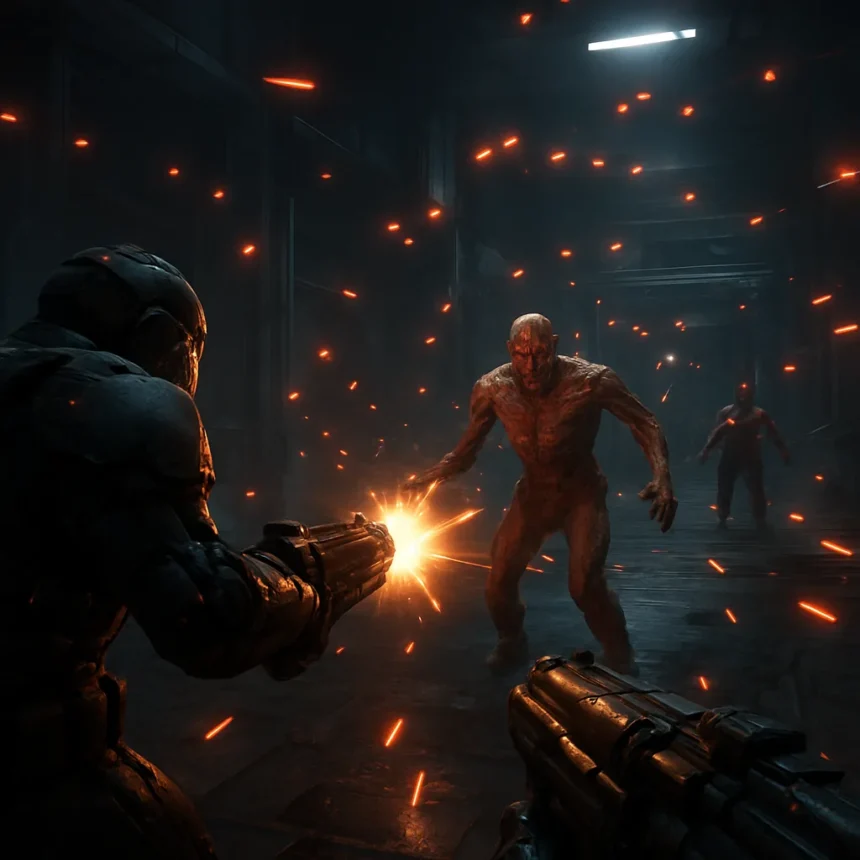
Luna Abyss bullet-hell FPS is an ambitious indie experiment that attempts to fuse two genres that should never work together—and somehow almost makes it stick. The game strips away the gothic fantasy of Doom Eternal and replaces it with a derelict megastructure prison on the moon, where players navigate dense bullet patterns while maintaining the aggressive, movement-based combat that defines modern fast-paced shooters. It’s a collision of design philosophies that sounds chaotic on paper. In execution, it’s messy but compelling.
Key Takeaways
- Luna Abyss combines first-person shooter mechanics with bullet-hell dodging patterns in a single experience.
- The game draws visual and tonal inspiration from both Doom Eternal’s kinetic intensity and Yoko Taro’s moody, offbeat sci-fi sensibility.
- Set in a bleak industrial prison complex on Luna, the game creates a grim, desolate atmosphere rather than traditional hellscapes.
- The core concept is ambitious but only partially successful—the review concludes it “almost makes the idea work.”
- Luna Abyss has generated visibility through trailers, previews, and demo availability ahead of its planned release.
What Makes Luna Abyss Bullet-Hell FPS Tick
The Luna Abyss bullet-hell FPS concept starts with a simple premise: take the movement fluidity and weapon feedback of a modern shooter, then layer bullet patterns that demand constant repositioning. Most first-person games separate combat from navigation. Luna Abyss refuses that separation. Every firefight becomes a choreography problem where dodging enemy fire is as important as landing your own shots. The comparison to Doom Eternal makes sense—both games reward aggressive movement and punish standing still. But where Doom Eternal uses demon hordes and melee glory kills, Luna Abyss strips the spectacle away. You’re exploring a derelict megastructure, a prison complex on the mimic moon, surrounded by industrial decay and sci-fi menace. There’s no redemption arc, no slayer mythology. Just you, your weapons, and an overwhelming number of projectiles.
The design philosophy pulls from unexpected sources. The Yoko Taro comparison—the game designer behind Nier and Drakengard—signals that Luna Abyss is reaching for something thematically ambitious. Taro’s work often blends combat intensity with existential bleakness, a tonal mix that feels right for a game set in a forgotten prison orbiting the moon. The environments aren’t designed to look cool. They’re designed to feel oppressive, hostile, wrong. That aesthetic choice shapes how the bullet patterns feel. They’re not obstacles to overcome with skill; they’re expressions of an environment actively trying to kill you.
Does the Genre Fusion Actually Work?
The honest answer is: mostly, but not perfectly. The Luna Abyss bullet-hell FPS concept works when the game commits to its hybrid identity and forces you to treat dodging and shooting as inseparable skills. Combat encounters that layer bullet patterns with weapon positioning create genuine tension. You can’t just camp behind cover or rely on pure aim—you have to move constantly, read the patterns, and time your shots around incoming fire. That’s where the game shines. But the concept also creates friction. First-person games traditionally use the camera as your aiming tool. Bullet-hell games demand that your camera movement is separate from your dodge movement. Luna Abyss has to solve that problem, and the solution isn’t always elegant. Sometimes the camera feels sluggish when you need precision. Other times, the bullet patterns feel designed for a top-down perspective that doesn’t quite translate to first-person perspective. The game almost makes the idea work, which is the core tension of the entire experience. It’s not a failure, but it’s not seamless either.


Comparatively, Doom Eternal never has to solve this problem because it prioritizes shooting over dodging. Pure bullet-hell games like Touhou never have to solve it because they’re top-down by design. Luna Abyss sits between both worlds, and that positioning is both its greatest strength and its most consistent weakness. The game doesn’t fully commit to either philosophy, which means it occasionally feels like it’s fighting itself.
The Derelict Prison and Sci-Fi Worldbuilding
The setting elevates what could have been a generic shooter concept. Luna Abyss places you inside a bleak, industrial prison complex on the mimic moon—a location that sounds like sci-fi flavor text but actually shapes the entire aesthetic. The environments are cramped, repetitive, and deliberately depressing. Metal corridors, locked doors, the sense that you’re trapped in a structure designed to contain something dangerous. That atmosphere matters because it justifies why the bullet patterns feel relentless and inescapable. You’re not fighting in an arena. You’re fighting for survival in a place built to trap you.



The game’s visual design leans into that oppression. There’s no bright lighting, no heroic framing. Everything is desaturated, industrial, worn. The sci-fi aesthetic avoids the gothic fantasy of Doom Eternal entirely. Where Doom uses demonic architecture and hellfire, Luna Abyss uses concrete, rust, and the cold emptiness of space. That tonal choice makes the game feel distinct within the shooter space, even if the core mechanics are still being refined.
Visibility and Reception
Luna Abyss has been building momentum through targeted previews and trailers. The game received fresh attention during the PC Gaming Show: Most Wanted, which gave it visibility among core gaming audiences. A Steam demo has been made available, allowing players to test the concept firsthand before committing to a purchase. That hands-on access is crucial for a game this conceptually unusual. Reading about a bullet-hell FPS is one thing; experiencing it is another. The demo approach lets players decide whether the genre fusion works for them before release.
Should You Care About Luna Abyss Bullet-Hell FPS?
If you’re drawn to experimental indie games that take risks, yes. Luna Abyss isn’t trying to be a polished AAA shooter. It’s trying to answer a design question: can you merge bullet-hell dodging with first-person combat? The answer appears to be yes, but with caveats. The game almost makes the idea work, which means it delivers an experience you can’t get anywhere else, even if that experience is occasionally awkward. If you want traditional shooter comfort or pure bullet-hell precision, you’ll find friction. If you’re willing to meet the game halfway and appreciate ambition over perfection, Luna Abyss offers something genuinely unusual.
Is Luna Abyss a bullet-hell or a shooter?
Luna Abyss is intentionally both. It combines bullet-hell dodging patterns with first-person shooter mechanics, forcing you to treat movement and aiming as equally important skills. The game doesn’t cleanly fit into either category—it’s a deliberate hybrid.


What’s the setting of Luna Abyss?
The game takes place in a derelict prison complex on the mimic moon, Luna. It’s a bleak, industrial sci-fi environment designed to feel oppressive and hostile, very different from the gothic hellscapes of Doom Eternal.
How does Luna Abyss compare to Doom Eternal?
Both games emphasize aggressive, movement-based combat. But Doom Eternal prioritizes shooting over dodging, while Luna Abyss demands constant repositioning to avoid bullet patterns. Doom uses demonic gothic aesthetics; Luna Abyss uses cold, industrial sci-fi design.
Luna Abyss bullet-hell FPS represents a genuine attempt to do something different in a crowded shooter market. It doesn’t always succeed, but the fact that it almost works—that it creates moments of genuine tension where dodging and shooting feel inseparable—makes it worth watching. For players tired of safe, iterative design, that ambition alone is worth the risk.
Edited by the All Things Geek team.
Source: Creativebloq




