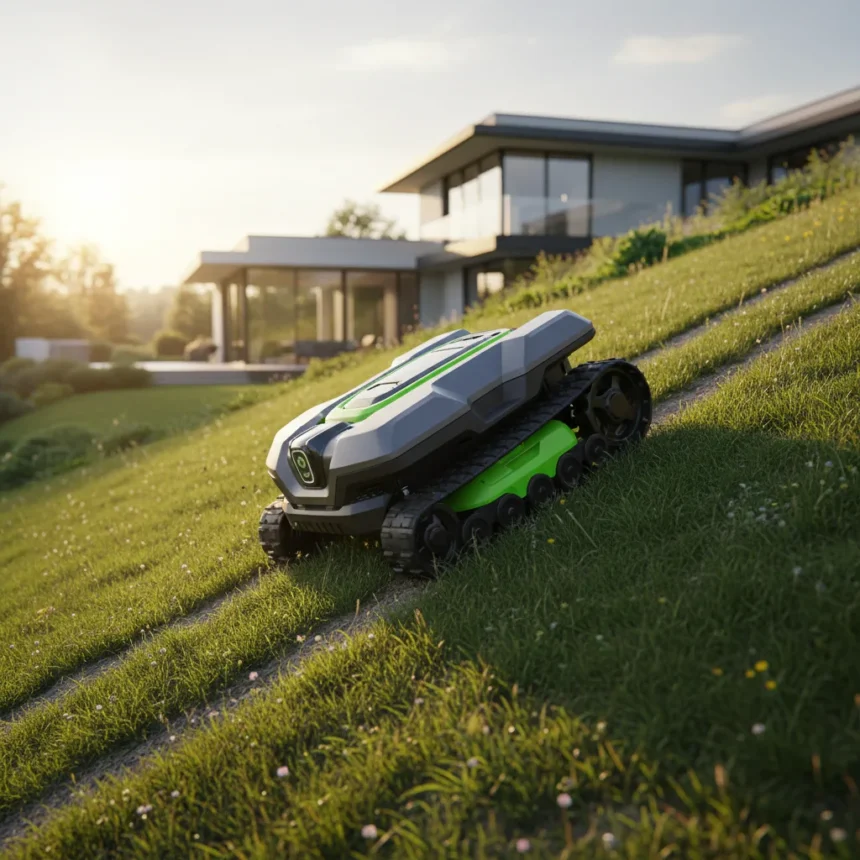
The Lymow One Plus is a tracked robot mower designed to handle extreme slopes, now available to buy. Most autonomous mowers rely on wheeled drives that struggle on uneven terrain—but this tracked system changes the equation. If your yard sits on a hillside or features steep banks that traditional robot mowers can’t navigate, this is the machine built to solve that problem.
Key Takeaways
- The Lymow One Plus uses a tracked drive system instead of wheels for superior slope handling
- The mower is now available for purchase
- Tracked design addresses a major limitation in mainstream robot mower design
- Competitors like the Mammotion LUBA 2 AWD and LUBA 3 AWD also target slope-heavy yards
- Extreme terrain capability sets this mower apart from wire-free GPS models like the EGO AURA-R2
Why Tracked Drive Matters for Extreme Slopes
Tracked drive systems distribute weight across a wider footprint than wheels, providing traction on surfaces where traditional mowers lose grip. The Lymow One Plus leverages this architecture to tackle terrain that would defeat conventional wheeled autonomous mowers. This is not just incremental improvement—it’s a fundamental shift in how the machine interacts with difficult ground.
Slope-capable mowers exist, but most rely on all-wheel-drive designs. The Mammotion LUBA 2 AWD and Mammotion LUBA 3 AWD 3000 both address steep yards with multi-wheel traction. The Lymow One Plus takes a different approach: instead of adding more wheels, it replaces wheels entirely with continuous tracks. Each approach has trade-offs. Tracked systems excel on loose or uneven ground; all-wheel-drive systems offer better integration with existing docking stations and app ecosystems. The Lymow One Plus prioritizes raw terrain capability.
Where the Lymow One Plus Fits in Your Yard
If your property includes slopes that existing robot mowers cannot handle, the Lymow One Plus is engineered for exactly that use case. Yards with steep banks, loose soil, or uneven surfaces are where tracked drive shines. The machine’s availability now means you do not have to wait for a future release—it is ready to order.


For flat or gently rolling lawns, a standard wheeled mower or all-wheel-drive alternative may be sufficient and potentially easier to manage. The Lymow One Plus is the specialist tool for extreme terrain, not the universal choice. Consider your yard’s actual slope angle and surface type before committing. A tracked mower is heavier and more complex than a standard model, which affects maintenance and docking logistics.
Tracked Robot Mower vs. All-Wheel-Drive Alternatives
The Mammotion LUBA series represents the all-wheel-drive approach to slope handling. Both tracked and multi-wheel systems claim slope capability, but they achieve it differently. Tracked systems grip through continuous surface contact; all-wheel-drive systems use multiple independent motors and traction sensors. Neither is universally superior—the choice depends on your terrain type and how much complexity you tolerate in a lawn care device.



The EGO AURA-R2 offers wire-free GPS navigation without slope-specific engineering. It is simpler and more user-friendly for standard lawns, but it is not designed for extreme terrain. If your yard is mostly flat with occasional gentle slopes, the EGO’s ease of use may outweigh the Lymow One Plus’s raw capability.
What Makes Tracked Design Different
Tracked systems have been proven in construction, agriculture, and military vehicles for decades. Applying that technology to consumer lawn care is relatively new. The continuous track distributes force more evenly than wheels, reducing soil compaction on delicate grass and maintaining traction where wheels would spin. This is why tracked mowers excel on wet, loose, or severely sloped ground.
The trade-off is complexity. Tracked drives require more maintenance than wheels, and they are heavier, which affects battery drain and overall efficiency on flat ground. For yards that genuinely need slope capability, these compromises are worth making. For yards that do not, they are unnecessary burden.
Is the Lymow One Plus right for your yard?
The Lymow One Plus is built for yards with extreme slopes that defeat standard robot mowers. If your property sits on a hillside, includes steep banks, or has loose soil that causes wheeled mowers to slip, this tracked system is designed for you. If your lawn is flat or gently rolling, a standard wheeled mower or all-wheel-drive alternative will serve you better and cost less to maintain.



How does tracked drive compare to all-wheel-drive for slopes?
Tracked systems grip through continuous surface contact and excel on loose or uneven ground. All-wheel-drive systems like the Mammotion LUBA series use multiple motors and traction sensors. Tracked mowers are more specialized for extreme terrain; all-wheel-drive mowers balance slope capability with general usability.
What is the difference between the Lymow One Plus and standard robot mowers?
Standard robot mowers use wheels and are designed for flat to gently rolling lawns. The Lymow One Plus uses a tracked drive system to handle extreme slopes that wheeled mowers cannot navigate. This makes it a specialist tool rather than a universal lawn care solution.
The Lymow One Plus represents a genuine innovation in slope-handling technology for autonomous mowers. If your yard demands it, the tracked system delivers capability that wheels and all-wheel-drive alternatives cannot match. For most users, standard mowers will suffice—but for those with truly difficult terrain, this is the tool that finally makes autonomous mowing viable.
Where to Buy
40 Amazon customer reviews | £199.99
Edited by the All Things Geek team.
Source: T3