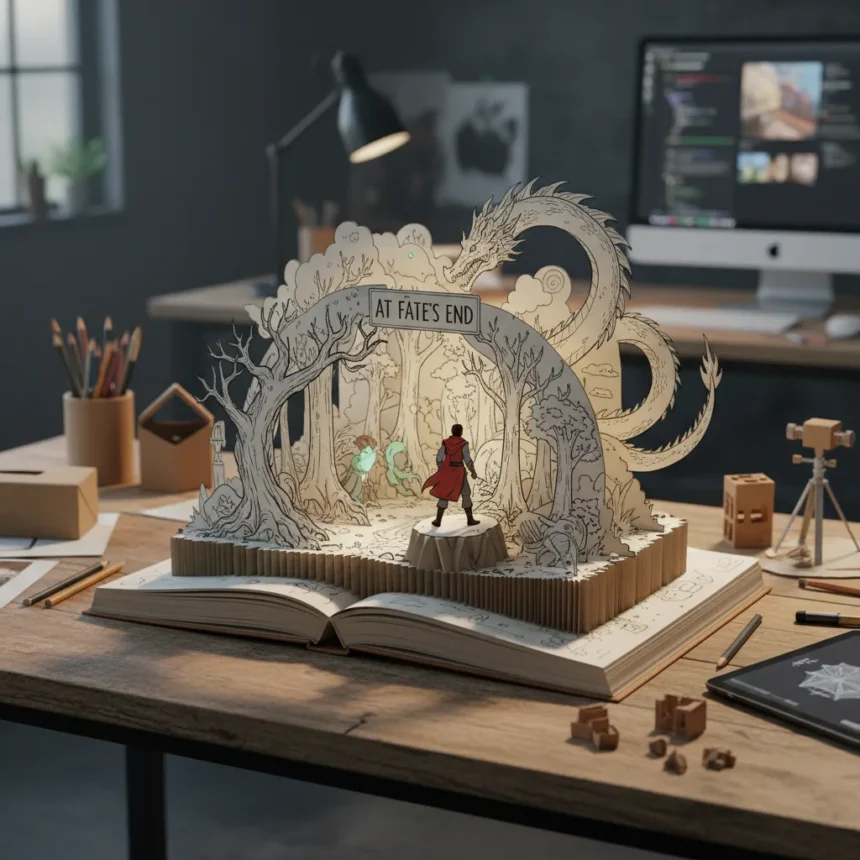
At Fate’s End 3D camera tricks represent a clever intersection of 2D illustration and three-dimensional cinematography, creating a visual experience that feels more alive than traditional hand-drawn games. The indie title achieves this by layering static 2D artwork with dynamic camera movements and spatial depth, making the world feel dimensional without sacrificing the hand-crafted aesthetic that defines its charm.
Key Takeaways
- At Fate’s End uses 3D camera techniques to enhance 2D hand-drawn artwork without losing its illustrated look.
- The approach creates a pop-up picture book effect where layers of art move independently as the camera shifts.
- Art director Jo Gauthier reveals the technical reasoning behind blending 2D and 3D technologies.
- This hybrid approach allows indie developers to create visual depth with limited resources.
- The technique demonstrates how camera work can make static 2D art feel dynamic and immersive.
How At Fate’s End Achieves the Pop-Up Book Effect
The core innovation behind At Fate’s End 3D camera tricks lies in treating hand-drawn artwork as layered elements within a three-dimensional space. Rather than rendering characters and environments in full 3D, the game positions flat 2D illustrations at different depths, then moves the camera through this imaginary space. When the camera shifts—panning left, tilting up, or pulling back—each layer of artwork moves at a different speed, creating parallax depth that mimics a physical pop-up book. This technique makes static drawings feel volumetric and alive without requiring the computational overhead of 3D modeling and rendering.
Art director Jo Gauthier explains that this hybrid approach solves a fundamental challenge for indie developers: how to create visual richness and movement within strict technical and artistic constraints. Hand-drawn 2D animation remains labor-intensive, but adding camera movement multiplies the perceived quality without proportionally increasing production time. A single piece of background artwork, when layered with foreground elements and viewed through a moving camera, suddenly feels like a fully realized environment rather than a flat stage.
Why 3D Camera Movement Transforms 2D Artwork
The psychological impact of camera movement cannot be overstated. Human perception interprets spatial shifts as evidence of three-dimensional depth, even when viewing entirely flat images. At Fate’s End 3D camera tricks exploit this cognitive bias by using subtle camera motions—slight rotations, gentle zooms, gentle pans—that signal dimensionality to the viewer’s brain. When a camera pulls back and reveals layers of artwork receding into the distance, the eye reads depth even though each layer is a 2D illustration.


This approach differs fundamentally from fully 3D games, which render every element from scratch for each frame. At Fate’s End preserves the artistic integrity of hand-drawn work while borrowing cinematographic techniques from film and animation. The result feels more cinematic than a static 2D platformer, yet retains the warmth and character of traditional illustration. The technique also allows developers to reuse artwork efficiently—a single background painting can be placed at multiple depths, with different camera angles revealing different compositions from the same asset.
At Fate’s End Camera Design and Player Immersion
The strategic use of At Fate’s End 3D camera tricks extends beyond visual novelty into gameplay and narrative design. Camera movements can guide player attention toward important story beats, puzzle elements, or environmental details without breaking immersion. When the camera follows a character’s gaze or pans to reveal danger, the movement feels natural and motivated rather than mechanical. This integration of camera work into the storytelling experience elevates the game beyond a technical showcase into a cohesive artistic vision.



The pop-up book aesthetic also creates a unique emotional tone. Players experience the world as if navigating a storybook brought to life, which reinforces themes of wonder, discovery, and narrative progression. The dimensional quality makes environments feel inhabited and rich, encouraging exploration and engagement with the world in ways that flat 2D games struggle to achieve. This is particularly powerful for indie titles, where artistic identity and emotional resonance often matter more than raw technical spectacle.
Comparing At Fate’s End to Traditional 2D and 3D Games
Traditional 2D games rely on static camera placement or simple scrolling, accepting flatness as part of their aesthetic. Fully 3D games demand extensive modeling, rigging, and rendering pipelines—resources that most indie studios cannot afford. At Fate’s End 3D camera tricks occupy a middle ground, borrowing the best qualities of both approaches. The game retains the artistic control and visual distinctiveness of hand-drawn work while gaining the spatial dynamism and cinematic presence of 3D cinematography. This hybrid approach is particularly valuable for narrative-driven indie games where art style and atmosphere matter as much as technical performance.
Is At Fate’s End worth playing for its visual innovation?
At Fate’s End demonstrates that visual innovation does not require latest technology—it requires creative problem-solving and understanding how perception works. The game proves that 3D camera tricks applied to 2D artwork can create experiences that rival fully 3D productions in terms of visual richness and emotional impact, while preserving the distinctive character of hand-drawn illustration. For players interested in game art and design, the title serves as a masterclass in resourceful visual storytelling.
Can other indie developers replicate At Fate’s End’s visual approach?
Yes. The technical foundation—layering 2D artwork at different depths and moving a camera through the space—is achievable in most modern game engines. What sets At Fate’s End apart is the thoughtful execution: the quality of the hand-drawn artwork, the subtlety of camera movements, and the integration of camera design into narrative and gameplay. Developers with strong artistic direction and an understanding of cinematography can adapt these principles to their own projects, though the labor-intensive nature of hand-drawn animation remains a constraint.


What makes the pop-up book aesthetic effective in games?
The pop-up book effect works because it combines familiar visual language—readers understand how pop-up books create depth through layered paper—with interactive agency. Players are not just viewing a pop-up book; they are moving through it, controlling the camera, and discovering new angles and compositions. This active participation deepens immersion and makes the dimensional quality feel earned rather than imposed. The aesthetic also evokes nostalgia and wonder, emotional states that enhance engagement with narrative-driven experiences.
At Fate’s End 3D camera tricks demonstrate that indie developers can compete on artistic vision and technical creativity rather than raw processing power. By understanding how perception, cinematography, and game design intersect, small teams can create visual experiences that feel fresh, immersive, and distinctly their own. The game is a reminder that innovation in game art often comes not from new technology, but from new ways of seeing and using existing tools.
Edited by the All Things Geek team.
Source: Creativebloq