





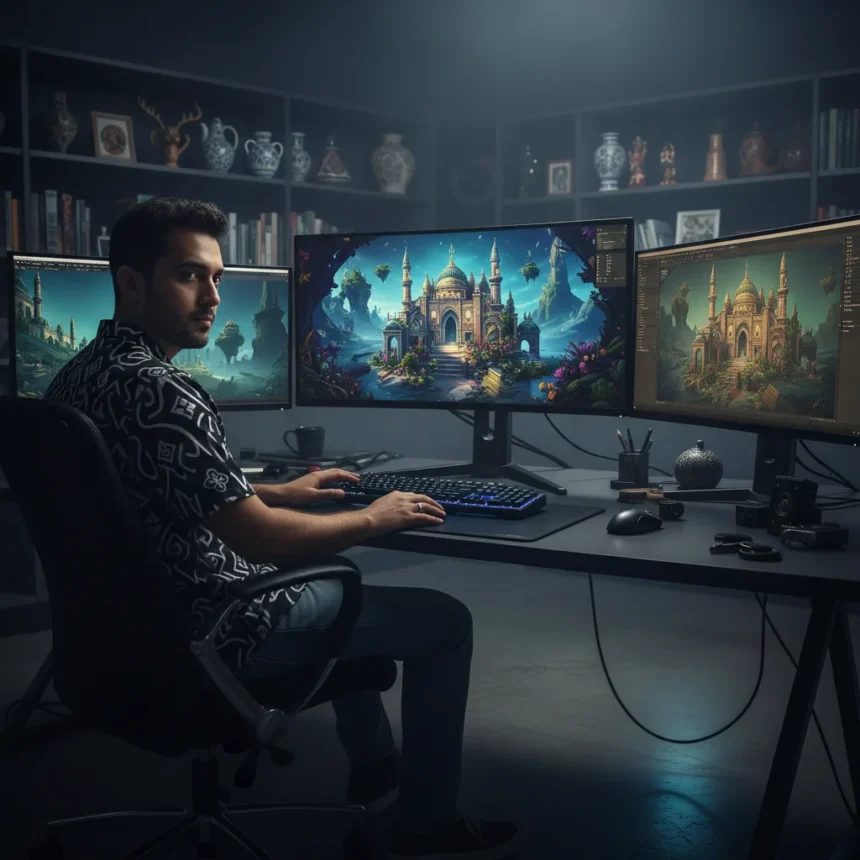
Ali Eser is a self-taught concept artist known for crafting mystical game worlds using Unreal Engine 5 and Blender, with creative direction rooted in Turkish cultural inspiration. Working without formal training, Eser has built a distinctive artistic practice that merges traditional concept design with latest 3D tools, creating immersive environments that blur the line between digital art and interactive experience.
Key Takeaways
- Ali Eser is a self-taught Turkish concept artist specializing in mystical game world design
- His primary tools are Unreal Engine 5 and Blender for 3D creation and visualization
- Turkish cultural heritage serves as a major creative inspiration for his artistic direction
- Self-taught artists in game development are increasingly competing with formally trained peers
- Concept art for games requires mastery of both aesthetic vision and technical software
How Self-taught Artists Are Reshaping Game World Design
The path from self-taught hobbyist to professional concept artist has become increasingly viable in the game industry. Ali Eser’s journey exemplifies this shift—artists no longer need traditional credentials to build credible, commercially viable work. Instead, they rely on portfolio strength, technical skill, and the ability to communicate visual ideas across complex 3D environments. Game studios now prioritize demonstrated ability over educational pedigree, a change that has opened doors for artists willing to teach themselves industry-standard tools.
Eser’s approach reflects a broader trend in digital art: the democratization of professional-grade software and online learning resources has lowered barriers to entry. Artists can now access tutorials, community feedback, and real-world project examples without enrolling in formal programs. This shift has created a more diverse talent pool in concept design, where cultural backgrounds and unconventional perspectives increasingly drive innovation in game aesthetics.
Unreal Engine 5 and Blender: A Powerful Workflow Combination
The pairing of Unreal Engine 5 and Blender represents a modern standard for concept artists working on game worlds. Blender handles the sculpting, modeling, and asset creation phase, offering robust tools for building detailed 3D geometry. Unreal Engine 5 then serves as the visualization and integration layer, allowing artists to see how assets perform in real-time lighting, with dynamic effects and environmental context. This two-tool workflow avoids vendor lock-in and lets artists leverage the strengths of each platform.


For game concept artists, this combination enables rapid iteration. An artist can sculpt a mystical structure in Blender, import it into Unreal Engine 5, light it according to the game’s mood and tone, and adjust details without returning to the modeling software. The real-time feedback loop accelerates creative decisions and helps communicate visual intent to game designers and art directors. Eser’s use of both tools suggests a mature understanding of when to switch between them—a skill that separates professional concept artists from hobbyists.
Turkish Cultural Inspiration in Mystical Game Worlds
Eser’s work draws heavily from Turkish cultural and historical elements, translating them into fantastical game environments. This approach infuses his concept art with authenticity and narrative depth that generic fantasy worlds often lack. By anchoring his designs in real cultural references—architectural motifs, color palettes, spiritual symbolism—he creates worlds that feel lived-in rather than arbitrarily assembled.



Using cultural heritage as a creative foundation also addresses a gap in game design: most AAA titles draw from Western European fantasy tropes or Asian aesthetics, leaving Turkish, Middle Eastern, and Central Asian visual traditions underrepresented. Artists like Eser who deliberately channel their own cultural backgrounds into game worlds expand the visual vocabulary available to the industry. This practice benefits both the artist (a distinctive, recognizable style) and the audience (fresher, more culturally diverse game environments).
The Technical and Creative Balance in Concept Design
Concept art for games sits at the intersection of technical execution and creative vision. An artist must understand not just how to make something look beautiful, but how it will function within a game engine, how it will perform on target hardware, and how it will guide player navigation and emotion. Eser’s self-taught path required mastering both dimensions—the artistic eye and the technical constraints.
This balance explains why self-taught artists often succeed in game concept design: they tend to learn tools in the context of real projects, rather than in isolation. A formal education in fine art alone does not teach Unreal Engine workflows; a computer science degree does not teach visual storytelling. Self-taught artists who commit to game development from the start often develop integrated knowledge faster than those who learn tools and art separately.
Why Self-taught Artists Matter in the Game Industry
The success of self-taught concept artists like Ali Eser signals a maturation in how the game industry evaluates talent. Studios increasingly judge artists on the strength of their portfolio and their ability to solve visual problems, not on whether they hold a degree. This shift has practical advantages: it expands the talent pool, introduces diverse perspectives, and rewards artists who are genuinely passionate about game development rather than those pursuing credentials.


For aspiring concept artists, Eser’s career offers a clear message: formal training is optional if you are willing to invest time in learning tools, studying design principles, and building a strong portfolio. The barrier is not access to education—it is consistency and the willingness to iterate on your work publicly, accept feedback, and continuously improve. In game development, where visual communication is paramount, demonstrated ability trumps institutional affiliation.
Is a formal degree necessary to become a concept artist?
No. Many successful concept artists, including self-taught professionals, have built careers without formal degrees. What matters is a strong portfolio, proficiency in industry tools like Unreal Engine 5 and Blender, and the ability to solve visual design problems. Game studios evaluate artists on demonstrated skill, not credentials.
What tools should I learn to become a game concept artist?
Blender and Unreal Engine 5 are industry-standard choices, as exemplified by Ali Eser’s workflow. Blender handles 3D modeling and sculpting, while Unreal Engine 5 provides real-time visualization and integration. Many concept artists also learn 2D tools like Photoshop or Substance Painter for texturing and detail work, depending on their specialization.
How important is cultural inspiration in game concept art?
Cultural inspiration can be a significant differentiator. It helps artists develop a distinctive visual voice and fills gaps in game design where certain traditions are underrepresented. Eser’s use of Turkish cultural elements creates worlds that feel authentic and fresh, setting his work apart from generic fantasy aesthetics.
Ali Eser’s journey demonstrates that the path to professional concept art is no longer a single, credential-dependent route. Self-taught artists who master industry tools, develop a coherent visual style, and draw inspiration from their own cultural backgrounds are reshaping game design. For aspiring artists, the message is clear: start learning, build your portfolio, and let your work speak for itself.
Where to Buy
32% OFFXPPenArtist Pro 24 Gen 2 4K Ultra Hd Drawing Tablet$879.99$1,299.99shop now | 31% OFFWatson-GuptillHow to Become a Video Game Artist$15.15$21.99shop now | 21% OFFImpact BooksDesigning Creatures and Characters$22.84$29shop now | 43% OFFDesign Studio PressThe Big Bad World of Concept Art for Video Games$19.94$34.95shop now | Packt PublishingBlender for Beginners Part 1$49.99shop now
Edited by the All Things Geek team.
Source: Creativebloq




