





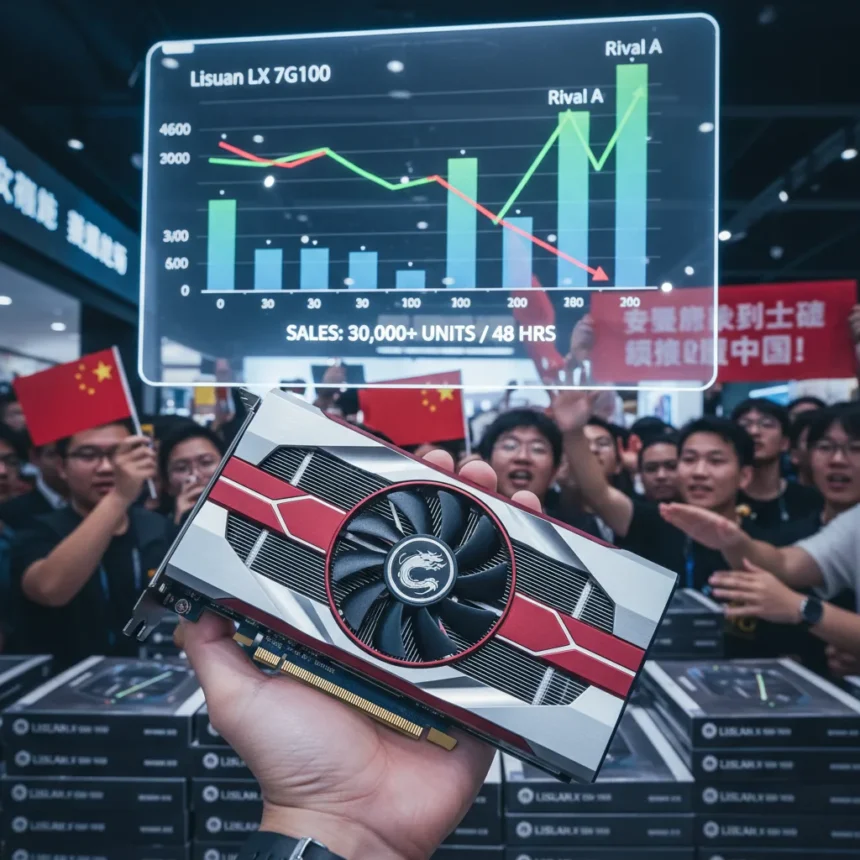
The Lisuan LX 7G100 is a gaming graphics card made by Chinese GPU maker Lisuan Tech, launched on 26 July 2025, priced at approximately $485, and available in the Chinese market. Within 48 hours of preorder opening, over 30,000 units sold out—a stunning result for a domestic GPU that benchmarks reveal cannot compete with mainstream rivals. The sellout proves that brand nationalism, scarcity marketing, and curiosity can override raw performance data in a competitive hardware market.
Key Takeaways
- The Lisuan LX 7G100 sold over 30,000 units in 48 hours despite trailing older NVIDIA and AMD cards in testing.
- Priced at $485, the LX 7G100 undercuts the RTX 5060 Ti 16GB ($489) but delivers significantly weaker performance.
- The GPU features 12GB GDDR6 memory, a 192-bit bus, and a 6-nanometer process but lacks ray tracing support.
- Benchmark results show the RTX 4060 is 20–70% faster, with the LX 7G100 trailing by roughly 30% in most tests.
- The card’s rapid sellout suggests demand driven by domestic pride and limited availability rather than technical superiority.
Lisuan LX 7G100 Specs and Positioning
The Lisuan LX 7G100 uses 12GB of GDDR6 memory paired with a 192-bit memory bus and PCIe x16 support, built on a 6-nanometer manufacturing process. The Founders Edition was limited to just 1,000 units, creating artificial scarcity that likely fueled preorder demand. At $485 in the Chinese market, the card sits in an awkward price bracket—cheaper than NVIDIA’s RTX 5060 Ti 16GB at $489, yet delivering substantially weaker performance for the money. The GPU does not support ray tracing, a significant omission when competing against modern consumer cards.
Lisuan Tech positioned this as its first serious gaming GPU push, departing from the company’s earlier focus on AI and professional workstation accelerators. The timing of the launch—July 2025—came amid growing Chinese government emphasis on domestic semiconductor independence. That geopolitical backdrop likely amplified buyer interest beyond what raw specifications alone would justify.
Performance: Hype Meets Reality
When tested against mainstream competitors, the Lisuan LX 7G100 delivers disappointing results. The NVIDIA RTX 4060 outperforms it by 20–70% across various benchmarks, while the Intel Arc B580 and AMD Radeon RX 6600 XT also pull ahead. In most tests, the LX 7G100 trails by roughly 30% compared to these alternatives, making it a poor value proposition for gamers seeking raw frame rates.


Real-world gaming performance illustrates the gap. In Cyberpunk 2077 with FSR 3 and frame generation enabled, the card averaged 88 FPS, but that relies on upscaling and AI frame insertion—not native performance. Black Myth: Wukong ran at around 56 FPS at 1080p, while The Witcher 3 managed 57 FPS. Elden Ring hit 80 FPS and GTA V reached roughly 150 FPS, but these are older titles that do not stress modern GPUs. For current AAA games, the LX 7G100 falls short of the 60+ FPS baseline most gamers expect at 1080p high settings.
The card trails even older generation hardware like the RTX 3060 in several tests, making it a hard sell for anyone with access to used or discounted previous-generation cards. Yet none of this stopped the sellout. The 30,000-unit preorder depletion in 48 hours reveals a market driven by factors beyond benchmark sheets—patriotic purchasing, fear of missing out, and the novelty of a homegrown alternative.


Why the Sellout Happened Despite Weak Specs
The Lisuan LX 7G100’s rapid sellout despite mediocre performance points to three overlapping forces. First, domestic pride played a role; Chinese buyers eager to support local semiconductor efforts may have treated the purchase as a patriotic act rather than a purely rational hardware decision. Second, artificial scarcity—the 1,000-unit Founders Edition limit and the overall preorder cap—created urgency and fear of permanent unavailability. Third, the GPU’s price of $485 undercuts the RTX 5060 Ti by $4, making it appear competitively positioned on paper, even though real-world gaming performance tells a different story.
The card also benefited from being a first-mover in the Chinese domestic gaming GPU space. Enthusiasts and early adopters wanted to try it, review it, and test Chinese GPU drivers firsthand. That curiosity factor would not sustain sales long-term, but it was enough to clear 30,000 units in two days. By December 2025, the company had begun shipping first-batch units to customers, and a second batch was scheduled for June 18.
Lisuan LX 7G100 vs. RTX 5060 Ti and Intel Arc B580
The RTX 5060 Ti 16GB starts at roughly $489, just $4 more than the Lisuan LX 7G100, yet delivers substantially faster frame rates across nearly every game and benchmark. NVIDIA’s driver maturity, ray tracing support, and DLSS technology give it a decisive edge for gaming. The Intel Arc B580 similarly outperforms the Lisuan card while offering better software stability and third-party game optimizations. For the same $485 price point, Chinese buyers could have imported an older RTX 4060 Super or waited for the RTX 5060 Ti to drop in price—and gotten better performance in return.
The Lisuan LX 7G100 does offer one advantage: native compatibility in the Chinese market without import hassles or warranty complications. For buyers restricted to domestic purchasing or wary of international logistics, that convenience factor may have tipped the scales. However, for anyone with access to mainstream cards, the LX 7G100 is a poor investment.



What This Sellout Reveals About GPU Markets
The Lisuan LX 7G100 sellout demonstrates that performance benchmarks are not the only driver of hardware demand. Patriotism, scarcity, and novelty can overpower technical merit in certain markets, especially when geopolitical tensions make domestic alternatives feel like a matter of national interest. This dynamic is unlikely to repeat with the same intensity if Lisuan releases a second-generation card with similarly weak performance—buyers who receive their first units will post honest reviews, and word-of-mouth will spread quickly.
For Lisuan Tech, the sellout is a marketing victory but a technical warning. The company has proven it can generate demand, but sustained success requires closing the performance gap. A 30% deficit against mainstream competitors is not sustainable long-term, especially if rival GPU makers respond with price cuts or new budget models. The second batch scheduled for June 18 will face higher expectations and less novelty appeal.
Should you buy the Lisuan LX 7G100?
No, unless you are unable to purchase NVIDIA or AMD cards in your region and need a GPU immediately. The RTX 5060 Ti 16GB at $489 offers far better gaming performance for nearly identical pricing. If you are in China and patriotic purchasing is a priority, understand that you are paying a premium for domestic support, not superior hardware. The LX 7G100 is a 1080p budget card that struggles with current AAA titles—it is not a value leader.
Does the Lisuan LX 7G100 support ray tracing?
No. The LX 7G100 lacks ray tracing hardware, limiting its appeal for modern games that rely on ray-traced lighting and reflections. This is a significant disadvantage compared to the RTX 5060 Ti and Arc B580, both of which support real-time ray tracing.
When will the Lisuan LX 7G100 become available globally?
The research brief provides no information about global availability plans. The card is currently available only in the Chinese market, and there is no confirmed timeline for international release.
The Lisuan LX 7G100 is a case study in marketing triumph and technical compromise. A 30,000-unit sellout in 48 hours is impressive by any measure, but it masks a fundamental truth: the card underperforms rivals at the same price point and lacks features modern gamers expect. Nationalism and scarcity can drive short-term sales, but they cannot sustain a GPU brand long-term. Lisuan Tech has proven it can generate hype. Now it must prove it can deliver performance.
Edited by the All Things Geek team.
Source: Tom's Hardware




