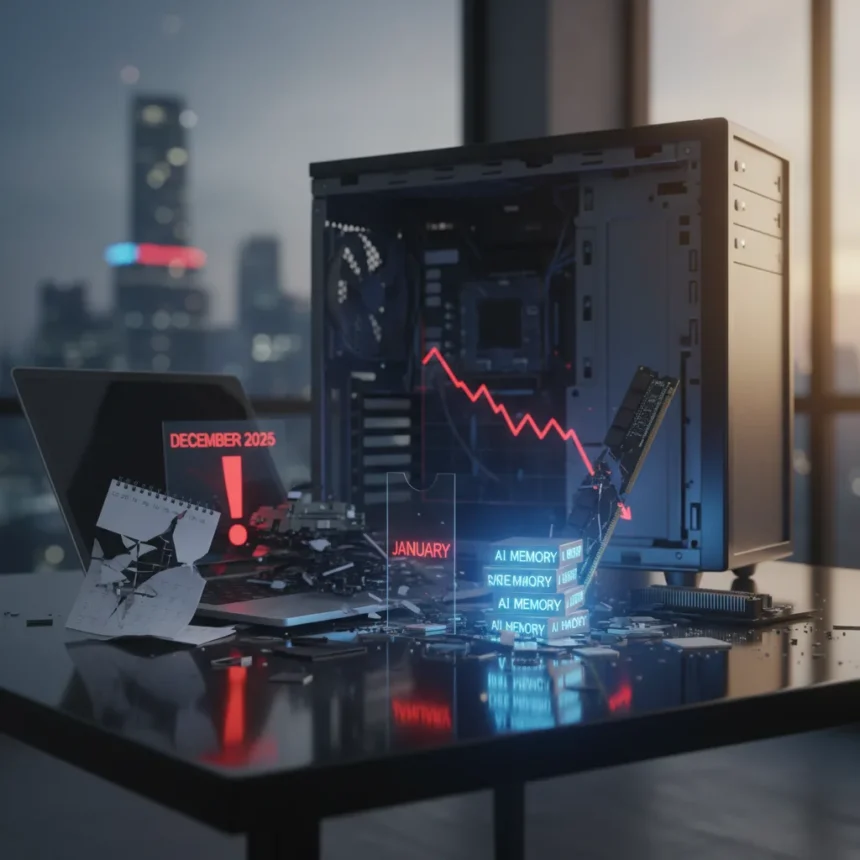
The PC shipment decline 2026 is shaping up to be the worst market downturn in over a decade, driven by a perfect storm of AI-fueled component shortages and the end of a temporary sales boost that masked deeper structural problems. US PC shipments grew 3% in Q4 2025 to 18.2 million units, but this rebound tells a deceptive story—companies and consumers were rushing to replace aging Windows 10 machines before October 2025 end-of-support, and retailers were stockpiling inventory before prices climbed. Once that pull-forward demand evaporates in 2026, the market faces a brutal contraction.
Key Takeaways
- US PC shipments rose 3% in Q4 2025 to 18.2 million units, driven by Windows 10 replacements and holiday demand.
- Memory now accounts for 35% of HP’s PC bill of materials, up sharply from 15-18% in the prior quarter.
- Analysts forecast PC shipment decline 2026 between 5% and 13% globally, with some predicting the steepest drop since 2012.
- Laptop prices could rise 40-60% in 2026 as AI demand pushes memory and storage costs up another 60%.
- Low-end PCs under $500 face the hardest hit, with forecasts showing a 28% volume collapse.
Why the PC Shipment Decline 2026 Is Coming
The PC shipment decline 2026 stems from two converging forces: the artificial boost from Windows 10 end-of-support is ending, and AI chip makers are hoarding memory and storage capacity. Memory prices have already surged sharply since mid-2025, and vendors are signaling further increases starting this month. Memory now represents 35% of HP’s PC bill of materials in Q1 2026, up from just 15-18% in the prior quarter. This cost explosion is unprecedented—it means the average laptop’s memory component has more than doubled in price contribution within months.
The commercial segment saw 6% growth in Q4 2025 to 8.2 million units, with enterprises accelerating Windows 11 migrations before the Windows 10 deadline. This was a one-time event. Once that deadline passed, the replacement urgency vanished. Meanwhile, AI demand for high-bandwidth memory (HBM) and data center storage is pulling supply away from consumer and business PC makers. Asus announced price hikes effective January 5, 2026, explicitly blaming AI for the cost increases. Other vendors are quietly preparing similar moves.
The Forecast: How Bad Is the PC Shipment Decline 2026?
Analyst estimates for the PC shipment decline 2026 vary, but all point downward. Gartner forecasts a 10.4% global decline, calling it the steepest drop in over a decade. Omdia predicts a 12% contraction to 245 million units, with Windows PCs—which account for 83% of all shipments—falling 12%. IDC has revised its forecast to an 11.3% decline, far worse than its December 2025 estimate of 4.9% to 8.9%. Only Counterpoint Research offers a milder view at 5% decline, but even that represents significant market contraction.


The most alarming data point: low-end PCs under $500 are forecast to collapse 28% in volume, dropping to 62.1 million units. This segment has the thinnest margins and weakest pricing power. Budget-conscious buyers will either hold onto existing machines longer or shift to smartphones and tablets. High-end PCs and AI-capable machines will fare better—Goldman Sachs forecasts AI PCs reaching 150 million units (59% penetration) and remaining resilient. The market is bifurcating: premium machines climb, budget machines crater.
Memory Costs and Laptop Prices: The Hidden Shock
Forecasts suggest memory and storage prices will climb another 60% in 2026, pushing laptop prices up 40-60% across the board. This is not a modest increase—it fundamentally changes the purchase calculus for millions of buyers. A laptop that cost $800 in 2025 could cost $1,120 to $1,280 in 2026, assuming vendors absorb some cost pressure rather than passing it all to consumers. Most will not absorb it.



This price shock hits hardest in emerging markets and price-sensitive segments. In the US and Western Europe, consumers may delay upgrades or shift to refurbished machines. In developing regions, the $500-$800 segment—where most growth was expected—becomes inaccessible. Vendors are responding by pivoting to premium and AI-capable machines, where margins are higher and buyers are less price-sensitive. Apple, Lenovo, HP, and Dell are all emphasizing edge computing and AI features to justify higher price points.
Is There Any Good News?
B2B optimism offers a sliver of hope. An Omdia poll from November 2025 found that 57% of business partners forecast PC business growth in 2026 versus 2025, despite the shipment headwinds. This suggests vendors expect revenue growth through higher average selling prices (ASPs) even as unit volumes shrink. PC revenues are forecast to grow 1.6% in 2026 despite the volume collapse. Enterprises may also continue Windows 11 migrations into 2026, providing some commercial demand floor.
However, this revenue growth masks underlying weakness. Higher prices driven by component scarcity are not the same as healthy market expansion. Vendors’ ability to negotiate memory and storage contracts will determine actual shipment performance—scale and supplier relationships matter more than ever. Smaller players with weaker procurement leverage will struggle most.
When Does the Market Recover?
The pull-forward effect from late 2025 and Q1 2026 will exhaust itself by Q2 2026, leaving the market exposed to real demand weakness. No rebound is expected until 2028 at the earliest, when AI PC adoption accelerates further and memory supply constraints ease. The next two years represent a structural reset for the PC industry—away from volume, toward margin; away from budget, toward premium; away from traditional computing, toward AI-capable devices.



Should I buy a PC before prices spike?
If you need a new PC, buying before February 2026 offers better pricing than waiting for spring and summer. Inventory from the late-2025 pull-forward is still available, and vendors have not yet fully implemented price increases. After Q1 2026, expect 40-60% higher prices on comparable configurations, particularly in the $500-$1,200 range.
Will the PC market ever return to growth?
Yes, but not until 2028 or later. The 2026-2027 period will be defined by contraction as vendors clear inventory and adjust to new cost structures. Growth returns when AI PC adoption reaches critical mass and memory supply constraints ease. Until then, the market will remain under pressure.
Are business PCs safer to buy than consumer PCs?
Commercial PC shipments have shown four consecutive quarters of growth through Q4 2025, driven by Windows 11 migrations and enterprise refresh cycles. However, once that migration completes in 2026, commercial demand will normalize. Business PCs face the same memory cost pressures as consumer machines, so pricing relief is unlikely regardless of segment.
The PC shipment decline 2026 is not a temporary dip—it is a structural reset triggered by AI’s appetite for the same memory and storage components that power laptops and desktops. Buyers who need new machines should act now. Those who can wait should prepare for sticker shock and a market heavily tilted toward expensive, AI-capable devices. The budget PC era is ending, and the premium PC era is beginning.
Edited by the All Things Geek team.
Source: Windows Central