





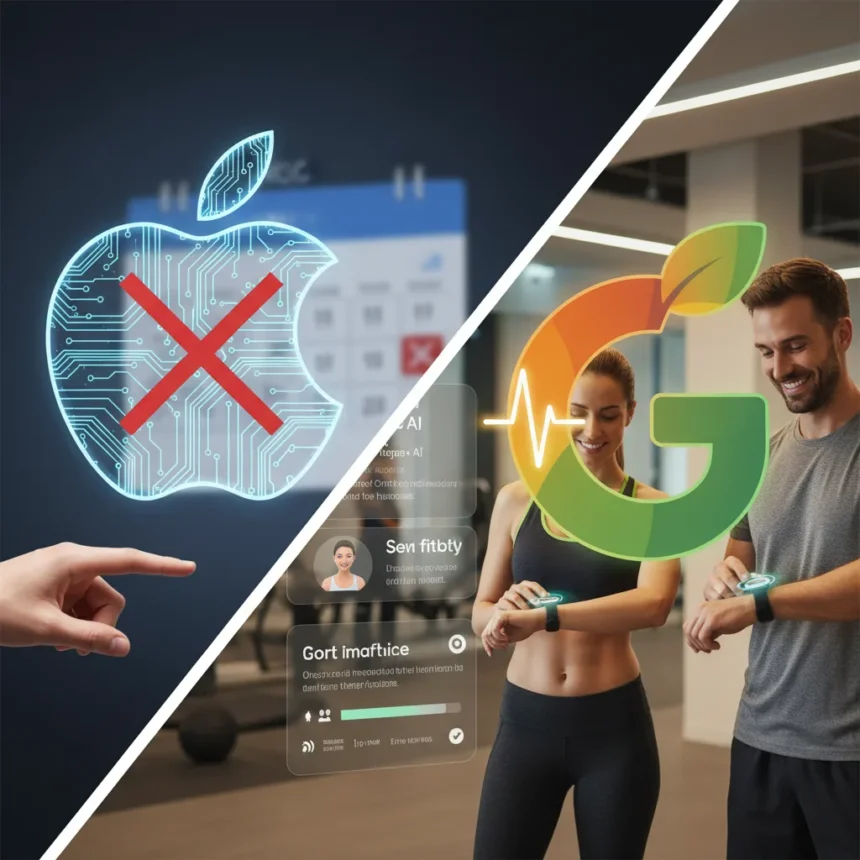
Apple’s AI health coach delay represents a significant stumble in the wearable health wars, according to recent reports. The company’s long-rumored AI-powered fitness and wellness coach, expected to rival Fitbit’s capabilities, will not debut at WWDC in June, pushing back Apple’s entry into a market Google is already dominating.
Key Takeaways
- Apple’s AI health coach has been delayed and will miss WWDC 2025 in June
- Google’s Fitbit AI coach is already rolling out, gaining first-mover advantage
- The delay gives competitors months to establish dominance in AI fitness coaching
- Apple’s health ecosystem faces pressure from faster-moving rivals
- Fitness fans lose access to advanced personalized coaching features sooner
Why the AI health coach delay matters for Apple’s health strategy
Apple has spent years building its health ecosystem through the Apple Watch and Health app, positioning itself as a leader in personal wellness. The rumored AI health coach would have deepened that advantage by offering personalized fitness guidance powered by machine learning. Missing WWDC means Apple loses a critical window to announce and build momentum around the feature.
This is not a minor slip. Google and Fitbit are already shipping AI health coaching capabilities to users, establishing themselves as the default choice for anyone seeking intelligent fitness guidance. When Apple eventually launches its version, it will be playing catch-up rather than setting the pace. The fitness coaching market is moving fast, and delays compound quickly when competitors are actively shipping.
Google Fitbit’s AI coach is already winning the race
Google has rebranded its Fitbit app to Google Health and integrated a dedicated AI health coach into the platform, available to users right now. This move transforms Fitbit from a simple activity tracker into an AI-powered wellness advisor. Google is not waiting for perfect—it is shipping, iterating, and building user habits around its AI coach before Apple even announces.
The competitive advantage is tangible. Users who adopt Google’s AI health coach will have months of personalized training data, habit formation, and ecosystem lock-in before Apple’s alternative arrives. Switching costs—both psychological and practical—favor whichever platform users are already using daily. By the time Apple launches, it will need to convince users to abandon an established routine and learn a new system.
What the delay means for fitness fans
For fitness enthusiasts, the AI health coach delay is frustrating. Advanced personalized coaching—the kind powered by machine learning that adapts to your performance, goals, and preferences—is no longer a luxury feature. It is becoming table stakes in the wearable market. Users who want that level of intelligence today cannot wait for Apple; they are turning to Google and Fitbit instead.



This delay also signals that Apple may be pulling back on some of its iOS health ambitions more broadly. The company clearly faces resource constraints or technical challenges that forced a rescheduling. When a company delays a flagship feature, it often indicates deeper issues with execution, integration, or strategy that extend beyond that single product.
The broader ecosystem implications
Apple’s health roadmap has always relied on the tight integration between the Apple Watch, iPhone, and Health app. An AI health coach fits naturally into that ecosystem, enhancing the value of owning multiple Apple devices. The delay weakens Apple’s pitch to fitness-focused buyers who might otherwise choose the Apple Watch ecosystem over Garmin, Whoop, or other specialized fitness platforms.
Google, meanwhile, is aggressively positioning itself as the AI health company. By bundling an AI coach into Fitbit and Google Health, the company is creating a compelling reason for Android users to stay within its ecosystem—or for iOS users to consider switching. Apple cannot afford to cede health and fitness to Google, yet that is exactly what this delay risks.
When should we expect Apple’s AI health coach?
The research indicates the feature will not appear at WWDC in June, but no alternative launch window has been confirmed. Apple could announce it at a fall event, ship it as a surprise update, or integrate it into next year’s hardware refresh. The uncertainty itself is damaging—fitness fans cannot plan around vaporware, so many will simply move on to competing solutions.



How does this affect Apple Watch buyers today?
Current Apple Watch owners will eventually receive the AI health coach when it ships, assuming they remain in the Apple ecosystem. However, the delay means they are missing out on months of advanced coaching compared to Fitbit and Google Health users. This creates an asymmetry in experience that could influence future purchasing decisions.
What should fitness fans do in the meantime?
If you are waiting for Apple’s AI health coach, you have two realistic options: stick with your current Apple Watch and use existing Health app features, or explore Google’s Fitbit AI coach and Google Health ecosystem now. Waiting for Apple is a gamble—the company has not confirmed a launch date, and delays often slip further. Fitness gains and habit formation happen in real time; waiting for a perfect future feature means missing months of progress today.
Apple’s AI health coach delay is a strategic misstep that hands Google an open goal. The fitness coaching market is moving fast, and first-mover advantage matters. By the time Apple ships, the market will have already chosen sides—and Google will have had months to build loyalty and lock in users. For Apple, this is a reminder that even dominant platforms cannot afford to lag in emerging categories, especially when competitors are hungry and moving quickly.
Where to Buy
Edited by the All Things Geek team.
Source: TechRadar