






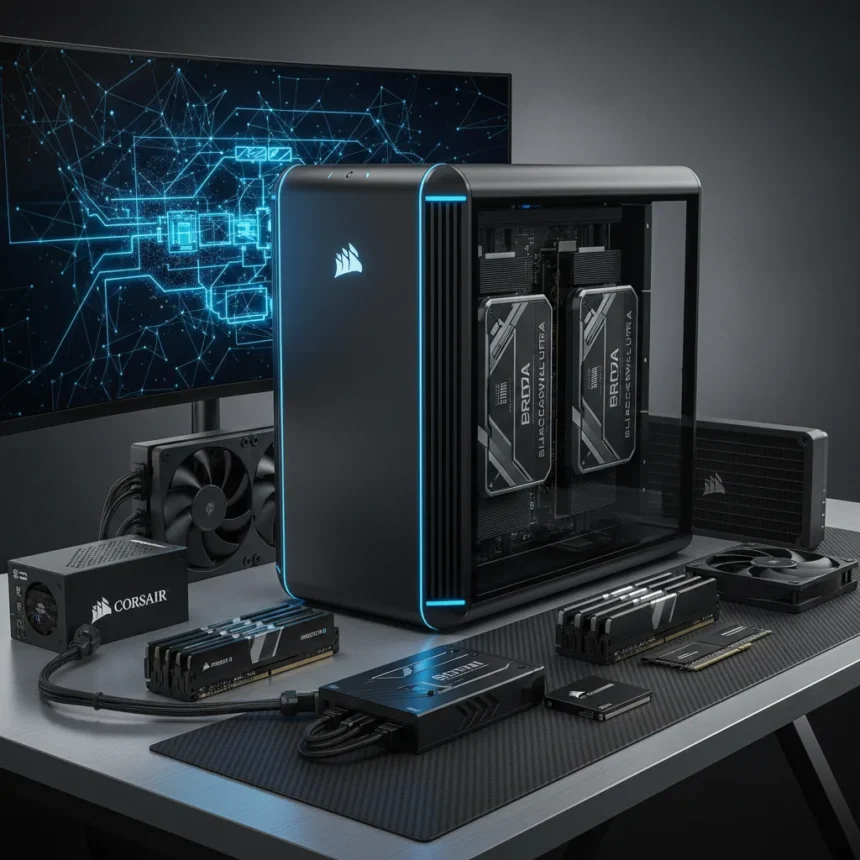
Corsair’s Pro lineup represents the company’s strategic pivot into AI workstations and servers, positioning itself directly in the path of enterprise demand for high-performance AI infrastructure. The lineup integrates Nvidia’s Grace Blackwell Ultra (GB300) GPUs, marking Corsair’s shift from consumer-focused PC manufacturing toward the rapidly expanding AI factory segment.
Key Takeaways
- Corsair Pro lineup targets AI workstations and servers using Nvidia Blackwell Ultra architecture
- GB300 NVL72 delivers 1.5x more AI performance than previous GB200 NVL72 generation
- Blackwell Ultra superchip combines one Grace CPU with two Blackwell Ultra GPUs via NVLink-C2C
- GB300 NVL72 achieves 1.1 exaFLOPS dense FP4 compute with 72 GPUs and 36 CPUs per rack
- Liquid cooling and fifth-generation NVLink enable sustained performance at scale
Why Corsair Is Moving Into AI Infrastructure
The market for AI workstations and servers has exploded as organizations race to deploy trillion-parameter language models and reasoning-focused AI systems. Traditional PC manufacturers face a choice: remain in the consumer segment or capture the higher-margin enterprise AI infrastructure opportunity. Corsair’s Pro lineup signals the company is choosing the latter. By building configurations around Nvidia’s newest Blackwell Ultra architecture, Corsair is positioning itself alongside established OEMs like ASUS and Exxact, which already offer GB300-based systems for enterprise deployment.
What makes this move timely is that Blackwell Ultra represents a fundamental shift in AI compute philosophy. Unlike previous generations focused primarily on training speed, Blackwell Ultra emphasizes inference, reasoning, and agentic AI workloads—the types of tasks that define the emerging AI factory era. For Corsair, this means tapping into demand from enterprises, hyperscale cloud providers, and research institutions that need purpose-built hardware rather than repurposed gaming rigs.
Blackwell Ultra Performance: What AI Workstations and Servers Gain
The Grace Blackwell Ultra superchip delivers up to 30 PFLOPS of dense AI compute and 40 PFLOPS of sparse compute, with 1 TB of unified memory combining HBM3E and LPDDR5X. At the rack scale, a GB300 NVL72 system—the foundational configuration for Corsair’s Pro lineup—achieves 1.1 exaFLOPS of dense FP4 compute, representing 1.5x more AI performance than the preceding GB200 NVL72 generation. Each system packs 72 Blackwell Ultra GPUs, 36 Grace CPUs, and 2,592 Arm Neoverse V2 cores, delivering 288 GB of HBM3e per GPU and 37 TB of fast memory across the entire rack.



The architecture includes fifth-generation NVLink with 130 TB/s bandwidth, NVLink-C2C for CPU-GPU coupling, and PCI-Express Gen 6 support. Blackwell Ultra also doubles attention-layer acceleration and increases AI compute FLOPS by 1.5x compared to earlier Blackwell designs. For AI workstations and servers, this means inference tasks that previously required multiple racks can now consolidate onto fewer systems, reducing power consumption and operational complexity.
How Corsair’s Pro Lineup Compares to Existing Alternatives
ASUS and Exxact already ship GB300-based systems, so Corsair is entering a competitive but still-nascent market. The distinction lies not in raw specs—all vendors building on the same Nvidia architecture will achieve similar performance—but in system integration, cooling design, and support infrastructure. Corsair’s heritage in high-performance PC cooling and modular system design gives it a potential edge in thermal management, a critical concern for AI workstations and servers running continuous inference workloads. Liquid cooling is standard across GB300 deployments, but implementation quality varies significantly between vendors.



The broader competitive context is the transition from GB200 to GB300. Earlier GB200 NVL72 systems emphasized training speed with 30X faster real-time inference for trillion-parameter LLMs. GB300 refocuses that advantage on reasoning and sparse compute, making it better suited for production inference where cost-per-token matters more than raw training throughput. Corsair’s decision to launch with GB300 rather than lingering on GB200 signals it understands this shift.
Enterprise Adoption and Market Timing
Nvidia positions Blackwell Ultra as the foundation for the AI factory era, emphasizing deployment at hyperscale and enterprise scales. Corsair’s Pro lineup arrives as enterprises move past experimentation and toward production AI infrastructure. Organizations deploying reasoning models, multi-step agentic workflows, and long-context inference need systems designed for sustained operation, not peak burst performance. AI workstations and servers that balance power efficiency, thermal stability, and serviceability become competitive differentiators.
The timing also reflects market consolidation. As AI infrastructure moves from research labs into production data centers, the vendors who can deliver reliable, well-integrated systems will capture the most valuable contracts. Corsair’s move suggests confidence that this consolidation is underway and that enterprise customers are ready to move beyond Nvidia reference designs.
What This Means for Corsair’s Business
Historically, Corsair built its reputation on gaming peripherals, power supplies, and enthusiast PC components. The Pro lineup represents a fundamental business diversification into enterprise infrastructure, where margins are higher and customer lock-in is stronger. Success in AI workstations and servers could transform Corsair from a consumer brand into a recognized enterprise OEM, opening doors to contracts with cloud providers, research institutions, and large-scale AI deployment teams.



The risk is execution. Enterprise customers demand 24/7 support, long-term component availability, and proven thermal and reliability performance. Corsair will need to demonstrate that its Pro lineup can operate reliably at scale, not just achieve impressive benchmark numbers in controlled environments.
Is Corsair’s Pro lineup worth considering for AI infrastructure?
If your organization is evaluating AI workstations and servers based on Blackwell Ultra, Corsair’s entry adds a credible option to a short list of vendors. The underlying hardware—Nvidia’s GB300 architecture—is proven and represents the current state of the art for inference and reasoning workloads. Corsair’s advantage lies in integration quality and thermal design, not raw performance specs. Evaluate based on your specific workload, cooling infrastructure, and support requirements rather than brand alone.
How does GB300 compare to earlier Blackwell generations?
GB300 NVL72 delivers 1.5x more AI performance than GB200 NVL72, with stronger emphasis on sparse compute and reasoning workloads. GB200 focused on training speed with 30X faster real-time inference for trillion-parameter models. GB300 refocuses that advantage on production inference where cost-per-token and reasoning capability matter more than peak throughput.
What cooling approach do AI workstations and servers require?
Liquid cooling is standard across GB300-based systems to manage the thermal output of 72 GPUs and 36 CPUs operating at full utilization. Air cooling alone cannot sustain the power density required for continuous inference workloads. Corsair’s expertise in liquid cooling design positions the Pro lineup to handle thermal challenges that many enterprises find challenging with first-generation deployments.
Corsair’s Pro lineup signals that the AI infrastructure market has matured beyond experimental deployments and one-off research projects. By building AI workstations and servers around Blackwell Ultra, Corsair is betting that enterprises are ready to standardize on purpose-built AI hardware. Whether that bet pays off depends on execution, support, and the company’s ability to compete against established enterprise OEMs. For now, the Pro lineup represents a credible entry into a market that will only grow as reasoning models and agentic AI become production staples.
Edited by the All Things Geek team.
Source: TechRadar




