





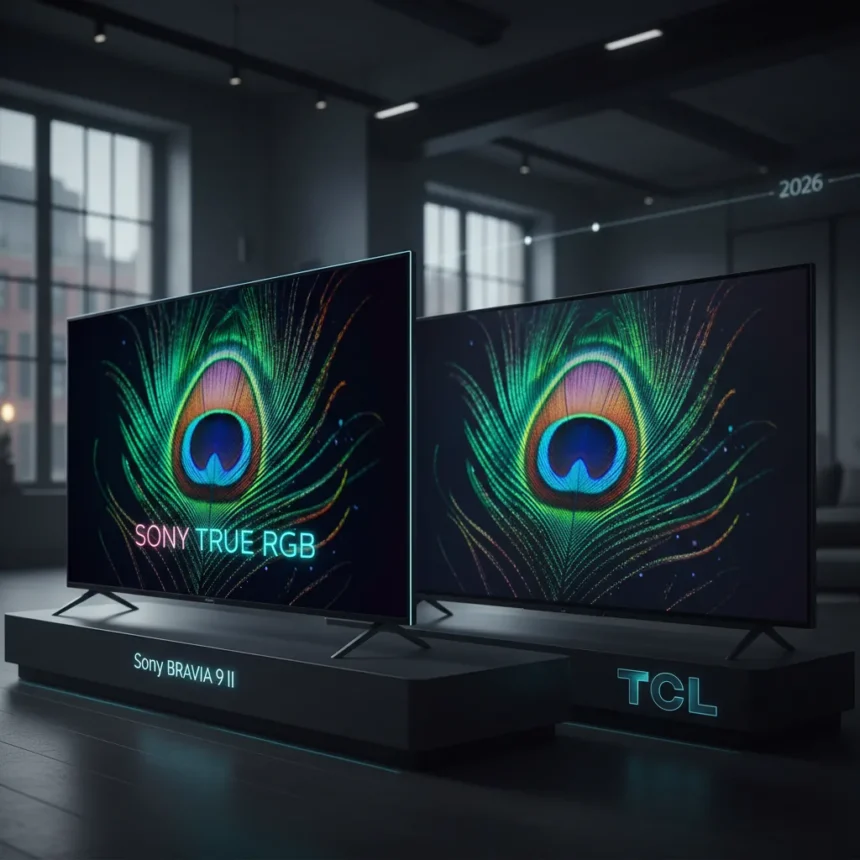
Sony True RGB TVs are finally moving from prototype demonstrations to real products, with the Bravia 9 II and Bravia 7 II set to launch in 2026. After years of showing off RGB backlight prototypes, Sony is committing to what it calls True RGB technology—a trademark-protected implementation that takes a fundamentally different approach than TCL’s competing RGB TV direction.
Key Takeaways
- Sony’s True RGB TVs launch in 2026 with the Bravia 9 II and Bravia 7 II leading the lineup.
- Sony’s RGB implementation differs architecturally from TCL’s RGB MiniLED approach.
- RGB backlighting is positioning itself as a challenger to OLED and Mini LED premium TV categories.
- Sony has demonstrated multiple RGB prototypes before settling on the Bravia 9 II and 7 II designs.
- A Sony-TCL joint venture for TV manufacturing is expected to begin operations in April 2027.
What Sony True RGB TVs Actually Are
Sony True RGB TVs represent a new category of premium television technology that uses red, green, and blue backlighting instead of the white LED or quantum dot systems found in conventional sets. The key distinction is how Sony implements this technology compared to competitors. While TCL and Hisense label their approach RGB MiniLED, and Samsung and LG pursue Micro RGB variants, Sony has chosen to trademark its implementation as True RGB, signaling a proprietary architecture that diverges from the industry’s other RGB strategies.
The Bravia 9 II sits at the top of Sony’s 2026 TV lineup and represents the flagship expression of True RGB technology. The Bravia 7 II offers a step down but still carries the True RGB badge. Neither set has been fully specified in consumer-facing detail yet—Sony has kept the technical specifications, brightness targets, panel sizes, and exact performance metrics under wraps during the prototype phase. This is typical for Sony’s TV launches, where final specs often remain confidential until closer to market availability.
How Sony True RGB Differs from TCL’s RGB Strategy
The framing of Sony’s True RGB as distinct from TCL’s approach reveals a fundamental architectural difference between the two manufacturers. TCL’s RGB MiniLED implementation combines miniaturized LED backlighting with red, green, and blue color channels, optimizing for cost and manufacturing scale. Sony’s True RGB, by contrast, appears designed as a more premium-tier solution, suggesting a different balance between color accuracy, brightness, and production complexity.



This matters because 2026 is shaping up to be a transformative year for premium TV technology, with RGB backlighting poised to challenge OLED’s dominance and Mini LED’s market position. Each manufacturer’s RGB implementation reflects different engineering priorities. Samsung and LG pursuing Micro RGB suggests a focus on miniaturization, while Sony’s trademarked True RGB branding implies a proprietary advantage Sony believes justifies its own product tier. Without full technical specifications available yet, the exact performance differences remain unclear, but the naming strategy alone signals that Sony is not simply adopting an off-the-shelf RGB approach—it is building its own.
The Road to 2026 and Beyond
Sony has demonstrated RGB TV prototypes multiple times before settling on the Bravia 9 II and Bravia 7 II as its launch vehicles. This iterative approach is common for display technology, where manufacturers refine color accuracy, brightness, and thermal management across multiple generations of prototypes before committing to production tooling. The 2026 launch timeline gives Sony time to finalize manufacturing partnerships and ensure supply chain readiness for what could be a high-demand premium category.



Interestingly, Sony’s TV business is undergoing significant structural changes. A joint venture between Sony and TCL is expected to begin operations in April 2027, which will handle Sony’s TV manufacturing and operations. This timing creates a unique situation where Sony is launching True RGB TVs in 2026 under its current operations structure, then transitioning to TCL-manufactured sets under the joint venture a year later. The implications for True RGB’s future production and availability across regions remain to be seen, but the partnership suggests Sony views its TV business as strategically important enough to warrant deeper integration with a major display manufacturer.
Why This Matters Now
RGB backlighting is not a marginal technology—it is being positioned as the next major premium TV category, with Samsung, LG, TCL, and Hisense all developing competing versions. Sony’s entry with a trademarked True RGB approach signals that the company is taking this transition seriously and believes it can differentiate on implementation quality rather than simply matching competitors’ specs. For consumers shopping in 2026, this means the premium TV market will fragment into OLED, Mini LED, and multiple flavors of RGB technology, each with its own strengths and trade-offs.
The fact that Sony is willing to trademark and brand its RGB implementation separately from TCL’s approach suggests confidence that True RGB will be recognized as a distinct product category, not just another RGB variant. Whether that confidence is justified will depend on how the Bravia 9 II and Bravia 7 II perform in real-world viewing and how aggressively Sony prices them relative to OLED and Mini LED competitors.
Will Sony True RGB TVs Replace OLED?
RGB backlighting is being positioned as a potential OLED challenger, but it is not a direct replacement. OLED’s self-emissive pixel technology delivers perfect blacks and infinite contrast in a way that backlighting—even RGB backlighting—cannot match. RGB TVs are likely to excel in bright room performance and peak brightness, where they may outshine OLED. The real question is whether consumers value those strengths enough to switch from OLED’s contrast superiority, and that will only be answered once the Bravia 9 II and 7 II hit the market in 2026.



When will Sony True RGB TVs be available?
Sony plans to launch True RGB TVs in 2026, starting with the Bravia 9 II and Bravia 7 II. No specific release date within 2026 has been announced yet, and regional availability details have not been disclosed. Pricing and exact model configurations remain unconfirmed as well.
How does Sony True RGB compare to Mini LED?
Mini LED uses miniaturized white LEDs with dimming zones to control brightness and contrast, while RGB TVs like Sony’s True RGB use separate red, green, and blue backlights for color control. RGB is expected to deliver superior color accuracy and brightness potential, but Mini LED has a maturity advantage and lower production costs. Both are being positioned as premium alternatives to OLED in 2026.
Sony’s commitment to True RGB technology in 2026 signals that the company believes RGB backlighting will become a significant premium TV category. Whether True RGB lives up to the hype depends entirely on execution—how well the Bravia 9 II and 7 II perform in brightness, color accuracy, and reliability when they finally arrive. For now, Sony is betting that its proprietary implementation will justify its flagship positioning and carve out a distinct space between OLED and Mini LED in the premium TV market.
Where to Buy
Sony Bravia 7 55-inch Mini LED TV
Edited by the All Things Geek team.
Source: T3




