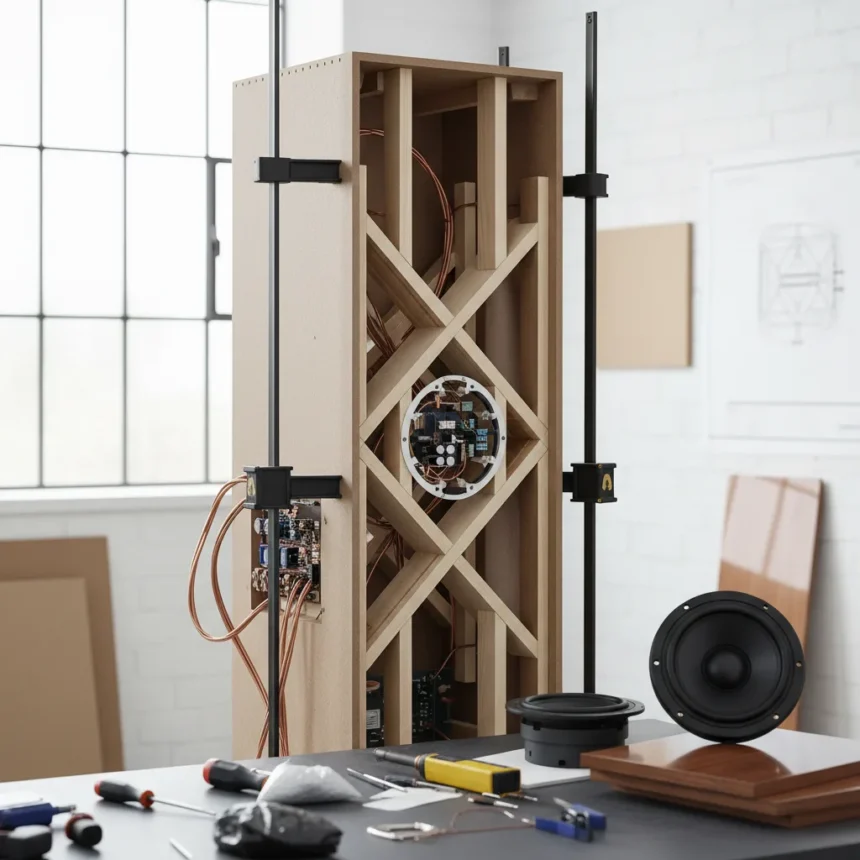
Floorstanding speakers engineering presents challenges that many manufacturers underestimate. The core problem is simple: bigger cabinets mean bigger problems. When you scale up a speaker enclosure from bookshelf to floorstanding dimensions, you are not just making a larger version of the same design—you are introducing a cascade of engineering complications that demand precision at every stage.
Key Takeaways
- Floorstanding speakers require rigid cabinets to prevent unwanted panel vibration and structural resonance.
- Cabinet dimensions, driver placement, and internal volume are interdependent design variables that must align precisely.
- Consistency in construction is critical—small variations in larger enclosures compound into audible flaws.
- Larger speaker boxes demand more attention to port design and baffle dimensions than smaller alternatives.
- A stereo speaker’s performance depends on how accurately the drivers move, which cabinet rigidity directly affects.
The Vibration Problem in Large Enclosures
Vibration control is where floorstanding speakers engineering diverges sharply from bookshelf design. A larger cabinet has more surface area, which means more panels that can vibrate sympathetically when drivers push air. Those vibrations are not just noise—they are energy bleeding away from the sound you actually want to hear, replaced by coloration and distortion that muddies the midrange and clouds the treble. A solid cabinet that prevents extraneous vibration of the panels is the foundation of any competent floorstanding design.
The engineering challenge compounds because size amplifies the problem. A small bookshelf speaker can sometimes tolerate minor panel flex. A floorstanding cabinet cannot. The larger the box, the more critical the bracing strategy becomes. Internal bracing, material choice, and panel thickness all interact to determine whether a cabinet remains inert or becomes a secondary resonator that pollutes the audio signal.
Design Variables That Cannot Be Improvised
Speaker cabinet design depends heavily on three interdependent variables: the placement of drivers and ports, the dimensions of the front baffle, and the internal volume of the cabinet. Change one, and you must recalculate the others. This is where consistency becomes non-negotiable. A floorstanding speaker is not a collection of independent components—it is a system where every dimension and decision ripples through the acoustic behavior of the entire box.



The front baffle dimensions determine how drivers interact with each other and with the room. Port placement affects bass response and the cabinet’s internal pressure dynamics. Internal volume sets the acoustic compliance that the woofer feels, which changes its effective resonance frequency. Get any of these wrong, and the speaker sounds bloated, thin, or colored. Get them all right, and the drivers move accurately—which is the ultimate goal of any stereo speaker. Manufacturers who rush through these calculations or treat them as secondary concerns end up with floorstanding speakers that disappoint despite impressive specifications on paper.
Why Consistency Matters More in Bigger Boxes
Consistency is key when building floorstanding speakers. This is not just a slogan—it is an engineering imperative. In a small bookshelf, a tolerance stack-up of a few millimeters might be inaudible. In a floorstanding cabinet, the same tolerance accumulation can shift the cabinet’s resonance frequency by several hertz, changing how the woofer couples to the room and altering the bass character. Manufacturing variation that would be acceptable in a compact design becomes a liability in a larger one.



This is why the best floorstanding speaker manufacturers obsess over quality control. They measure cabinet dimensions repeatedly. They verify bracing geometry. They test driver placement tolerances. They understand that a floorstanding speaker is only as good as its least precise component, and in a large enclosure, precision is harder to maintain. A builder working with a larger cabinet cannot afford the casual approach that sometimes works for smaller designs.
Floorstanding vs. Bookshelf: The Scaling Problem
The difference between floorstanding speakers engineering and bookshelf design reveals itself when you try to simply enlarge a proven compact model. Bookshelf speakers benefit from their compactness—smaller panels are naturally stiffer, internal volumes are easier to control, and driver interaction is more forgiving. Floorstanding designs cannot rely on these advantages. The larger cabinet introduces resonance modes that smaller boxes never experience. The woofer operates in a larger internal volume, which changes its acoustic behavior. Ports that work in a compact design may need redesign for a floorstanding application.
Some manufacturers attempt to scale bookshelf designs upward without accounting for these differences. The result is a floorstanding speaker that sounds bloated in the bass, lacks coherence between drivers, or exhibits resonant peaks that color the midrange. Competent floorstanding engineering means starting from first principles for the larger format, not simply stretching dimensions proportionally.
Why Bigger Boxes Demand Better Engineering
The engineering rigor required for floorstanding speakers is higher than many casual listeners realize. A stereo speaker consists of an enclosure, drivers, and crossover, and the enclosure’s quality directly determines how accurately the drivers can move. In a floorstanding cabinet, the enclosure must be rigid enough to isolate driver motion from panel vibration. It must maintain precise internal volumes. It must accommodate driver placement that achieves proper acoustic integration. It must house bracing that does not interfere with internal volume or create acoustic dead spots.



This is why floorstanding speakers from reputable manufacturers cost what they do. The engineering is not hidden in exotic materials or marketing hype—it is in the precision of execution. Every dimension matters. Every decision cascades through the acoustic system. A floorstanding speaker that performs well is the result of careful calculation, rigorous testing, and manufacturing discipline. A floorstanding speaker that disappoints is often the result of treating the larger format as simply a bigger version of a smaller design.
Can You Build a Floorstanding Speaker Yourself?
DIY floorstanding speaker construction is possible, but it demands more precision than many hobbyists expect. You must understand cabinet design principles, calculate internal volumes and port dimensions correctly, and have the tools and patience to build a rigid enclosure. Small mistakes compound in larger boxes. A misplaced port or miscalculated baffle dimension will audibly degrade performance in a floorstanding design in ways that might be forgivable in a compact build.
The barrier to success is not complexity—it is consistency. You need accurate plans, quality materials, and the discipline to execute those plans exactly as designed. Improvising dimensions or skipping bracing steps will result in a floorstanding speaker that underperforms relative to the cost of materials and time invested.
What makes floorstanding speakers harder to build than bookshelves?
Larger cabinets introduce more surface area that can vibrate, more internal volume to control, and more resonance modes that can color the sound. Small manufacturing tolerances that are acceptable in compact designs become problematic in floorstanding enclosures. The interdependence of driver placement, baffle dimensions, and internal volume means that changes in one area require recalculation of others.
How important is cabinet bracing in floorstanding speaker design?
Cabinet bracing is critical. Bracing prevents panel vibration, which would otherwise leak energy from the audio signal and introduce coloration. In larger floorstanding cabinets, inadequate bracing becomes immediately audible as a loss of clarity and definition, especially in the midrange.
Can a floorstanding speaker design be scaled up from a bookshelf model?
Direct scaling rarely works. Larger cabinets exhibit different resonance modes, change how drivers interact with internal volume, and require different port designs. Competent floorstanding engineering starts from first principles for the larger format rather than simply enlarging proportions.
Floorstanding speakers engineering is not mysterious, but it is unforgiving. The larger the cabinet, the less tolerance for error. Manufacturers and builders who succeed understand that consistency, precision, and respect for acoustic principles are not optional—they are the foundation of floorstanding speaker design. Cut corners on cabinet rigidity or dimensional accuracy, and you end up with a large box that sounds worse than a well-executed compact design at half the price.
Edited by the All Things Geek team.
Source: What Hi-Fi?