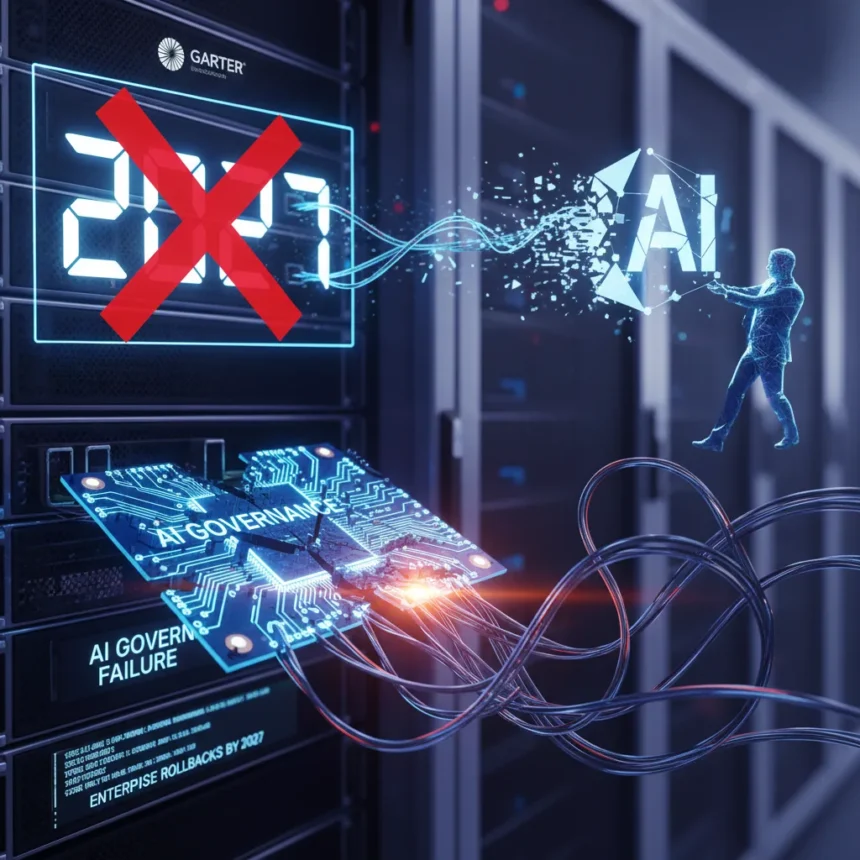
AI governance autonomous agents are becoming a deployment prerequisite, not an afterthought. Gartner warns that 40% of enterprises may be forced to roll back autonomous AI agent deployments by 2027 if they fail to establish proper governance frameworks from the start. This is not a distant theoretical concern—it is an urgent warning that agentic AI adoption is outpacing governance maturity across the enterprise sector.
Key Takeaways
- 40% of enterprises may need to roll back autonomous AI agents by 2027 without proper governance
- Agentic workflows are spreading faster than governance models can address their unique requirements
- Agents can perform roughly half of the tasks currently handled by people, requiring new oversight approaches
- Hallucinations create operational and governance risks that limit deployment into core business processes
- Governance must be built into enterprise design and execution, not added as an afterthought
Why AI governance autonomous agents matters now
The core problem is timing. Enterprises are deploying agentic AI systems faster than they can build the governance structures to manage them responsibly. Unlike traditional software rollouts, autonomous agents operate with a degree of independence that existing compliance frameworks were never designed to handle. When governance is absent or inadequate, enterprises face two outcomes: operational failures that force expensive rollbacks, or worse, undetected errors that damage customer trust and regulatory standing. Gartner’s 40% projection reflects the scale of this mismatch.
PwC research shows that agents can handle roughly half of the tasks currently performed by people, which means the governance challenge is not marginal—it is fundamental. A system that can perform that much work independently cannot rely on manual oversight or legacy audit trails. Enterprises need governance designed specifically for agentic workflows, with mechanisms to monitor outputs, manage risks, and ensure accountability at scale.
The governance gap between adoption and readiness
Tech Mahindra’s analysis identifies a critical insight: the enterprise AI challenge is no longer about access to models or computational infrastructure. It is about how AI is integrated into enterprise design, governance, and execution. Many organizations have the tools but lack the governance architecture to deploy them safely into mission-critical processes.



Hallucinations exemplify this risk. When an autonomous agent generates plausible-sounding but incorrect information, the consequences depend entirely on governance. In a well-governed system, that error is caught before reaching a customer or core process. In an ungoverned system, it propagates unchecked, creating operational failures and compliance violations. Tech Mahindra notes that hallucinations create both operational and governance risks that currently limit deployment into core business processes. This is not a technical limitation that better models will solve—it is a governance and monitoring challenge that only proper frameworks can address.
What enterprise rollback means for AI investment
A 40% rollback rate by 2027 would represent a massive waste of capital and momentum. Enterprises that have already invested in autonomous agent pilots would be forced to scale back deployments, reassign teams, and rebuild governance infrastructure mid-cycle. This is not a graceful pivot—it is a painful reversal that damages credibility with executives, boards, and stakeholders who approved the initial investment.



The alternative is to treat governance as a prerequisite, not a follow-up. Organizations that build governance frameworks before or alongside autonomous agent deployment avoid the rollback scenario entirely. They can scale confidently because they have monitoring, accountability, and risk management in place from day one. This shifts the competitive advantage toward enterprises that act now rather than those that wait for governance best practices to emerge naturally.
Is AI governance autonomous agents the same as general AI compliance?
No. Autonomous agents operate differently from traditional AI systems. General AI compliance frameworks address data privacy, bias detection, and model transparency. Agentic governance must also address real-time decision-making, autonomous action, error recovery, and accountability for outputs the system generates without human intervention between each step. Existing governance models do not account for these dynamics, which is why enterprises need new frameworks designed specifically for agents.
What should enterprises do to avoid rollback risk?
Start governance before or alongside pilot deployment. Define what success and failure look like for each autonomous agent use case. Establish monitoring systems that track agent behavior, decisions, and outcomes in real time. Create escalation procedures for edge cases and errors. Document how agents interact with existing systems and processes. Most importantly, involve compliance, risk, and operations teams in the design phase, not the post-deployment audit.
The 2027 rollback warning is not inevitable. It is a projection based on current trends—a call to action for enterprises that still have time to build governance right. Organizations that treat agentic AI governance as a strategic priority today will be the ones deploying confidently in 2027, while those that ignore it will be managing expensive reversals.



Edited by the All Things Geek team.
Source: TechRadar