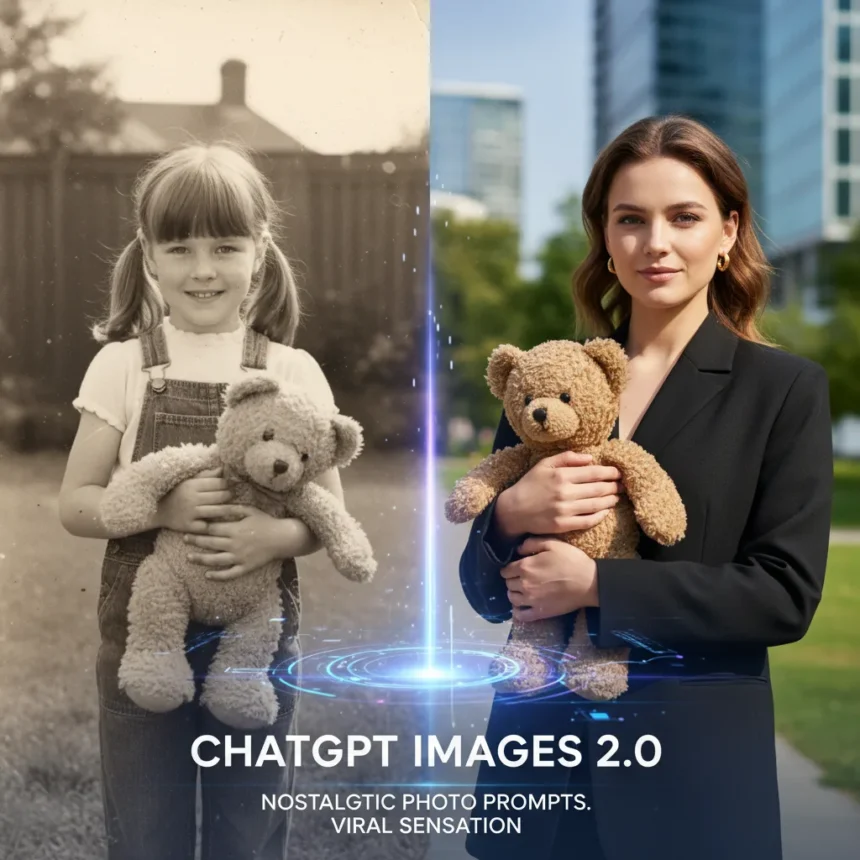
ChatGPT Images 2.0 has sparked a viral trend where users upload personal photographs to generate imaginative images of themselves meeting their childhood selves, blending nostalgia with AI creativity in ways that have captured widespread attention across social media.
Key Takeaways
- ChatGPT Images 2.0 enables users to create images depicting encounters with their childhood selves using personal photos.
- The nostalgic photo prompt has gone viral on social platforms, driving engagement and creative experimentation.
- Users combine two personal photographs to generate a single composite image showing past and present meeting.
- The trend demonstrates growing interest in emotionally resonant AI image generation beyond standard product photography.
- The feature highlights how ChatGPT Images 2.0 handles complex multi-reference prompts involving personal imagery.
What Makes This ChatGPT Images 2.0 Prompt So Compelling
The viral nostalgic prompt works by asking users to provide two photographs—one from childhood and one recent—then requesting ChatGPT Images 2.0 to generate a single image showing both versions of the person meeting. The emotional appeal lies in the juxtaposition: viewers see their younger selves encountering their adult present, often in imaginative settings or scenarios. This taps into a universal human experience—curiosity about how our past selves would react to who we have become.
What separates this trend from typical AI image generation is its personal, reflective quality. Rather than generating abstract art or product mockups, users are creating deeply individual narratives. The prompt forces ChatGPT Images 2.0 to interpret and synthesize facial features, expressions, and context from two separate images, a task that requires understanding composition, emotion, and coherence across multiple references.
The viral momentum suggests that people are hungry for AI tools that facilitate introspection and storytelling, not just efficiency or entertainment. ChatGPT Images 2.0 delivers both by making the technical complexity invisible—users simply upload photos and describe what they want to see.



How ChatGPT Images 2.0 Handles Multi-Reference Prompts
ChatGPT Images 2.0 distinguishes itself from earlier image generation models by accepting multiple reference images and weaving them into a coherent output. The nostalgic prompt exploits this capability by anchoring the generation to specific facial features and contexts from both photographs. Rather than generating a generic image of two people, the model attempts to preserve recognizable elements from each input.
This multi-reference approach opens possibilities beyond nostalgia prompts. Users could theoretically ask ChatGPT Images 2.0 to imagine family members in shared scenarios, recreate lost photographs with AI-enhanced detail, or explore hypothetical timelines. The flexibility suggests that future viral prompts may emerge as people discover new ways to layer personal meaning into AI-generated images.



The trade-off is control. Users cannot fine-tune every detail of the output—they rely on how well the model interprets their written description alongside the visual references. Some results will be striking and emotionally resonant; others may miss the mark. That unpredictability is part of what makes sharing these images socially compelling.
Why Personal AI Image Generation Is Gaining Momentum
The success of this ChatGPT Images 2.0 trend reflects a broader shift in how people engage with generative AI. Early adoption focused on productivity—writing emails, summarizing documents, coding assistance. Image generation initially centered on commercial use cases: marketing, design, product visualization. But as these tools mature, creators and everyday users are discovering emotional and creative applications.
The nostalgic photo prompt succeeds because it is low-stakes and high-reward. Anyone with a smartphone can gather the reference images needed. The output is shareable, conversation-starting, and deeply personal without requiring artistic skill. Unlike a commissioned portrait or professional photography, this approach democratizes a form of creative expression that previously required either talent or money.
ChatGPT Images 2.0 benefits from being embedded in a conversational AI platform. Users can iterate on prompts, ask follow-up questions, and refine results through dialogue. This differs from standalone image generators where interaction is often limited to a single upload-and-generate cycle. The conversational layer adds a dimension of creative collaboration that may be driving the trend’s staying power.


Comparing ChatGPT Images 2.0 to Other Image Generators
ChatGPT Images 2.0 competes in a crowded space alongside tools like Midjourney, DALL-E, and Stable Diffusion. Each has strengths: Midjourney excels at stylized, artistic outputs; Stable Diffusion offers open-source flexibility and lower costs; DALL-E integrates with ChatGPT but has faced criticism for certain limitations. What ChatGPT Images 2.0 brings is accessibility through conversation and the ability to handle multi-reference prompts in a user-friendly interface.
The nostalgic photo trend may not have gained the same traction on a tool that required learning technical prompt syntax or navigating a separate application. The fact that users can simply describe their intention to ChatGPT and upload images directly lowers the barrier to experimentation. This ease of access is a competitive advantage that other generators, despite superior image quality in some cases, have not fully replicated.
Will This Trend Fade or Evolve?
Viral AI trends typically follow a predictable arc: rapid adoption, saturation, and decline. However, the nostalgic photo prompt has staying power because it taps into something deeper than novelty. As long as people feel nostalgic and curious about their own timelines, this use case will persist. What may change is the specific prompt format—users may expand the concept to imagine future selves, alternate versions, or family scenarios.
OpenAI has shown willingness to highlight user-generated trends in ChatGPT’s marketing and documentation. If this nostalgic prompt continues to generate engagement and positive sentiment, ChatGPT Images 2.0 may become more widely associated with personal, emotionally resonant image generation rather than purely commercial or technical applications.
Can I use ChatGPT Images 2.0 with any personal photos?
Yes, ChatGPT Images 2.0 accepts most standard image formats and does not restrict you to specific photo types. The quality of the output depends on image clarity and how well the model can extract facial features and context from your uploads. Clearer, well-lit photographs typically yield better results than blurry or low-contrast images.
Is the nostalgic photo prompt available to all ChatGPT users?
The nostalgic photo prompt is a user-created use case, not an official feature within ChatGPT. Any user with access to ChatGPT Images 2.0 can attempt the prompt by describing the concept and uploading their reference images. Availability may depend on your ChatGPT subscription tier and regional access to image generation features.
What happens if the AI cannot recognize faces in my photos?
If ChatGPT Images 2.0 struggles to extract clear facial features from your reference images, the output may be less recognizable or coherent. The model works best with well-composed portraits where faces are clearly visible and well-lit. Heavily edited, obscured, or extremely old photographs may produce less satisfying results, though the model will still attempt to generate an image based on your written description.
The viral success of the nostalgic photo prompt on ChatGPT Images 2.0 reveals something important about where generative AI is heading: away from pure utility and toward tools that help us explore identity, memory, and emotion. Whether you are chasing a fleeting trend or genuinely curious about how your younger self would react to your present, this feature demonstrates that AI image generation has matured beyond commercial applications into deeply personal creative territory.
Edited by the All Things Geek team.
Source: TechRadar