



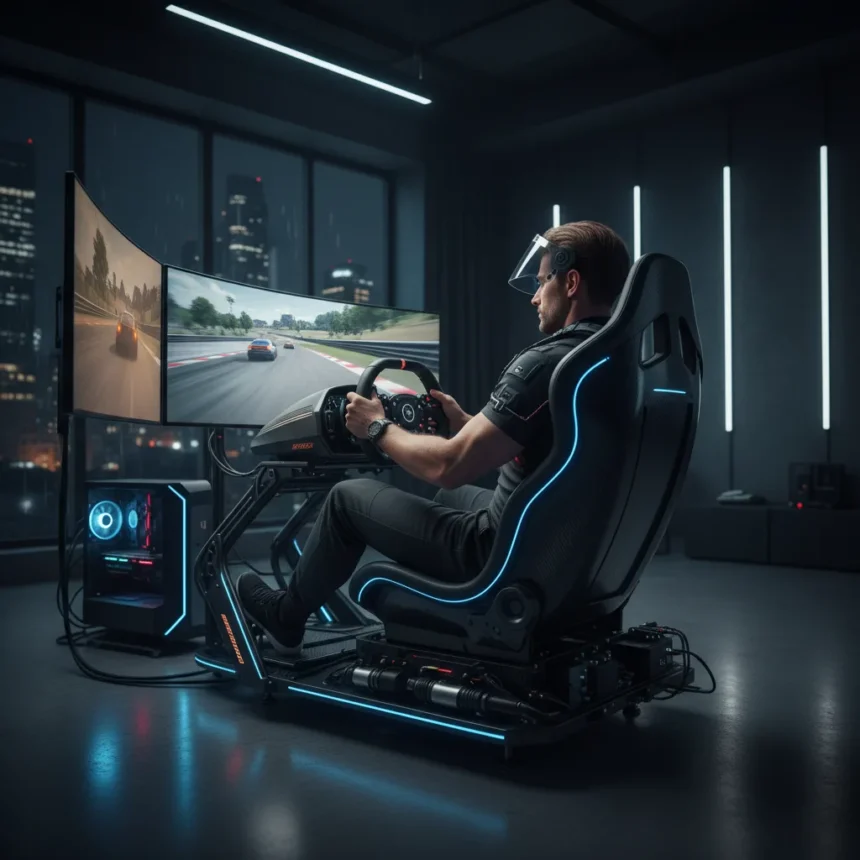
Haptic racing seats represent a fundamental shift in how PC sim racing delivers immersion. These devices use tactile feedback to translate track vibrations, engine rumble, and collision impacts directly into the driver’s body, creating a sensory experience that blurs the line between virtual and physical racing. The technology goes beyond traditional force feedback steering wheels by engaging the entire seat, making the simulation feel so convincing that drivers report struggling to believe they’re playing a video game indoors rather than experiencing an actual racetrack.
Key Takeaways
- Haptic racing seats deliver full-body tactile feedback that transforms PC sim racing immersion dramatically.
- The technology makes indoor racing feel racetrack-realistic, engaging drivers’ sense of touch and motion.
- Haptic seats represent a significant evolution beyond traditional force feedback wheels in sim racing.
- This innovation is positioned as the next major leap in video game immersion technology.
- Full-body haptics engage multiple sensory channels simultaneously for heightened realism.
How Haptic Racing Seats Create Racetrack Realism
Haptic racing seats work by translating in-game physics into physical vibrations and movements. Every engine rev, tire slip, curb strike, and collision generates corresponding tactile feedback through the seat. This full-body engagement creates a multi-sensory experience that traditional steering wheel force feedback alone cannot replicate. The seat communicates what the driver is experiencing through touch, making subtle track conditions, weight transfer, and vehicle dynamics physically apparent rather than merely visual or auditory.
The immersion effect is so convincing that drivers report a genuine disorientation when they remove themselves from the seat. The brain receives consistent sensory input confirming that the experience is real—the body feels vibrations matching what the eyes see on screen, the ears hear through the audio, and the hands feel through the wheel. This sensory alignment eliminates the cognitive disconnect that normally separates PC gaming from reality, creating what users describe as an almost indistinguishable simulation experience.
Haptic Racing Seats vs. Traditional Sim Racing Setups
Standard PC sim racing rigs rely on force feedback steering wheels and visual/audio cues. While effective, these setups leave the driver’s torso and lower body disengaged from the simulation. Haptic racing seats fill this gap by delivering vibration and motion directly to the seat surface, engaging the entire body in the feedback loop. This creates a more complete sensory picture—drivers feel not just what the wheel is doing, but what the entire vehicle is experiencing.


The comparison highlights why haptic technology is being positioned as the next major evolution in sim racing immersion. Traditional setups excel at steering feedback but cannot communicate track texture, braking force, or lateral acceleration through the driver’s core. Haptic seats address this limitation by making the entire driving position a feedback device, transforming a primarily visual-and-audio experience into a truly multisensory one.
Why Haptic Feedback Matters for Sim Racing Authenticity
Racing drivers rely on feel. Professional drivers describe sensing track conditions through their body, understanding vehicle behavior through vibration and motion, and making split-second decisions based on tactile cues. Haptic racing seats replicate this critical sensory channel in digital form. When a driver feels the seat vibrate during a slide, their muscle memory and instinctive responses activate in ways that visual information alone cannot trigger.



This tactile authenticity also improves performance consistency. Drivers who practice on haptic-equipped rigs develop muscle memory and racing lines that transfer more directly to real-world driving or to racing on non-haptic systems. The added sensory dimension makes the simulation more neurologically authentic, engaging the same sensory processing pathways that actual racing demands.
Is a Haptic Racing Seat Worth the Investment?
For serious sim racers, competitive esports participants, and drivers using simulation for skill development, haptic racing seats represent a meaningful upgrade. The immersion improvement is substantial enough that users report difficulty returning to non-haptic setups. For casual racing game players, the cost-to-enjoyment ratio depends on how much immersion and realism matter relative to other priorities.
The technology signals a broader shift in gaming peripherals toward full-body sensory engagement. As haptic racing seats become more established, they are likely to become a standard component of high-end sim racing rigs, similar to how force feedback wheels are today. Early adopters gain the immersion advantage now; later buyers will benefit from more mature products and potentially lower prices.
What makes haptic racing seats different from force feedback wheels?
Force feedback wheels communicate steering input and resistance through the wheel itself. Haptic racing seats engage the entire body by delivering vibration and motion through the seat surface. This full-body approach creates a more complete sensory experience that wheels alone cannot provide, making track conditions, acceleration, and collisions physically apparent across the driver’s core rather than just through hand and arm feedback.


Can haptic racing seats improve actual racing performance?
Yes, for drivers using simulation as a training tool. The added sensory feedback helps drivers develop more authentic muscle memory and instinctive responses to vehicle behavior. This tactile authenticity means skills developed on a haptic-equipped rig transfer more effectively to non-haptic systems or to real-world driving, since the training engages the same sensory processing that actual racing demands.
Are haptic racing seats compatible with all racing games?
Compatibility depends on the specific seat and game. Most haptic racing seats are designed to work with PC-based racing simulations that support motion or haptic input, though not all racing games offer native haptic support. Prospective buyers should verify compatibility with their preferred racing titles before purchasing, as support varies across different games and platforms.
Haptic racing seats represent a genuine inflection point in sim racing technology. They close the sensory gap between digital and physical racing by engaging the entire body in the feedback experience. For drivers serious about immersion or skill development, this technology delivers on its promise—the experience genuinely feels like being on a racetrack rather than sitting at a PC. As the technology matures and becomes more widely adopted, haptic feedback is likely to become the new baseline expectation for high-end sim racing, reshaping how drivers expect racing games to feel.
Edited by the All Things Geek team.
Source: Windows Central