





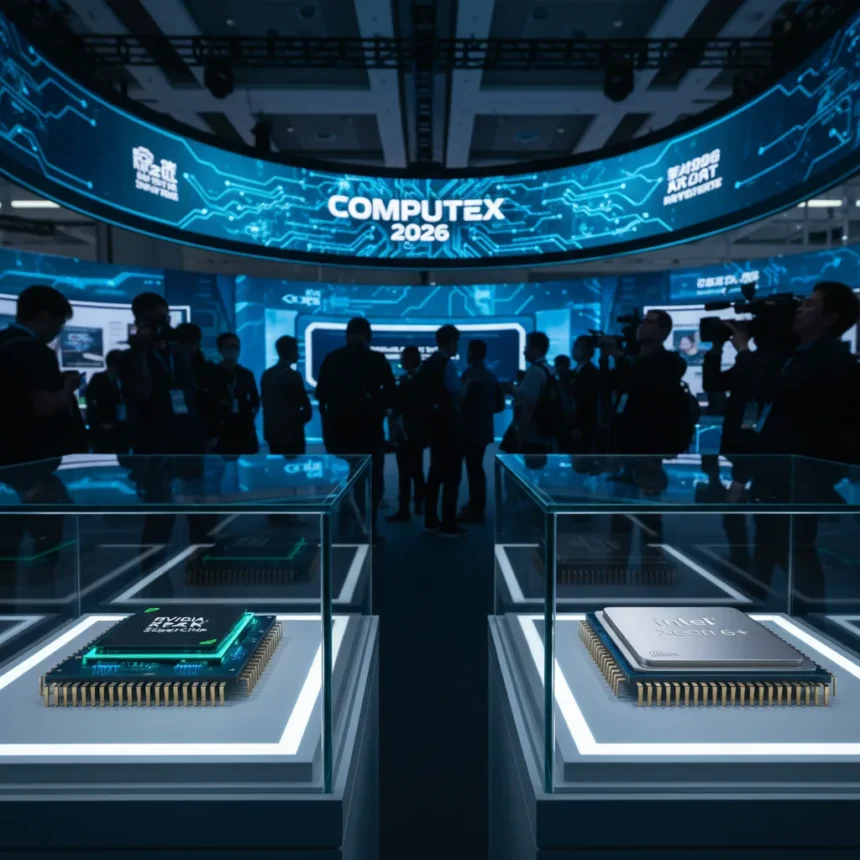
Computex 2026 announcements kicked off with two of the chip industry’s heavyweights unveiling their most aggressive hardware pushes in years. Nvidia launched the RTX Spark Superchip targeting both laptop and desktop markets, while Intel prepared its Xeon 6+ processor to defend its enterprise foothold. The opening day of Asia’s largest tech conference signaled an intensifying battle for dominance across consumer and professional computing segments.
Key Takeaways
- Nvidia’s RTX Spark Superchip targets both laptop and desktop computing markets simultaneously
- Intel’s Xeon 6+ represents the company’s next-generation enterprise processor strategy
- Computex 2026 Day Zero announcements set the tone for a hardware-focused conference season
- Both companies are expanding beyond their traditional market strongholds
- The announcements signal intensifying competition in AI-accelerated and professional computing
Nvidia’s RTX Spark Superchip: A Dual-Market Assault
Nvidia’s Computex 2026 announcements centered on the RTX Spark Superchip, a processor designed to serve both laptop users and desktop builders. This dual-market approach represents a significant shift in Nvidia’s positioning strategy, moving beyond its traditional focus on discrete graphics cards toward integrated solutions that span form factors. The superchip designation suggests a unified architecture combining GPU, CPU, and memory components on a single die, a design philosophy that could reshape how manufacturers approach portable and stationary computing devices.
The RTX Spark targets the growing demand for AI-capable computing at the edge and in consumer devices. Laptops have become primary workstations for professionals, and the desktop market remains crucial for content creators, engineers, and enthusiasts. By designing a single chip that addresses both segments, Nvidia is attempting to consolidate its influence across markets where competitors like Intel and AMD have traditionally held stronger positions. The laptop market especially has seen rapid adoption of AI features, making Nvidia’s timing strategically significant.
What distinguishes the RTX Spark announcement from typical hardware reveals is its scope. Rather than a single product, Nvidia is launching an entire ecosystem assault, positioning the superchip as the foundation for a new generation of devices. This approach mirrors successful strategies in mobile computing, where a single architecture can power devices ranging from budget models to premium flagships.


Intel’s Xeon 6+ and the Enterprise Defense
Intel’s Computex 2026 announcements regarding the Xeon 6+ indicate the company is preparing a comprehensive response to competitive pressure in the data center and professional computing spaces. The Xeon line has historically been Intel’s most profitable segment, and the 6+ designation suggests an incremental but meaningful upgrade rather than a revolutionary redesign. This measured approach reflects Intel’s need to balance innovation with stability in enterprise environments where customers prioritize reliability over raw performance leaps.
The Xeon 6+ announcement arrives as enterprises increasingly deploy AI workloads alongside traditional computing tasks. Intel’s strategy appears focused on offering a processor that handles both conventional workloads and emerging AI applications without forcing customers to replace infrastructure. This differs from Nvidia’s more aggressive push into new market segments, reflecting the different competitive positions and customer bases of the two companies.


Enterprise customers typically adopt new processors on longer cycles than consumer markets, making Intel’s readiness to announce the Xeon 6+ a signal that the company expects significant demand once the processor reaches availability. The enterprise segment values backward compatibility and ecosystem maturity, advantages Intel retains despite recent competitive challenges.
Computex 2026 Announcements Signal Market Realignment
The opening-day announcements at Computex 2026 reveal a hardware industry in transition. Nvidia’s aggressive push into laptops and desktops challenges Intel’s traditional strongholds in consumer computing, while Intel’s Xeon 6+ demonstrates the company’s commitment to defending its enterprise fortress. Neither company is content with its current market position, and both are betting that emerging AI capabilities will reshape customer priorities and create new opportunities for differentiation.
The timing of these announcements during Computex‘s opening hours suggests both companies view the conference as the premier venue for reaching decision-makers and industry observers. In previous years, Computex announcements focused on incremental improvements and niche products. This year’s Day Zero reveals indicate a return to high-stakes competition where major product categories are being redefined.
Market watchers should note that Computex 2026 announcements typically precede actual product availability by several months. The RTX Spark Superchip and Xeon 6+ are strategic declarations of intent, not immediate shipping products. Customers and analysts will need to wait for detailed specifications, pricing, and availability windows before assessing whether these announcements truly represent the game-changing products both companies are positioning them to be.


What Does Computex 2026 Mean for Consumers and Enterprises?
For consumers, Nvidia’s RTX Spark Superchip could mean more affordable laptops with built-in AI capabilities, potentially reducing the price premium for portable devices that can handle demanding creative and analytical tasks. Desktop builders may gain access to integrated solutions that simplify system design while maintaining performance. The RTX Spark’s dual-market approach suggests Nvidia believes there is sufficient demand to justify a unified architecture, a bet that will either validate or challenge current assumptions about what consumers actually want from their devices.
Enterprise customers evaluating the Xeon 6+ face a different calculus. Upgrade decisions in data centers involve complex cost-benefit analyses that extend beyond raw performance. Intel’s Computex 2026 announcement of the Xeon 6+ signals that the company has solutions ready for customers planning infrastructure refreshes, a crucial message in competitive enterprise markets where perceived momentum matters as much as technical specifications.
FAQ
What is the RTX Spark Superchip?
The RTX Spark Superchip is Nvidia’s new processor announced at Computex 2026, designed to integrate GPU, CPU, and memory components on a single die. It targets both laptop and desktop computing markets, representing Nvidia’s expansion beyond traditional discrete graphics cards.
When will the RTX Spark Superchip and Xeon 6+ be available?
Specific availability dates were not confirmed in the Computex 2026 Day Zero announcements. Both products were presented as strategic initiatives, with actual release timing and detailed specifications expected to follow as the conference progresses and companies provide additional information.
How do Computex 2026 announcements compare to previous years?
The opening-day announcements at Computex 2026 reflect a shift toward high-stakes competition and market redefinition rather than incremental updates. Both Nvidia and Intel are using the conference to signal aggressive expansion into new segments and defend existing strongholds, indicating the hardware industry remains in active competition for dominance.
Computex 2026 Day Zero announcements from Nvidia and Intel have set a competitive tone that will likely persist throughout the conference. The RTX Spark Superchip and Xeon 6+ represent more than new products—they signal where two of the world’s largest chip companies believe the future of computing is heading. For professionals, enterprises, and consumers watching these developments, the real story will emerge as detailed specifications, pricing, and availability windows become clear in the weeks and months ahead.
Edited by the All Things Geek team.
Source: Tom's Hardware