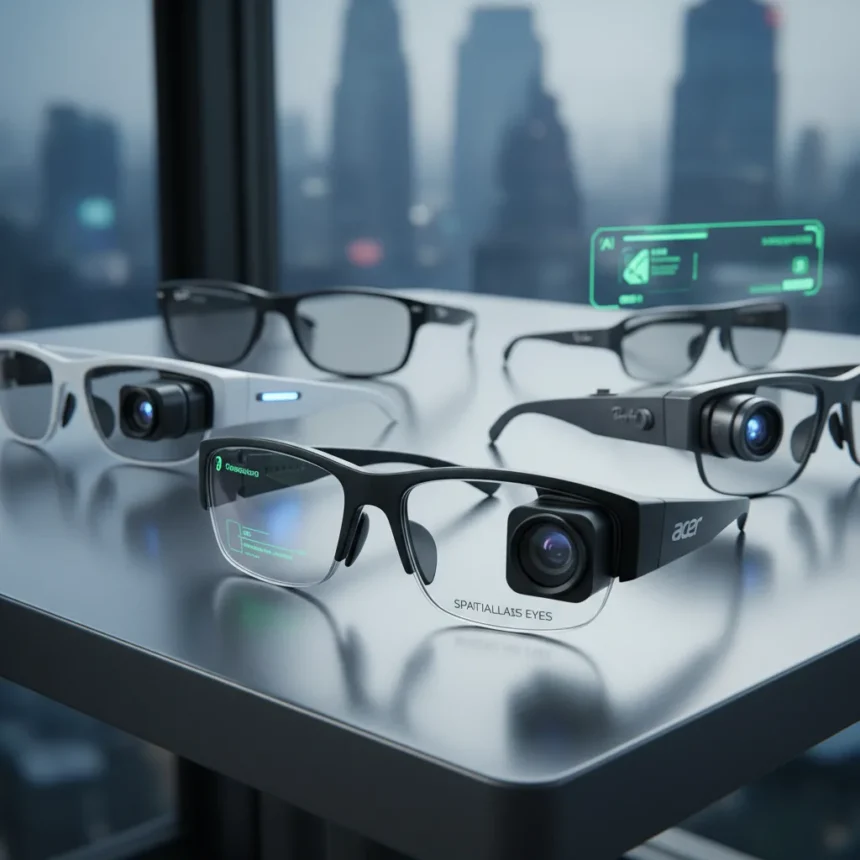
AI and AR smart glasses are no longer a two-horse race, and Acer’s latest announcement makes that clearer than ever. The smart-glasses category — once treated as a curiosity dominated by a handful of names — is rapidly filling with serious hardware contenders, and Acer has just added its own entry to a market that is becoming one of tech’s most contested battlegrounds.
Key Takeaways
- Acer has unveiled new AI and AR smart glasses, adding competitive pressure on Meta in the wearables space.
- The smart-glasses market is growing more crowded, with multiple major tech companies pushing eyewear hardware simultaneously.
- Xreal’s 1S AR glasses are priced at $449, giving consumers a concrete reference point for where the category sits commercially.
- Meta’s Aria Gen 2 targets academic researchers and includes heart-rate sensing, eye tracking, and spatial audio — a very different positioning than consumer-facing products.
- Google, Samsung, and Xreal are among the players expanding the smart-glasses landscape alongside Acer and Meta.
Why Acer Entering AI and AR Smart Glasses Changes the Conversation
Acer’s move into AI and AR smart glasses matters not just because of what the product does, but because of what it signals. When a company better known for laptops and monitors decides smart eyewear is worth its engineering resources, the category has crossed a threshold. This isn’t a startup bet — it’s a mainstream hardware maker reading the market.
The timing is pointed. The smart-glasses space is accelerating on multiple fronts simultaneously. Google, Samsung, Xreal, and eyewear-focused partners are all pushing into intelligent eyewear, according to coverage of Google I/O 2026. Acer’s announcement lands in the middle of this surge, not ahead of it — which tells you how fast the window for early-mover advantage is closing.
What’s notable is that Acer is reportedly bringing both AI and AR capabilities to its glasses, rather than choosing one lane. That dual positioning puts it in direct conversation with the broader ambitions of the category, where the most interesting products are blurring the line between passive AI assistance and active augmented-reality overlays.



How Does This Stack Up Against Meta’s Smart Glasses Strategy?
Meta remains the most visible name in consumer smart glasses, but its strategy has fractured into distinct product tiers that serve very different audiences. Meta’s Aria Gen 2, for instance, is aimed squarely at academic researchers and won’t reach general consumers — its features include heart-rate sensing, a contact microphone, eye tracking, hand tracking, and spatial audio. That’s impressive hardware, but it’s not a product you’ll find at a retailer.
The consumer end of Meta’s smart-glasses lineup faces a different kind of pressure. That’s where Acer, Xreal, and others are pushing hardest. Xreal’s 1S AR glasses, highlighted at CES 2026, carry a $449 price tag — a concrete data point that shows the category is trying to find a consumer-accessible price floor. Whether Acer targets a similar range remains unconfirmed, but its entry forces Meta to defend territory it has been building for years.



Meta’s advantage has always been ecosystem depth and brand recognition in this space. Acer’s advantage is distribution reach and the trust of enterprise and prosumer buyers who already live in its hardware world. Those are genuinely different strengths, and the competition between them won’t resolve quickly.
The Broader AI and AR Smart Glasses Market Is Moving Fast
The competitive picture extends well beyond Acer versus Meta. The smart-glasses landscape now includes Google, Samsung, Xreal, and a growing list of eyewear hardware partners, all moving at roughly the same time. That kind of simultaneous pressure from multiple directions is what transforms a niche into a platform war.
What’s driving this convergence? AI capability has matured enough that embedding it in a wearable form factor is no longer a novelty — it’s a genuine use case. The question isn’t whether smart glasses can do useful things anymore. The question is which hardware maker builds the product that people actually want to wear all day. That’s a harder problem than specs alone can solve, and no one has definitively cracked it yet.
The category’s commercial viability is still being tested. Xreal’s $449 price point for the 1S suggests the market is trying to stay accessible, but that’s still a significant ask for hardware that many buyers haven’t yet integrated into their daily lives. Acer’s entry could push pricing dynamics in either direction — upward if it targets enterprise, downward if it goes after mainstream consumers.



Is Meta’s dominance in smart glasses under threat?
Meta has a meaningful head start in consumer smart glasses, but its lead is narrowing. With Acer, Xreal, Google, and Samsung all pushing into the category simultaneously, Meta no longer sets the pace alone. The company’s research-focused Aria Gen 2 serves a specialist audience, which leaves its consumer lineup exposed to challengers with broad distribution and competitive pricing.
What makes Acer’s smart glasses announcement significant?
Acer is a mainstream hardware manufacturer with global distribution and enterprise credibility. Its decision to enter the AI and AR smart glasses space signals that the category has matured beyond early-adopter territory. When established PC makers start treating smart eyewear as a core product line, the market’s trajectory becomes harder to ignore.
How much do AR smart glasses cost in 2026?
Pricing varies widely by product tier. Xreal’s 1S AR glasses are priced at $449, based on coverage from CES 2026. Research-oriented devices like Meta’s Aria Gen 2 are not sold to general consumers at all. Acer’s pricing for its new glasses has not been confirmed in available reporting.
The smart-glasses category is at an inflection point, and Acer’s arrival is a symptom of that shift, not just a news item. When the market fills this quickly — with players ranging from research labs to mainstream PC manufacturers — the companies that defined the early space have to earn their position all over again. Meta built its smart-glasses reputation over years. Acer, Xreal, Google, and Samsung are all signalling that reputation alone won’t be enough.
Edited by the All Things Geek team.
Source: Tom's Guide