







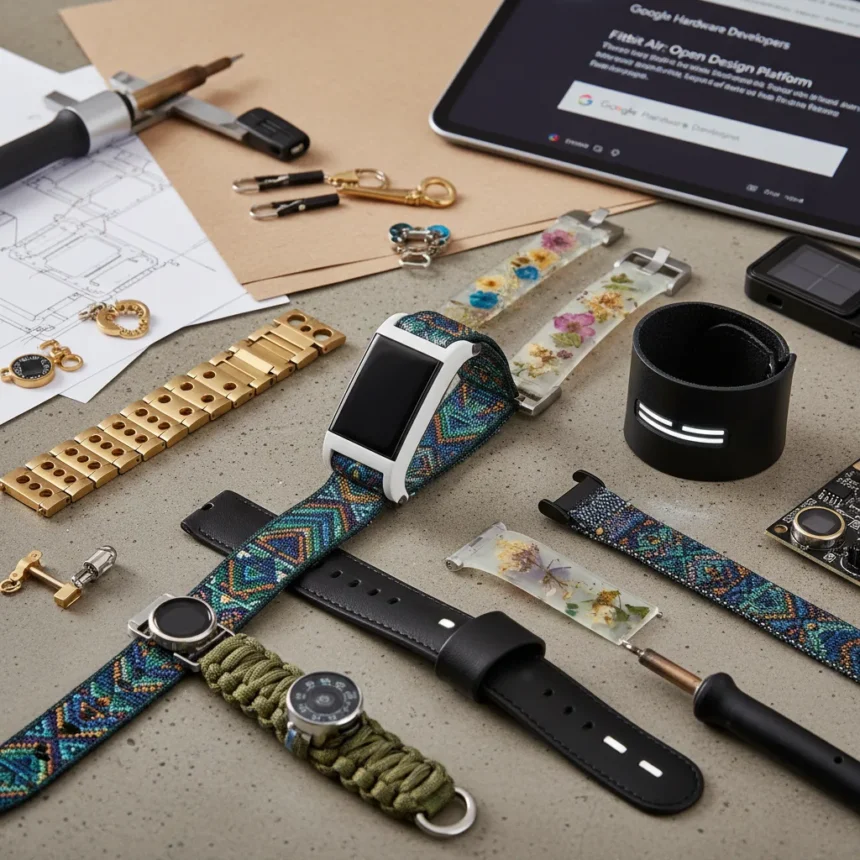
Google has officially released hardware specifications and accessory design guidelines for the Fitbit Air, transforming the minimalist fitness tracker into a platform where independent designers and artisan makers can build their own custom bands and related accessories. The move opens a previously closed ecosystem to creativity, responding to early user experimentation since the tracker’s launch.
Key Takeaways
- Google released 2D CAD drawings with exact mating dimensions, tolerances, and attachment force specifications for Fitbit Air builders.
- Fitbit Air uses a swappable pebble design that snaps into different bands using a tension-based mechanism.
- Sensor clearance and steady skin pressure (35 mmHg minimum) are critical for optical heart rate and SpO2 accuracy.
- The guidelines cover skin-friendly materials, chemical limits, and environmental testing standards.
- Independent makers can now compete alongside official bands like the Performance Loop, Active, and Elevated Modern options.
Why Google Opened Fitbit Air to Custom Band Design
The Fitbit Air community has already demonstrated creativity since launch, with users experimenting with homemade bicep band solutions and other workarounds. Rather than restrict the ecosystem, Google decided to formalize the opportunity. The company released the specifications because the community had come up with innovative ideas to make the Fitbit Air their own, according to the official announcement. By publishing the design guidelines, Google is betting that a thriving third-party accessory market will deepen user engagement and extend the tracker’s appeal beyond its core minimalist positioning.
This strategy mirrors how successful wearable platforms have evolved. Fitbit Air competes in the always-on, screenless category alongside Whoop bands and smart rings, where customization and personal style matter as much as health metrics. By opening the design process, Google is signaling that the Fitbit Air is not just a health sensor—it is a fashion statement waiting to happen.
What Makers Need to Know About Fitbit Air Custom Bands
Google’s released CAD drawings include the pill-shaped pebble housing the sensor and the sleeve used by the Performance Loop Band, complete with mating dimensions, tolerances, and mating force specifications. These technical details are not window dressing; they determine whether a custom band will function reliably. The Fitbit Air uses a tension-based snap-in mechanism, and enclosures must follow the provided tolerances so the sensor stays locked in place during rigorous movement while remaining removable for band swaps.

Sensor clearance is non-negotiable. The optical heart rate and SpO2 sensors must remain unobstructed and maintain flush skin contact for accurate readings. Google specifies that bands should maintain steady, gentle pressure against the skin in the sensing area, with a recommended minimum pressure of 35 mmHg (0.68 psi) for nominal wear to support optimal performance during motion. Makers must also prioritize skin-friendly materials to reduce irritation or allergic reactions, and adhere to chemical limits and environmental standards outlined in the guidelines.
The barrier to entry is lower than it sounds. A maker with basic CAD knowledge, access to 3D printing or injection molding, and an understanding of material science can prototype a band. The detailed specifications eliminate guesswork and reduce the trial-and-error cycles that plague amateur accessory design. This democratization of hardware design is what separates Fitbit Air from closed ecosystems where only licensed manufacturers can build add-ons.


How Fitbit Air Bands Work: Swappable Pebble Design
The Fitbit Air’s strength lies in its modular architecture. The device itself is a lightweight, screenless pebble that houses the sensors and battery, delivering up to seven days of battery life. To change bands, users pop the pebble out of the current band and insert it into a new one—a process Google frames as changing the look in seconds. This swappable design is what makes the custom band ecosystem possible. Unlike traditional fitness trackers where the band and sensor housing are fused, the Fitbit Air separates form from function.
Google currently offers three official band options: the Performance Loop Band, made from recycled materials and micro-adjustable; the Active Band, a sweatproof and wetproof silicone option for high-intensity training; and the Elevated Modern Band, a more fashionable bracelet-like option with classic colors. Each serves a different use case. Custom bands can now fill niche gaps—a climbing band with reinforced attachment points, a medical-grade band for sensitive skin, or a luxury option with premium materials. The ecosystem has room for all of them.
Fitbit Air Specs and Health Features
The Fitbit Air is positioned as a tiny and affordable tracker that monitors health 24/7. It delivers AFib detection, sleep analysis, SpO2 sensing, and heart-rate variability tracking, syncing data to the Google Health app on Android and iOS devices. The screenless design means no notifications or app distractions—just passive, continuous health monitoring. At 99.99 euros, it undercuts many competitors while offering a focused feature set.
The minimalist approach is intentional. By removing the screen, Google reduced power consumption and complexity, enabling the impressive seven-day battery life. This philosophy extends to the accessory ecosystem: the bands are not smart in themselves, just conduits for the pebble’s sensors. That simplicity is what makes custom band design feasible for independent makers without advanced electronics expertise.



What This Means for the Wearables Market
Opening the Fitbit Air to custom bands signals a shift in how Google views its wearables strategy. Rather than controlling every touchpoint, the company is betting on community-driven innovation. This approach has worked for open platforms like Android and could accelerate adoption among makers and enthusiasts who value customization. A thriving accessory market also extends the product lifecycle—users who might otherwise retire their tracker can refresh it with a new band design.
For independent designers, the timing is significant. The wearables market is saturated with generic silicone bands and knockoff accessories. Fitbit Air’s public specifications and design guidelines create a legitimate pathway to build and sell quality alternatives. A maker with a unique aesthetic or functional innovation can now compete directly with Google’s official offerings, provided they respect the engineering constraints.
Can I design a band for Fitbit Air if I’m not an engineer?
Google’s CAD drawings and detailed specifications are designed to help you build a high-quality accessory band, even without formal engineering training. If you have basic 3D design skills or access to a maker community with CAD expertise, you can prototype a band. The key is understanding the mating dimensions, tolerances, and the 35 mmHg pressure requirement. Many makers start with 3D printing to test fit and function before moving to injection molding for production.
What materials should I use for a custom Fitbit Air band?
Google advises using skin-friendly materials to reduce the risk of irritation or allergic reactions. Silicone, TPU (thermoplastic polyurethane), and fabric are safe starting points. Avoid materials that trap moisture or have rough edges. The guidelines also include chemical limits and environmental standards, so review those before selecting polymers or dyes.
How does the Fitbit Air compare to other always-on trackers?
The Fitbit Air operates in the screenless, always-on category alongside Whoop bands and smart rings, where the focus is continuous health data rather than notifications. What sets the Fitbit Air apart is its modular design and the now-public specifications that enable custom accessories. Whoop and most smart rings lock users into proprietary band ecosystems. The Fitbit Air’s openness to independent makers is a competitive advantage for users who want to customize their wearable without sacrificing accuracy or battery life.
Google’s decision to open the Fitbit Air specifications is a calculated bet on community creativity. Independent makers now have the tools to build bands that official designers might never consider—niche solutions for specific sports, professions, or aesthetics. For the Fitbit Air, this is not just about accessory variety; it is about turning the tracker into a platform where users feel ownership and investment. That shift from closed product to open ecosystem could define the tracker’s long-term success.
Edited by the All Things Geek team.
Source: Android Central




