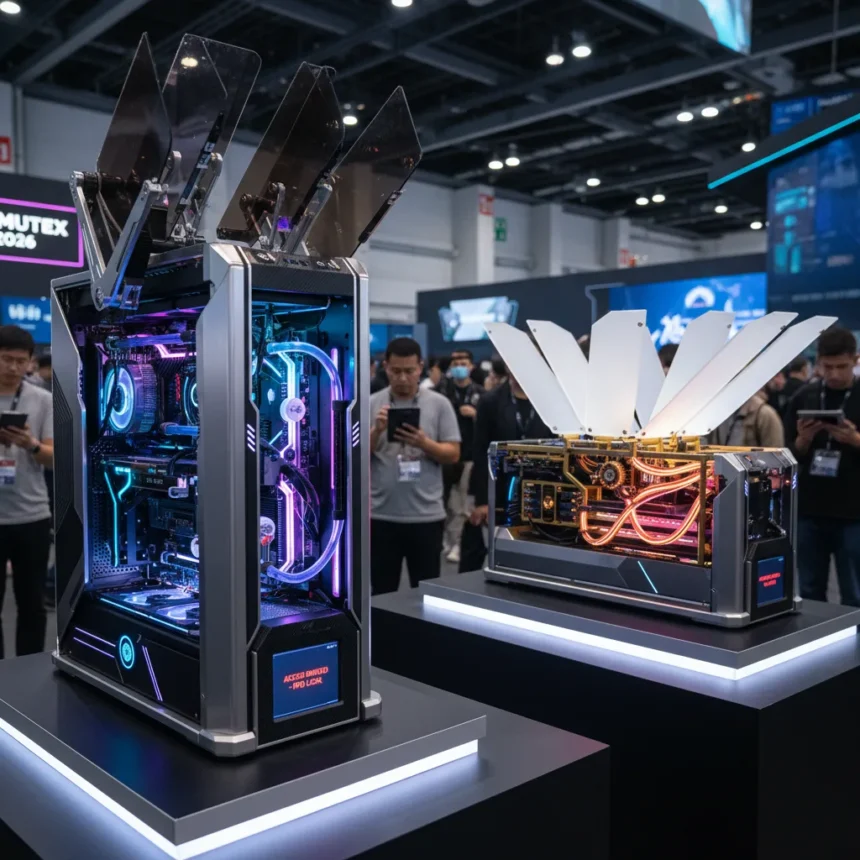
The wildest gaming PCs at Computex 2026 prove that modern enthusiasts care about more than just raw horsepower. Two standout builds—the NextGear Clear Shift and InWin Aeon—treat the case itself as a centerpiece, not a container. These machines prioritize visual spectacle and interactive features over traditional performance metrics.
Key Takeaways
- NextGear Clear Shift features motorized panels that switch from transparent to opaque at the press of a button.
- InWin Aeon uses reflective mosaic panels and RFID card access to unlock the chassis.
- Both designs were displayed at CES 2026 and featured at Computex 2026.
- These builds represent a shift toward case design as a primary aesthetic and functional feature.
- Neither machine prioritizes specs over theatrical presentation and user interaction.
The NextGear Clear Shift: Hardware That Hides on Command
The NextGear Clear Shift stands out because it solves a problem most PC builders never knew they had: the ability to show off your internals when you want and hide them completely when you don’t. At the touch of a button, the front and side window panels transition from see-through to opaque, concealing the CPU, GPU, and other components instantly. This is not literal sci-fi cloaking—it is a smart opacity switch—but the effect feels theatrical enough to justify the name.
Why does this matter? Most gaming PC cases force you into a choice: either your hardware is always visible, or it never is. The Clear Shift eliminates that trade-off. You can showcase your RGB lighting and custom water cooling during a LAN party, then hide the visual clutter when the PC sits in a living room. It is a small feature that acknowledges how PC aesthetics fit into different contexts.
Compared to traditional tempered glass cases, which lock you into one visual state, the Clear Shift offers flexibility. It also sidesteps the eternal debate about whether visible components look impressive or cluttered—you get to decide based on the moment.


InWin Aeon: Sci-Fi Meets Mechanical Precision
InWin describes the Aeon as a vision beyond convention and a mechanized architectural statement. That is marketing language, but the design backs it up. The case uses reflective mosaic panels to create a modern, sculptural appearance that looks more like a futuristic artifact than a traditional gaming PC enclosure. This is not subtle. The Aeon is designed to be noticed.
The standout feature is the RFID card reader built into the chassis. Swipe the supplied card, and the case unlocks. It is a small touch, but it transforms the case from a passive container into an interactive object. You do not just open the Aeon—you authenticate access to it. For enthusiasts who treat their PC as a centerpiece, this kind of detail signals that the machine is intentional and considered, not just another black box under a desk.



The reflective panels catch light differently depending on viewing angle and ambient conditions, making the case look different throughout the day. This is the opposite of the static, unchanging aesthetic of most gaming rigs. The Aeon forces you to engage with its design rather than simply tolerate it.
Why Computex 2026 Proved Case Design Is the New Frontier
For years, gaming PC innovation focused on power: faster GPUs, more cores, better cooling. Computex 2026 signaled a shift. The wildest gaming PCs now prioritize experience and presentation. A case that can hide its internals or unlock via RFID card does not improve frame rates or reduce latency. But it does make owning a high-end PC feel like owning something special, not just a collection of components.
This reflects a broader maturation in the enthusiast market. When gaming PCs were niche products, raw specs dominated. Now that they are mainstream, differentiation comes from design, interaction, and how the machine fits into your lifestyle. The NextGear Clear Shift and InWin Aeon represent this evolution. They are not the fastest or most powerful machines at the show. They are the ones people remember.
Both designs also challenge the assumption that gaming PCs should be aggressive or edgy. The Clear Shift offers elegance through restraint. The Aeon achieves presence through sculptural form rather than RGB overkill. These are machines for people who want their PC to reflect taste, not just taste in specs.



Can These Designs Actually Deliver on Practicality?
Motorized opacity panels and RFID access sound impressive, but real-world usability matters. The Clear Shift’s motorized panels must be reliable—a stuck or slow transition would undermine the entire concept. InWin’s RFID system needs to be intuitive and not create friction every time you want to access the inside of the case for upgrades or maintenance.
The brief does not confirm whether these systems have been tested for long-term reliability or how quickly the Clear Shift panels actually transition. It also does not address how difficult it is to service components inside either case. For a gaming PC, accessibility is as important as appearance. A beautiful case that makes upgrading your RAM a nightmare is a poor trade-off.
Compared to traditional cases with simple latches and removable panels, both the Clear Shift and Aeon add complexity. That complexity can be a feature or a liability depending on execution. Early impressions at Computex were positive, but real-world durability and usability remain to be tested.
Are These Cases Actually Available Yet?
The research available does not confirm pricing, availability, or launch timelines for either the NextGear Clear Shift or InWin Aeon. Both were shown at CES 2026 and featured at Computex 2026, but that does not guarantee they are ready for consumer purchase. High-concept case designs often remain showpieces or limited releases. Before investing in either machine, verify current availability and pricing through official retailers.
Should You Build Your Gaming PC Inside the Clear Shift or Aeon?
If you value visual presentation and interactive features, both cases offer something genuinely different from the market standard. The Clear Shift suits people who want flexibility—the ability to show off internals sometimes and hide them others. The Aeon appeals to those who see their PC as a design object, not just a tool. Neither case is for people who prioritize pure functionality or cost-effectiveness. These are premium aesthetic choices.
How do these cases compare to traditional tempered glass gaming cases?
Traditional tempered glass cases lock you into one visual state and offer no interactive features. The Clear Shift and Aeon both add mechanical or electronic elements that create novelty and engagement. However, traditional cases are often simpler to maintain and more affordable. The trade-off is between presentation and practicality.
What makes the InWin Aeon different from other high-end PC cases?
The Aeon combines reflective mosaic paneling with RFID-based access, creating both visual and functional differentiation. Most high-end cases focus on cooling performance or cable management. The Aeon prioritizes sculptural design and authentication mechanics, treating the case as a statement piece rather than just a container.
The wildest gaming PCs at Computex 2026 reveal that the PC case market is maturing beyond pure performance optimization. When hardware power plateaus, design and experience become the differentiators. The NextGear Clear Shift and InWin Aeon are not the fastest machines at the show, but they are the ones that make you pause and think differently about what a gaming PC can be. That shift—from specs-first to experience-first—might matter more than the next generation of GPUs.
Edited by the All Things Geek team.
Source: TechRadar