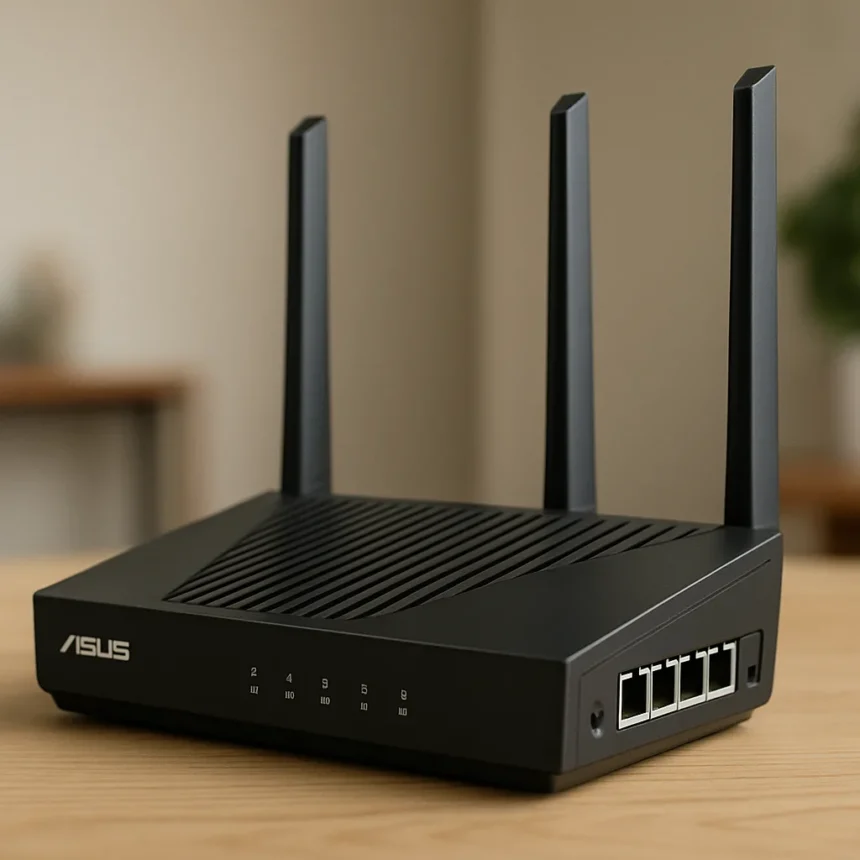
The Asus RT-BE92U Wi-Fi 7 router is a tri-band 802.11be router designed for homes that need serious throughput without waiting for prices to fall even further. It delivers BE9700-class speeds across three bands — up to 5764 Mbps on the 6GHz band, 2882 Mbps on 5GHz, and 1032 Mbps on 2.4GHz — and pairs that with a port lineup that includes a 10Gbps WAN/LAN and three 2.5Gbps LAN ports. It is available at retailers including Micro Center and Best Buy, though no official launch price has been confirmed at the time of writing.
What Makes the Asus RT-BE92U Wi-Fi 7 Router Worth Considering
The headline feature here is Multi-Link Operation, or MLO — a Wi-Fi 7 capability that lets compatible devices connect across multiple bands simultaneously. In practical terms, this means a device can use the 6GHz and 5GHz bands at the same time, reducing latency and improving reliability rather than just stacking raw speed on paper. Combined with 320MHz channel support and 4096-QAM modulation — which Asus claims delivers up to 20 percent more data transfers compared to the 1024-QAM found in Wi-Fi 6 and 6E — the RT-BE92U is built for environments where congestion is the real enemy, not just distance from the router.
The hardware underneath is a 2.0GHz quad-core processor paired with 1GB of DDR4 RAM and 256MB of flash storage. That is a reasonable foundation for a router handling multiple simultaneous high-bandwidth streams — think 8K video, low-latency gaming, and a house full of smart home devices all competing for airtime. Four external fixed antennas plus an additional internal antenna dedicated to the 2.4GHz band, along with high-power front-end modules, round out a design aimed at coverage as much as raw speed.
Port Selection Sets the RT-BE92U Apart From Dual-Band Rivals
Where the Asus RT-BE92U genuinely separates itself from lower-tier Wi-Fi 7 options is the wired side. One 10Gbps WAN/LAN port, one 2.5Gbps WAN/LAN port, and three dedicated 2.5Gbps LAN ports means this router is ready for multi-gigabit internet connections that are increasingly available in urban markets across Asia, Europe, and parts of the Middle East. A USB 3.2 Gen1 port adds support for network-attached storage, media serving, Samba and FTP sharing, and even mobile broadband tethering — making it a more versatile device than the spec sheet alone suggests.


Compare this to the TP-Link Archer BE550, a dual-band BE6800 router that lacks a 6GHz band entirely and offers no 10Gbps port. The Archer BE550 is slightly lighter at 1.74 lbs versus the RT-BE92U’s 1.88 lbs and does support wall mounting — something the Asus does not — but for anyone on a multi-gigabit plan or planning to use MLO, the RT-BE92U’s architecture is the stronger long-term investment. The TP-Link Archer BE9700, by contrast, matches the 10Gbps and 2.5Gbps port configuration and targets a similar multi-gigabit audience, making it the more direct competitor to watch on pricing.
Asus RT-BE92U Software: AiMesh, AiProtection, and Real Flexibility
Asus loads the RT-BE92U with its full software stack, and it is genuinely one of the more capable ecosystems in consumer networking. AiMesh support — including Smart AiMesh with AI-assisted optimization — means this router can serve as either the primary node or a mesh node in a larger Asus network, giving households room to expand coverage without replacing hardware. AiProtection handles network-level security and parental controls, while QoS, Dual-WAN, and WireGuard VPN support via Instant Guard round out a feature set that rivals what some prosumer gear offers.



Operating modes include Wireless Router, Repeater, Media Bridge, Access Point, and AiMesh Node — giving installers and enthusiasts real flexibility. MAC filtering supports up to 64 entries, and RADIUS Client support signals that Asus is not ignoring the small business and power-user segment. The router is backward compatible with Wi-Fi 6, Wi-Fi 5, and older standards, so existing devices will not be left behind during the transition.
Is the Asus RT-BE92U the right Wi-Fi 7 router for your home?
That depends almost entirely on your internet connection and device mix. If you are on a gigabit or faster plan and have Wi-Fi 7 devices — or plan to buy them — the RT-BE92U’s 6GHz MLO support and multi-gigabit port layout make it a genuinely future-proof choice. If your ISP tops out at 500Mbps and your devices are still Wi-Fi 6, a dual-band router at a lower price point will deliver the same real-world experience for less money today.
How does the RT-BE92U compare to Wi-Fi 6E routers?
Wi-Fi 6E routers like the TP-Link Archer AXE95 also offer a 6GHz band, but they lack Wi-Fi 7’s MLO and 320MHz channel support, which are the features that meaningfully reduce latency rather than just adding theoretical throughput. The RT-BE92U’s 4096-QAM modulation is also a step beyond what 6E hardware supports, making it a more capable platform for dense device environments even if 6E routers remain competent for most current use cases.
Does the Asus RT-BE92U support mesh networking?
Yes. The RT-BE92U supports Asus AiMesh, which allows it to function as either a primary router or a mesh node within an existing Asus AiMesh network. Smart AiMesh with AI boost is included, which helps optimize device connections across nodes automatically — a meaningful advantage for larger homes where manual band steering becomes impractical.



The Asus RT-BE92U Wi-Fi 7 router is a well-specified, genuinely capable piece of hardware that earns its place in the current Wi-Fi 7 market. Its combination of tri-band 6GHz coverage, MLO, a 10Gbps port, and Asus’s mature software ecosystem gives it a strong argument against both budget dual-band alternatives and older Wi-Fi 6E hardware. The lack of wall-mount support is a minor inconvenience, but for anyone building or upgrading a high-performance home network, the RT-BE92U is one of the more complete packages available right now.
Edited by the All Things Geek team.
Source: TechRadar