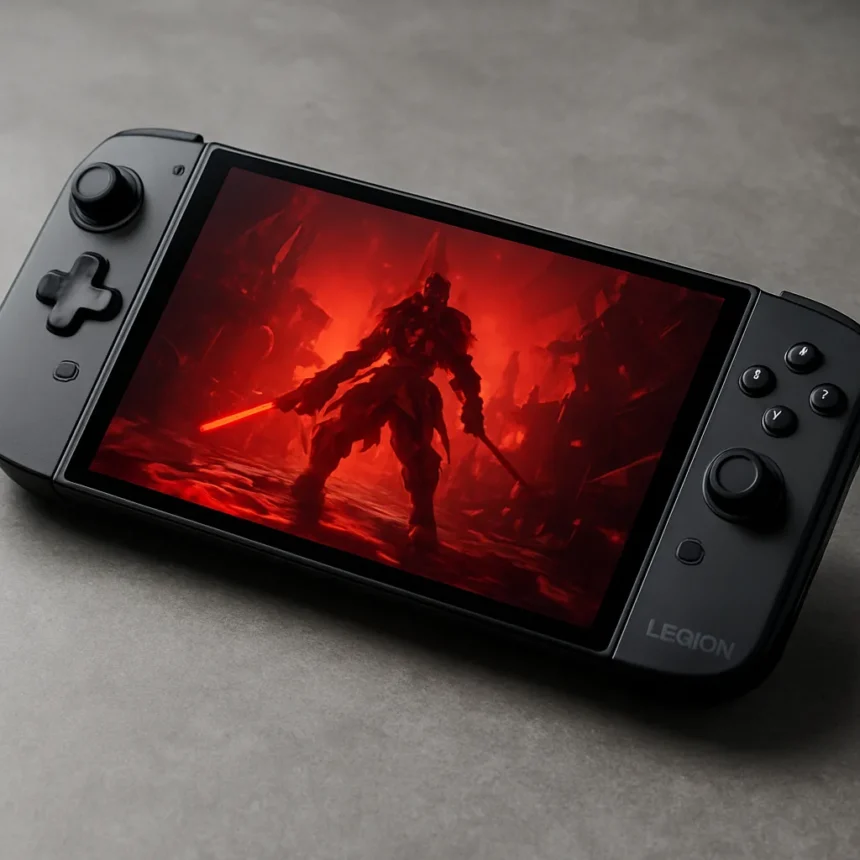
The Lenovo Legion Go 2 is a Windows 11 gaming handheld made by Lenovo, powered by the AMD Ryzen Z2 Extreme processor, priced at $1,349.99 for the 32GB/1TB configuration, and available now as Lenovo’s flagship portable gaming device. It is the most spec-heavy handheld PC on the market right now, and it makes no apologies for its ambitions — or its size.
What Makes the Lenovo Legion Go 2 Stand Out From Every Other Handheld
The headline spec is the AMD Ryzen Z2 Extreme, an eight-core, 16-thread chip built on Zen 5 architecture with a configurable TDP range of 15 to 35 watts and clock speeds stretching from 2.0 to 5.0 GHz. That flexibility matters enormously in a handheld, where balancing performance against battery life is the defining challenge. Paired with that chip is 32GB of LPDDR5x-8000 memory — soldered, unfortunately, but a significant step up from the 24GB found in the Asus ROG Ally X, which has been the benchmark for high-end handheld RAM until now.
Storage starts at 1TB via an M.2 2242 SSD, and critically, Lenovo has designed the slot to accept the longer M.2 2280 format, meaning you can upgrade to higher-capacity drives without compromise. A 2TB configuration is also available. This kind of upgradability is rare and welcome in a category that too often treats internal storage as a sealed unit.
The display is arguably the most striking single component. At 8.8 inches with a 1920×1200 OLED panel running at up to 144Hz with variable refresh rate support, it is the largest screen on any gaming handheld PC currently available. The 16:10 aspect ratio suits both gaming and productivity use, and Lenovo claims 97% DCI-P3 colour coverage, 500 nits sustained brightness, and a peak HDR output of 1,100 nits. Those figures are manufacturer claims and have not been independently lab-verified, but if they hold up, the display will be class-leading by a meaningful margin.


Lenovo Legion Go 2 Performance: Real-World Gaming Results
In demanding titles like Call of Duty: Black Ops 6, the Legion Go 2 delivers 55 to 75 frames per second at native 144Hz resolution on Normal to High settings. With Lenovo’s Full Screen Experience software optimisation enabled, that range pushes to 80 to 100 frames per second and beyond — figures that would embarrass many mainstream laptops, let alone rival handhelds. The RDNA 3.5 graphics architecture, running 16 compute units, provides the GPU horsepower behind those results.
Emulation performance is another strong suit. The Legion Go 2 handles Nintendo Switch titles at a rating of 95, modern PC games at 90, and PS3 content at 85, with older systems running even more smoothly. For players who want a single device that covers both cutting-edge PC gaming and a full retro library, the performance profile here is genuinely compelling. The 74Wh battery is among the largest in the handheld category, offering meaningful playtime even at higher power settings — though real-world endurance will depend heavily on the TDP profile you select.


It is worth noting that the Z2 Extreme lacks a dedicated NPU, which puts it behind some rivals on AI-assisted workloads. The graphics are also described variably across sources as Radeon 780M, Radeon 980M, and RDNA 3.5 — an inconsistency in Lenovo’s own communications that suggests the final production naming may still be settling. Buyers should verify the exact GPU designation at point of purchase.
Controls, Connectivity, and the Size Question
The controller layout is extensive. Hall effect analog sticks eliminate the drift issues that have plagued other handhelds, and the full button complement includes L1/R1/L2/R2 triggers, L3/R3, a gyroscope, a touchscreen, a scroll wheel, a trackpad, four additional M-series buttons on the sides and back, and a detachable FPS mode puck for mouse-style aiming. The asymmetrical thumbstick layout mirrors a traditional Xbox-style controller, which will feel natural to most Windows gamers.
Connectivity is equally thorough. Two USB 4.0 ports running at 40 Gbps support display output, power delivery, and external GPU enclosures — meaning the Legion Go 2 can theoretically anchor a desktop gaming setup when docked. Wi-Fi 6E and Wi-Fi 7 support, Bluetooth 5.3, a microSD reader, and a 3.5mm headphone jack round out the port selection. The 65W power adapter is included, and Pogo pins allow the detachable controllers to connect cleanly to the body.
The size and weight demand honest acknowledgement. At 920 grams with controllers attached and measuring 295.6 x 136.7 x 42.25 mm, the Legion Go 2 is a large, heavy device by handheld standards. It is not a device you will comfortably use one-handed or slip into a jacket pocket. Lenovo includes a carrying case, which helps, but the form factor is a deliberate trade-off — maximum performance in exchange for maximum portability.



Is the Lenovo Legion Go 2 worth buying over the ROG Ally X?
The Lenovo Legion Go 2 holds clear advantages over the Asus ROG Ally X in raw specifications: more RAM at 32GB versus 24GB, a larger and higher-resolution OLED display, upgradable storage, and a more comprehensive control layout including the FPS puck and additional M-series buttons. The ROG Ally X is a more compact and lighter device, which will matter to some buyers. If portability is your priority, the Ally X remains a serious contender. If outright performance and display quality are what you are optimising for, the Legion Go 2 is the stronger choice at its price point.
How long does the Lenovo Legion Go 2 battery last?
The Legion Go 2 carries a 74Wh battery, one of the largest capacities in the gaming handheld category. Actual playtime depends significantly on the TDP setting selected — running the chip at 35W will drain the battery far faster than a 15W efficiency profile. Lenovo has not published official battery life claims for specific game scenarios, so real-world endurance will vary by title and settings.
Can you upgrade the storage on the Lenovo Legion Go 2?
Yes. The Legion Go 2 ships with a 1TB M.2 2242 SSD, but the slot is designed to accept the longer M.2 2280 form factor, which opens up a wider range of high-capacity replacement drives. A 2TB factory configuration is also available. The 32GB of RAM is soldered and cannot be upgraded after purchase, so buyers who want maximum memory should configure accordingly at the time of purchase.
The Lenovo Legion Go 2 is the most capable gaming handheld PC available right now, and it earns that status through genuinely superior hardware rather than marketing. The combination of the Ryzen Z2 Extreme, 32GB of fast memory, the largest OLED display in the category, and a port selection that includes external GPU support makes it a device with a credible claim to being a portable desktop replacement. The weight and price will filter out casual buyers, and they should — this is a machine built for players who want the absolute best and are willing to carry it.
Where to Buy
Edited by the All Things Geek team.
Source: T3