





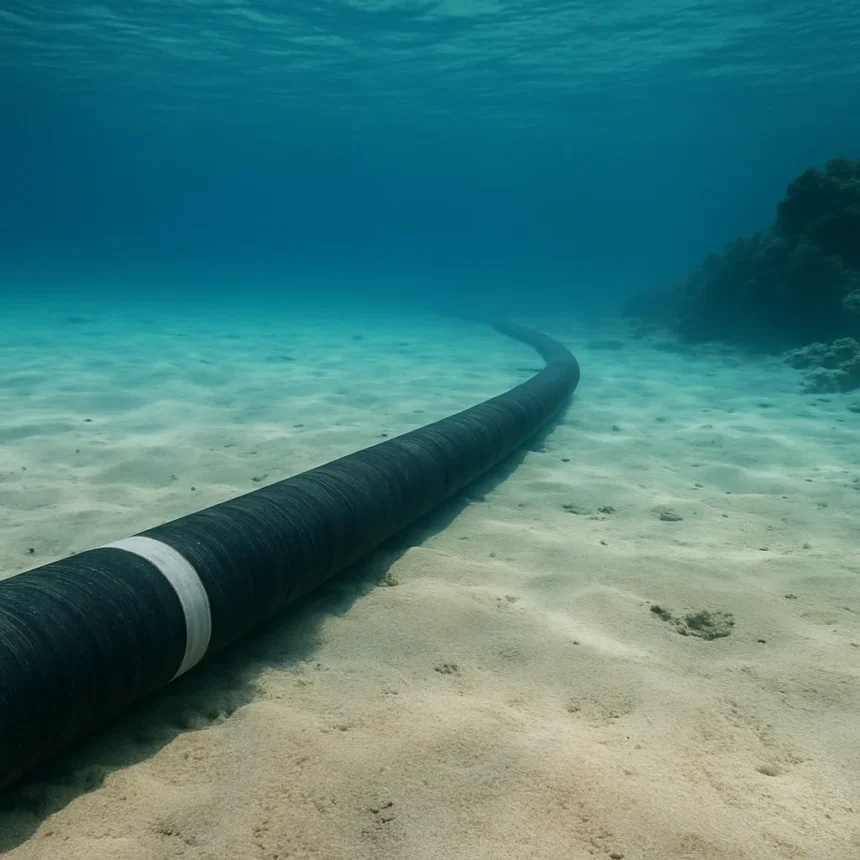
The 2Africa undersea cable system is the longest open-access submarine broadband cable in the world, built by a consortium led by Meta Platforms and constructed by Alcatel Submarine Networks, with its core infrastructure completed after nearly six years of construction following its launch in May 2020. Now, at the moment it should be celebrating a landmark achievement in global connectivity, the project’s Pearls extension — which would bring the full system length to 45,000 kilometers and extend reach into the Middle East and India — has been forced on hold by regional hostilities in the Middle East, specifically affecting planned Red Sea landings.
What makes the 2Africa undersea cable a genuine engineering milestone
The scale of the 2Africa undersea cable is difficult to overstate. At 45,000 kilometers including the Pearls extension, the system is longer than the circumference of the Earth. It connects 33 countries across Africa, Europe, and Asia, and is designed to reach more than 3 billion people. The consortium behind it includes Meta Platforms, Bayobab (part of MTN Group), center3 (stc), CMI, Orange, Telecom Egypt, Vodafone/Vodacom Group, and WIOCC — a rare alignment of competing telecoms interests around shared infrastructure.
The technical architecture is equally ambitious. The cable deploys advanced spatial division multiplexing technology, supporting up to 16 fiber pairs per cable. According to Meta Network Engineering VP Gaya Nagarajan, that is double the capacity of older systems, making 2Africa the first 16-fiber-pair subsea cable to fully connect Africa. The system also incorporates undersea optical wavelength switching, enabling flexible bandwidth management built to support artificial intelligence workloads, cloud services, and high-bandwidth applications. Design capacity reaches up to 180 Tbit/s on key parts — more than the total combined capacity of all existing subsea cables serving Africa. The west segment alone, running from England to South Africa with landings in Senegal, Ghana, Côte d’Ivoire, Nigeria, Gabon, the Republic of Congo, the DRC, and Angola, delivers 21 Tbps per fiber pair across eight fiber pairs.
Construction required 35 offshore vessels, amounting to nearly 32 years of vessel operations, as Nagarajan noted. Shore-end operations demanded additional inshore vessels mobilized locally for cable pulling, guarding, security, and dive support. The project spanned 50 jurisdictions. Burial depth was increased by 50 percent over previous systems, with routing designed to avoid seabed hazards including seamounts and hot brine pools. Two independent trunk powering architectures were built in for resilience.

Why the 2Africa undersea cable Pearls setback matters right now
The Pearls extension was scheduled to go live in 2026, at which point the full 45,000-kilometer system would have been operational. That timeline is now in jeopardy. Planned Red Sea landings — critical to connecting the Middle East and India legs of the Pearls route — are on hold due to ongoing regional hostilities. This is not the first complication the project has encountered, but it is a significant one. The Red Sea is a chokepoint for global subsea cable traffic, and disruption there has knock-on effects well beyond a single project.
For the regions that stand to benefit most, the delay is a real setback. Africa’s digital economy has long been constrained by insufficient international bandwidth. The 2Africa undersea cable was designed to change that equation decisively, with capacity exceeding the entire existing subsea cable fleet serving the continent. Every month the Pearls extension remains on hold is a month that connectivity gains for parts of the Middle East and South Asia are deferred.



How 2Africa compares to older subsea cable systems
Older subsea cable systems typically support up to eight fiber pairs per cable. The 2Africa undersea cable’s 16-fiber-pair architecture directly doubles that ceiling. The undersea optical wavelength switching capability is also a generational step forward — older cables lack the flexibility to dynamically allocate bandwidth across routes, a limitation that becomes increasingly costly as AI and cloud traffic patterns shift unpredictably. In that sense, 2Africa is not just larger than its predecessors; it is structurally better suited to the demands of the next decade of internet traffic.
Will the 2Africa Pearls extension still launch in 2026?
The Pearls extension was scheduled for 2026, but the Red Sea landings are currently on hold due to Middle East hostilities. No revised timeline has been announced. The core system is complete and operational, so the delay affects the Middle East and India extensions specifically, not the broader 33-country network already in service.
Who is behind the 2Africa undersea cable project?
The consortium includes Meta Platforms, Bayobab (MTN Group), center3 (stc), CMI, Orange, Telecom Egypt, Vodafone/Vodacom Group, and WIOCC. The cable was built by Alcatel Submarine Networks. It is described as an open-access system, meaning capacity is available to multiple operators rather than reserved for a single owner.
How much capacity does 2Africa add to Africa’s internet infrastructure?
The 2Africa undersea cable is designed to deliver more capacity than the total combined capacity of all existing subsea cables currently serving Africa. On key segments, design capacity reaches up to 180 Tbit/s. The west segment delivers 21 Tbps per fiber pair across eight fiber pairs.



The core 2Africa system is a genuine generational upgrade for global connectivity infrastructure, and its completion deserves recognition as such. But the Pearls extension hold is a reminder that even the most ambitious engineering projects operate inside geopolitical realities they cannot engineer around. Until the Red Sea situation stabilises, one of the most consequential pieces of internet infrastructure ever built remains unfinished — and the regions waiting on it will feel that gap.
Edited by the All Things Geek team.
Source: TechRadar




