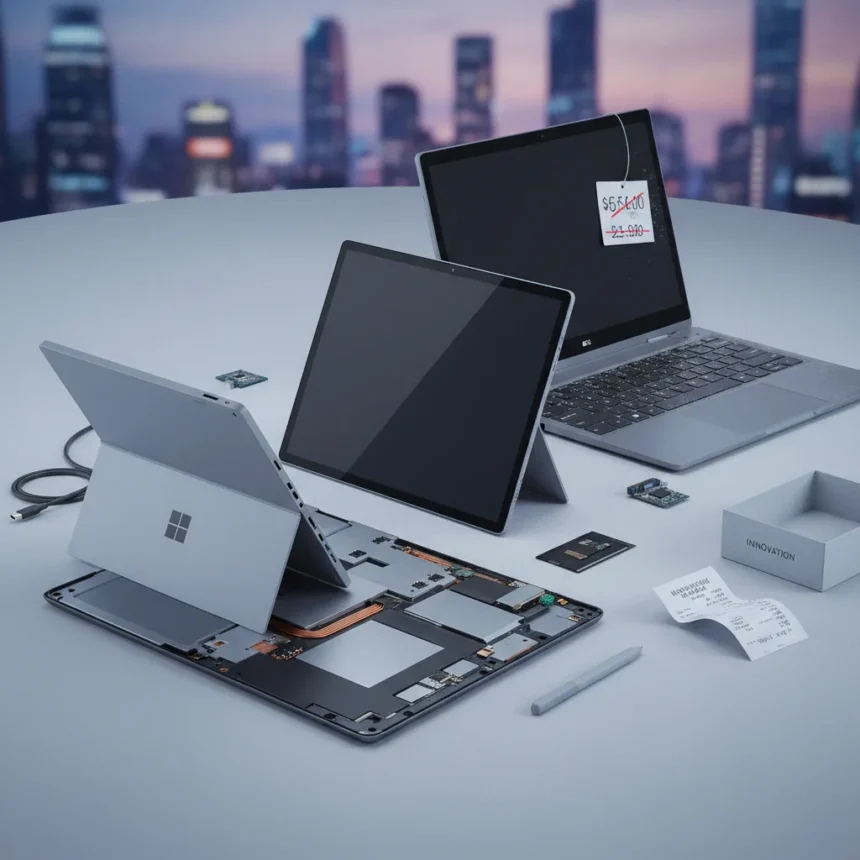
Microsoft’s Microsoft Surface pricing strategy represents a risky gamble that defies current market logic. The company is simultaneously raising prices on its Surface hardware lineup while stripping away the ambitious features and innovative design that once justified premium positioning. This dual move—higher costs paired with lower ambition—leaves the brand vulnerable in a landscape where competitors are delivering more value at comparable price points.
Key Takeaways
- Microsoft is increasing Surface device prices across its lineup without corresponding feature upgrades.
- The Surface hardware strategy is becoming simpler with reduced innovation and design ambition.
- This pricing approach contradicts market trends favoring value and meaningful differentiation.
- Competitors are positioning themselves as better value alternatives to premium Microsoft hardware.
- The strategy risks alienating consumers who expect premium pricing to reflect premium innovation.
Why Microsoft Surface pricing strategy feels misaligned
The core problem is straightforward: Microsoft is asking customers to pay more for less. Surface devices are moving toward simpler, more conventional designs while their prices climb. This represents a fundamental disconnect from how premium technology markets actually work. When a brand raises prices, consumers expect either breakthrough innovation, superior build quality, or exclusive features that justify the premium. Microsoft is delivering none of these.
The Microsoft Surface pricing strategy reveals a company betting that brand loyalty and ecosystem integration will overcome the value proposition gap. That bet assumes customers care more about the Windows logo than about what they actually get for their money. History suggests otherwise. Premium-priced products succeed when they lead their categories in meaningful ways—whether through performance, design, durability, or capability. Surface devices are increasingly following rather than leading.
How this strategy contradicts market dynamics
The broader technology market is moving in the opposite direction. Manufacturers across categories are emphasizing value, meaningful upgrades, and clear reasons to spend more. Flagship phones justify higher prices through computational photography, faster chips, or novel interaction methods. Gaming laptops at premium price points offer significantly better performance than budget alternatives. Even ultrabooks in the $1,000+ range compete on processor speed, display quality, and build materials that demonstrably matter to users.


Surface’s approach—raising prices while simplifying—ignores this reality. The lineup is becoming more homogeneous, with less ambitious designs that feel less like premium products and more like incremental updates. When customers compare a higher-priced Surface to alternatives from other manufacturers, they increasingly find the Surface lacking in justification. The Microsoft Surface pricing strategy assumes the brand itself carries enough weight to overcome this gap. In competitive markets, brand alone rarely sustains premium positioning for long.
What competitors are doing differently
Other manufacturers continue to innovate at premium price points. They introduce new materials, unusual form factors, specialized features for specific workflows, or performance improvements that clearly differentiate their devices. These companies understand that premium pricing demands premium innovation. Customers will pay more when they see tangible reasons to do so—when a device solves a problem in a way competitors cannot match, or when it delivers performance that genuinely changes how work gets done.



Surface’s retreat from ambition puts it at a disadvantage precisely where it should be strongest. As Microsoft’s own hardware line, Surface should showcase what Windows can do at its best. Instead, it increasingly looks like a cautious, incremental product family that plays it safe rather than pushing boundaries. This positioning weakens the entire Windows ecosystem by failing to demonstrate why premium Windows devices deserve premium prices.
The real risk: customer perception shifting
The Microsoft Surface pricing strategy carries a hidden cost beyond lost sales. It risks permanently damaging how customers perceive the brand. Once a premium product line loses its premium justification in customer minds, rebuilding that perception takes years and significant investment. Surface could easily become seen as overpriced hardware that underperforms relative to its cost—a reputation that sticks longer than any marketing campaign can overcome.
The window to correct course is open but narrowing. Microsoft still has the resources and expertise to make Surface devices genuinely ambitious again. But doing so requires acknowledging that the current path—higher prices, lower ambition—is unsustainable. Premium positioning demands premium thinking, and premium thinking demands that every price increase comes with a clear, compelling reason that customers can see and feel.
Does Microsoft plan to keep raising Surface prices?
The research brief does not specify whether Microsoft has announced future price increases beyond the current adjustments. The Microsoft Surface pricing strategy as described focuses on the current shift: prices are rising now while innovation is declining. Whether this continues depends on customer response and competitive pressure in coming quarters.



How does Surface compare to other premium Windows devices?
Surface competes in a crowded premium Windows device market where alternatives from other manufacturers continue to innovate. While the research brief does not name specific competitors, the Microsoft Surface pricing strategy’s weakness becomes clear when Surface devices are compared directly to alternatives at similar price points. Other manufacturers are delivering more ambitious designs and clearer feature differentiation, making the value proposition harder for Surface to justify.
Why is Microsoft raising prices if it’s simplifying the lineup?
The research brief describes the phenomenon—prices up, ambition down—without explaining Microsoft’s reasoning. This gap between action and justification is precisely what makes the Microsoft Surface pricing strategy feel disconnected from market reality. Companies typically raise prices to fund innovation or reflect increased manufacturing costs. Raising prices while simplifying suggests either cost pressures Microsoft is not publicly acknowledging, or confidence in brand loyalty that may not hold up under competitive pressure.
The Microsoft Surface pricing strategy represents a test of how much brand loyalty can overcome rational consumer decision-making. History suggests the answer is: not much. Microsoft has an opportunity to reverse course, but each quarter of higher prices paired with lower ambition makes that reversal more costly. The company should be asking itself why customers would choose Surface at premium prices when competitors offer more innovation at comparable costs. Until that question has a compelling answer, the strategy will continue to feel out of step with what the market actually demands.
Edited by the All Things Geek team.
Source: Windows Central