What Windows 11 High Refresh Rate Support Actually Means
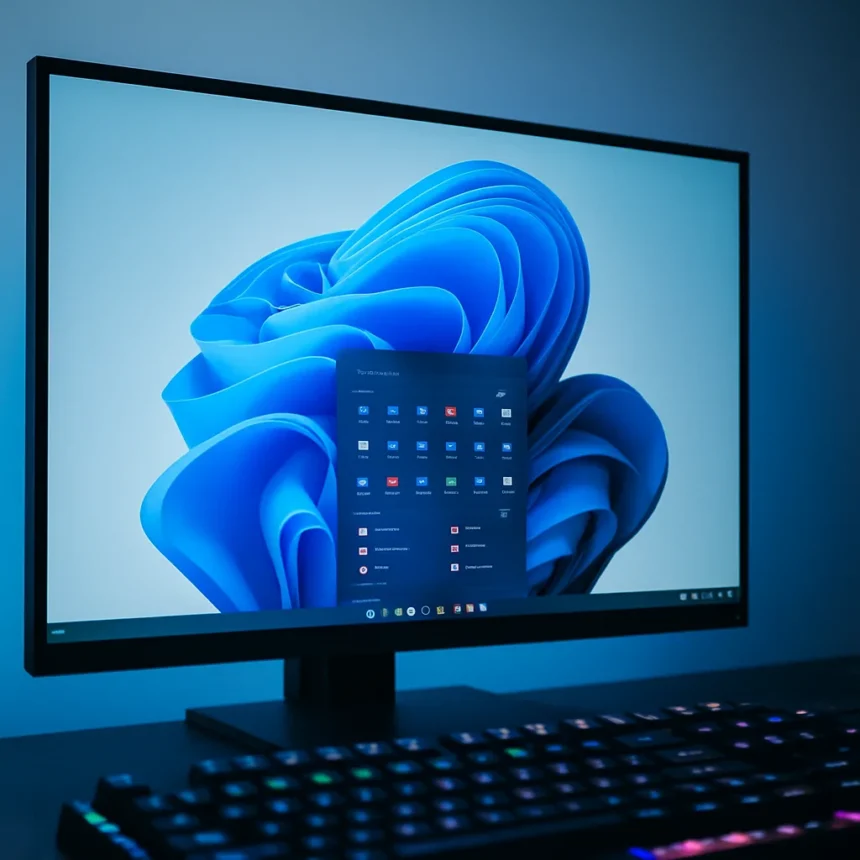
Windows 11 high refresh rate support has taken a significant leap forward, with Microsoft updating its Insider builds in the Release Preview channel to allow monitors to report refresh rates beyond 1,000 Hz — raising the OS-level ceiling to 5,000 Hz. The Release Preview channel sits one step from a final public rollout, meaning this is not a distant experiment. It is a production-ready change arriving ahead of a hardware wave that is already taking shape for 2026. Microsoft’s own patch notes confirm the shift plainly: monitors can now report refresh rates higher than 1000 Hz.
For most people using a 144 Hz or even a 360 Hz display today, that number sounds absurd. But the esports and competitive gaming market has been pushing hardware to extremes for years, and the OS has quietly been the bottleneck. Until now, Windows imposed a hard ceiling that made hardware ambitions irrelevant at the software layer. That ceiling is gone.
The 2026 Monitor Lineup That Makes This Relevant Right Now
The timing of this OS update is not accidental. A cluster of 1,000 Hz and 1,040 Hz LCD monitors from AOC, Philips, TCL, and Samsung are scheduled for 2026 launches, and without OS-level support, those panels would be shipping into a wall. Microsoft has effectively cleared the runway. The Acer Predator XB273U F6, a 27-inch QHD IPS panel running at 500 Hz natively with a Dynamic Frequency and Resolution mode that pushes it to 1,000 Hz, is among the first concrete products aligned with this shift. It also carries AMD FreeSync Premium support, which matters for the broader ecosystem.
A Chinese esports firm working in collaboration with AMD has developed a 1,000 Hz TN panel monitor with local dimming and black frame insertion, specifically targeting titles like CS2 and PUBG where frame rates at 1,000 fps are theoretically achievable at competitive settings. That partnership signals that the hardware is not vaporware — it is coming with ecosystem backing. Nvidia is also moving, having released its first update for G-Sync Pulsar displays to enable higher refresh rate support, putting both major GPU vendors in alignment with where Microsoft is heading.

Windows 11 High Refresh Rate vs. What Came Before
To understand why this OS update matters, it helps to consider what the previous limit meant in practice. A hard cap below 1,000 Hz at the operating system level meant that even if a monitor’s hardware could report a higher rate, Windows would not recognise or pass it through correctly. Nvidia’s G-Sync Pulsar update and AMD’s collaboration on 1,000 Hz panels were both moving ahead of OS readiness — a classic chicken-and-egg problem in hardware adoption. Microsoft’s update breaks that deadlock.
The comparison to existing high-refresh panels is instructive. The Dough Spectrum Black 32 uses black frame insertion to improve motion clarity, but that technique becomes less effective above 200 fps. The new generation of 1,000 Hz panels with dedicated BFI implementation, like the AMD-partnered TN monitor, is designed to work at the extreme end of the refresh rate spectrum rather than as a workaround for lower frame rates. That is a fundamentally different engineering proposition, and it requires OS support to function as intended.

Is 1,000 Hz gaming actually useful today?
At 1,000 Hz, the theoretical benefit is a reduction in motion blur and input latency that is measurable in competitive scenarios, particularly in fast-moving titles like CS2 and PUBG where professional players already push hardware to its limits. Achieving 1,000 fps in those games at competitive settings is plausible. Expecting the same in graphically demanding titles at high resolutions is not — and any honest assessment of this technology has to make that distinction clearly.
When will Windows 11 support for 1,000 Hz monitors reach the public?
The update is currently live in the Release Preview channel of Windows 11 Insider builds, which is the final stage before a feature reaches the general public. Microsoft has not announced a specific public release date, but the Release Preview designation means the rollout is imminent rather than speculative.
Which monitors will support refresh rates above 1,000 Hz in 2026?
AOC, Philips, TCL, and Samsung all have 1,000 Hz and 1,040 Hz LCD monitors in development for 2026. The Acer Predator XB273U F6 reaches 1,000 Hz via its Dynamic Frequency and Resolution mode. A Chinese esports firm in partnership with AMD is also developing a 1,000 Hz TN panel monitor with local dimming and black frame insertion targeting competitive gaming titles.
The arrival of Windows 11 high refresh rate support at the OS level is the piece the industry has been waiting for. Hardware partners have been building toward 1,000 Hz for years, but a monitor that cannot communicate its full capability to the operating system is a monitor selling a promise it cannot keep. With the 5,000 Hz ceiling now in place and the Release Preview channel signalling imminent public availability, 2026 is shaping up as the year extreme refresh rates move from trade show curiosity to something you can actually plug in and use.

Edited by the All Things Geek team.
Source: Tom's Hardware